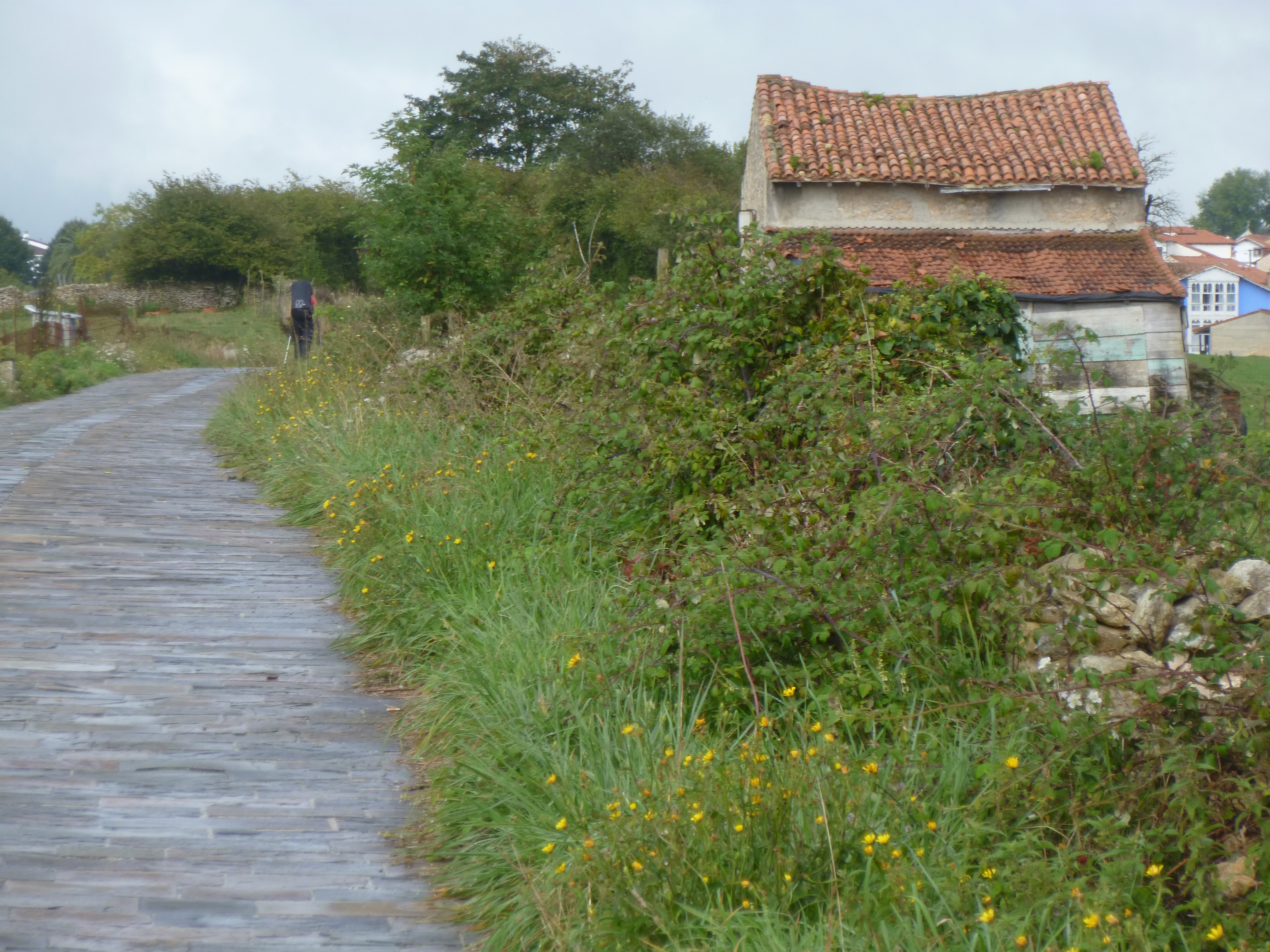
From Ribadeo to Gondán (well, no) to San Xusto (well, not there either . . . ) to Lourenzá

Sunday, September 27, 2015.  Breakfast is the usual, but I’m ready to walk after nearly three days rest.  Ria and I each pack our groceries because after the village 7 km. from here, there will be nothing, nothing, nothing.  This will be fairly common for several days.  Carry your food, sleep somewhere, buy groceries for the next day if you are lucky, etc.

So when I get to Vilar, with its promised bar (and albergue for those who need it), I see Ria at a picnic table, eating part of her food, and a few thirsty pilgrims hanging around the door of the bar, which is “CERRADO”, closed.  One woman wails, “But I NEEDED a Coke!”  And I, the no-soda person, thinks, “Perhaps there IS a god, and she doesn’t WANT anyone to drink that crap.”

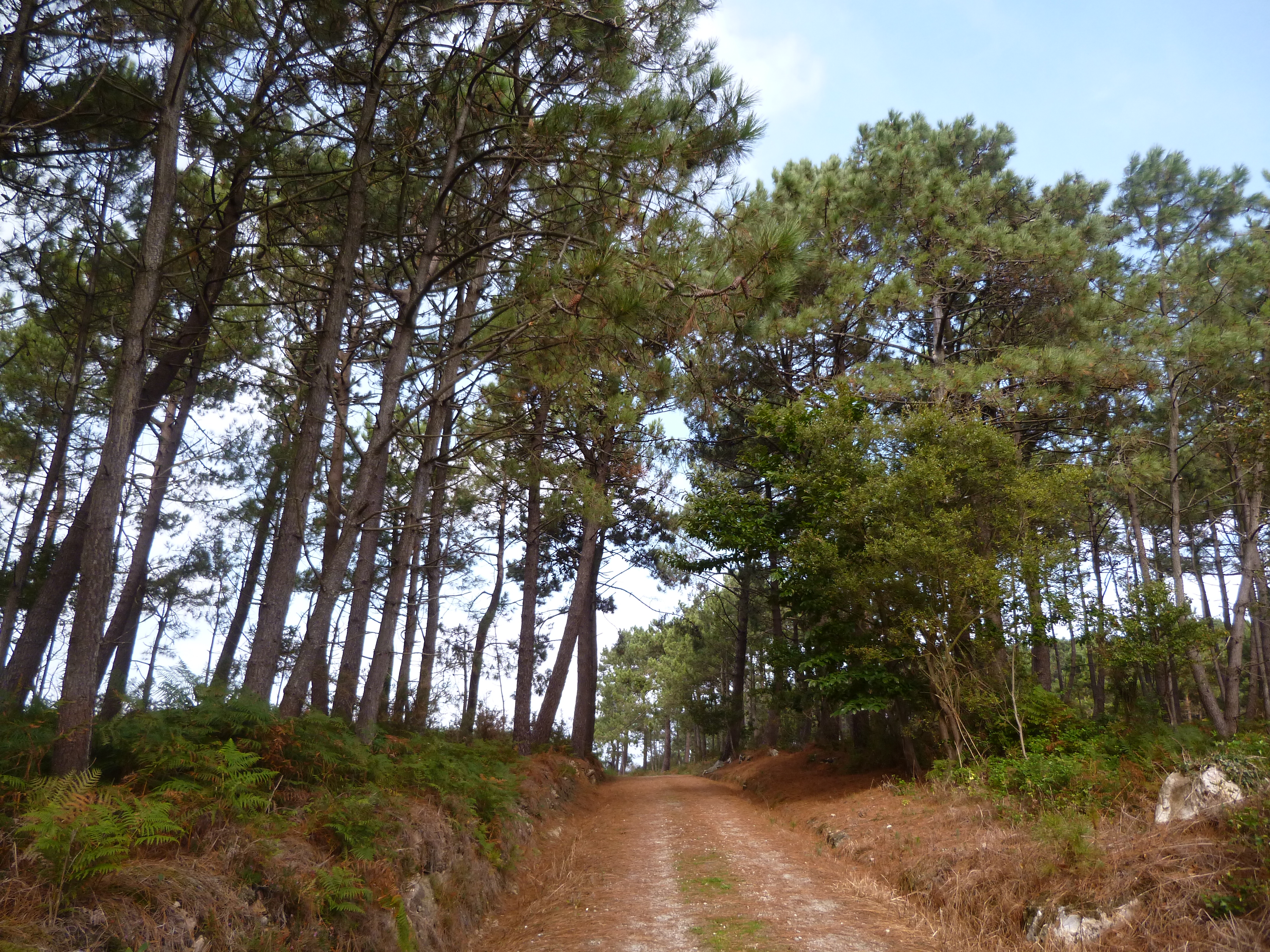
I sit with Ria, have half of my peach, and start the walk again.  Up a forest road, a gentle slope, so beautiful.  At the end of the path, I’m on a road again, probably the N-634, which seems to show up everywhere.  And there at the intersection is a village sign, “San Vicente” and a bar.  Open.  (There must be dozens of San Vicentes in Spain.  I’ve already encountered three of them.  Like “Springfield” – Vermont, Illinois, Massachusetts, Missouri, Ohio, etc. – in the U.S.)

I walk in and immediately know I’ve missed a turn.  First of all, my book says nothing about San Vicente, and though the book can be wrong, it usually mentions every little burg, especially if there is a bar.  And there is no one even resembling a peregrino in the place.  If I hadn’t missed a turn, this little room would be loaded with those pilgrims who wanted something at the last bar.  I get my water, pay my Euro and leave, headed west on the road.  I ask a construction worker whether this is the Camino  He nods and gestures in the direction I’m heading.  So I walk.  Eventually, west will do it.  And though my book map indicates that we don’t actually go to San Vicente, it IS on the map, and not out of the way, unlike Cudillera exactly a week ago.

Ahead of me is a man, with backpack, standing on the side of the road with his boots off.  As I approach him, he says he has “lost” his daughter.  Ria had told me about a German couple, father and daughter, whom she’d met several times, and this man tells me he was the person who waved goodbye to us this morning from his window at the Hotel RosMary.  His daughter had taken a little 2 km x 2 side trip at the closed bar, so she could visit an organic farm she wanted to see.  He said he would go on, since his feet were really hurting and he didn’t want to add 4 km. to his walk.

He tells me his pack weighs more than 15 kg., which means it’s a bit less than 35 lbs.  I ask what he brought that he now wishes he had left at home.  He begins the list . . . two towels (one microfiber and one regular towel, which never dries), five sets of underwear, tops and bottoms,  and he goes on.  We talk about being “my age”, and he tells me he is 63.  I feel pretty good about that, at nearly 69.  At this point, his daughter emerges from the “correct” trail, bouncing downhill, across the road, and to her father’s side like a tall, lithe mountain goat  She consoles her father and tells him they will find him a bus in A Ponte, just down the hill in a little village.  Since it’s the way we’re all supposed to go, I follow, though they are gone as they turn a corner and I see no evidence of any bus stop in this spit of a community.

I follow the shells and arrows, and now I see a road that strikes dread in my heart.  Remember my book . . . ?  Well, today it says, “A strong ascent follows.”  Yessir, yessir, three bags full . . . make that a dozen bags full.  These authors are minimalists in their descriptions.

What is ahead of me is a climb at maybe 35 degrees.  I just folded my napkin to the proper angle and I think that’s right.  45 degrees?  Neil says I would fall backward if it were really 45 degrees.  Whatever . . . 30 degrees?  Show up in my spot and see how your geometry works.   For nearly four hours.  It is endless.  Well, not really, but I see no end in sight.  Again.  Climbs nearly 1200 feet in about 2 miles and it takes me more than 3-1/2 hours to get to something that resembles “rolling hills.” But now a different part of my feet and legs are tortured, and though I’m rewarded often with beautiful scenery, after awhile it’s just a joke.  I make myself stop, take my pack and shoes off, dig out some of the groceries I brought and make myself a sandwich.  Eat the rest of my peach.  And a plum.  And drink lots of water.  And pee.  And put the shoes back on, pack on back, sticks in hand, and journey forward.  Up.

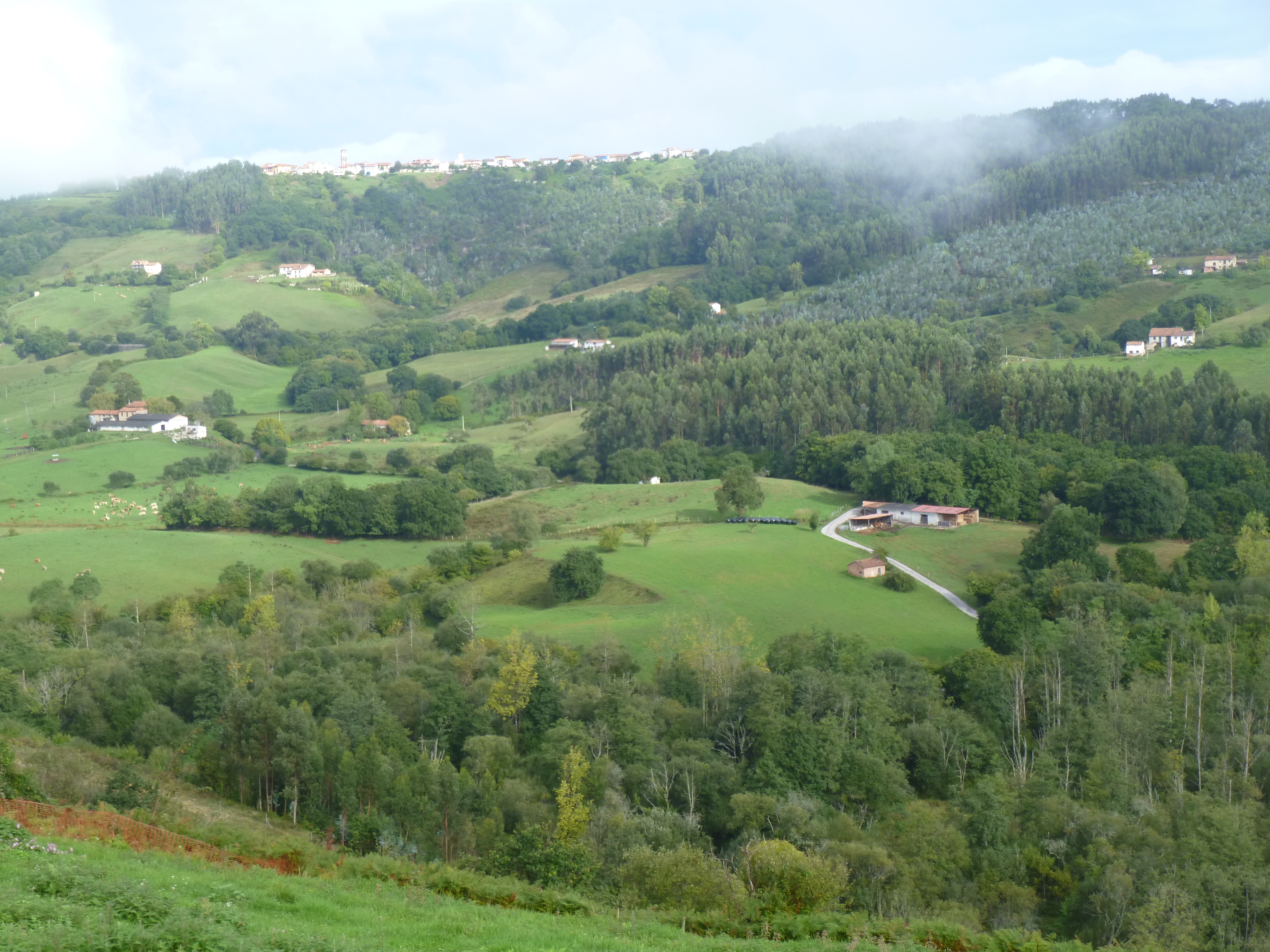
Such wonderful green meadows, though, in amongst the eucalyptus groves, like something out of Heidi, not like the regular meadows.  Like finely groomed ski hills in the summer. I have pictures but they look nothing like the slope I see in real life.  When things finally begin to flatten out, there are my cows and horses again.

And as a aside, why is it that I am tempted to take a photo of every cow, lamb, dog, cat, horse and donkey I see on the hillsides? I’ve taken plenty of them, but don’t need one of every single swishing tail and gnashing jaw, head down in a trough of water, a pasture of grass, a bale of hay, or just nibbling one another, swishing flies away with their various tails.
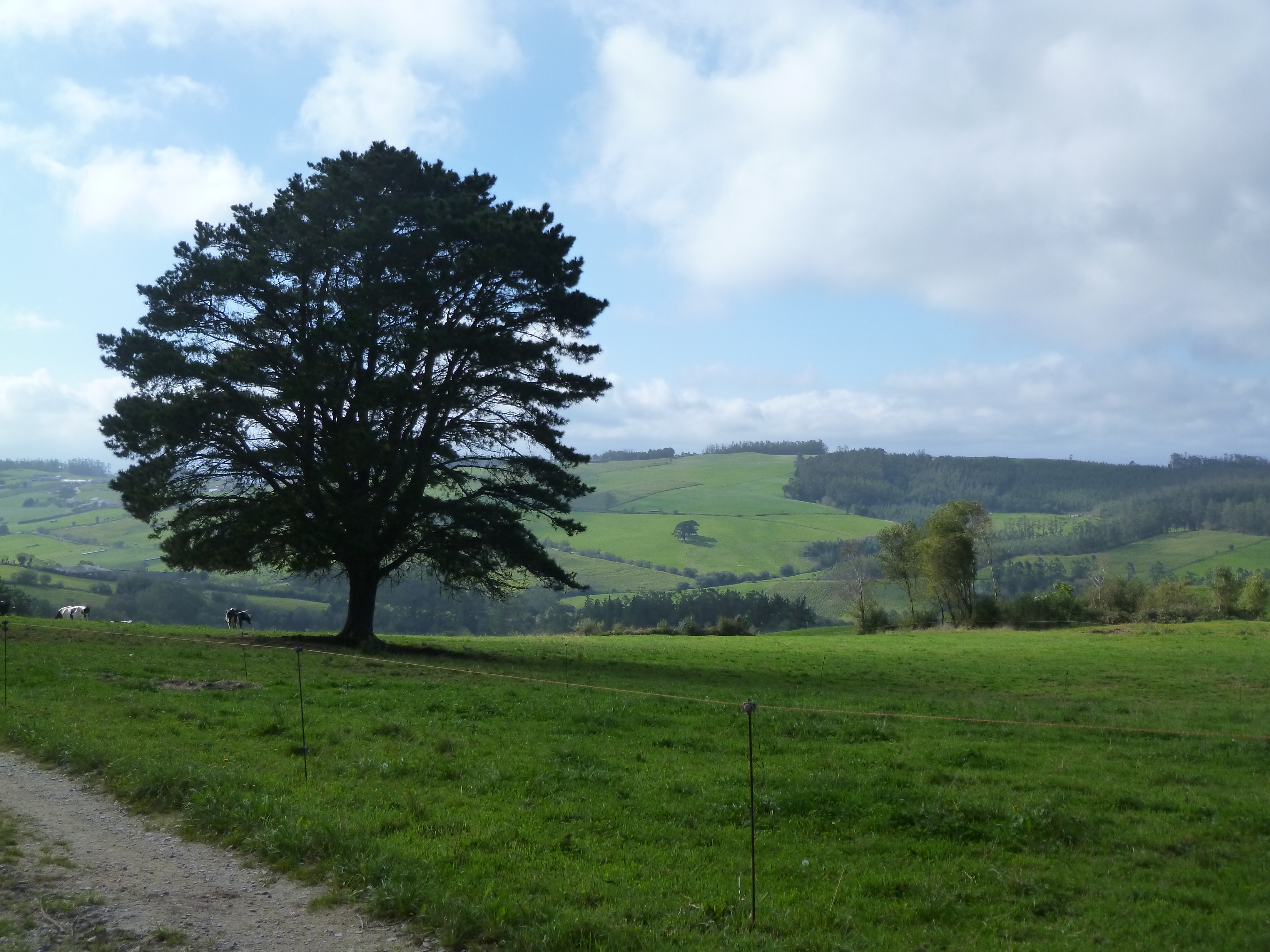
As the slope begins to even out . . .

As the slope begins to even out . . . cows!

My book says I’m supposed to get to VillaMartin Pequeña and then VillaMartin Grande, and then to the Albergue in Gondán (as opposed to Gontán, which will come two days later).  Oh, one more thing . . . the book says there IS an albergue in Gondán and that sometimes it is closed. Great.  But Ria and I have already checked and in 2km more there will be another  town with only a bar and an albergue, San Xusto.  There’s our plan.  And we know what planning does sometimes.

When I get to VillaMartin Pequeña, there is a map . . . and a poster ad for a taxi.  I say no to myself re the taxi, since Gondán is so close . . . about 5 km.  I begin to walk toward the VM Grande.  Then I call Ria to check in.  She has tried to text me twice but I didn’t get the messages.  She tells me Gondán’s albergue is abandoned today, and the San Xusto albergue is closed for bed bug fumigation.  She is heading to Lourenzá.  11 km down the road from me.  That would take me at least three hours of walking, perhaps four, depending on the hills.  And it’s 5:00 p.m. already.  I can just imagine dragging myself into Lourenzá in the dark.  I call the taxi.  I make a reservation where Ria and others already have a bed waiting.  Hostel A Union.

The driver asks where I want to go.  I tell him and he frowns.  “Hostal A Union no good.  Peregrinos don’t like.  You should go Casa Gloria.   You want me to call?”  I tell him my friends will be at the Union.  He shakes his head as if to say, “What a pity.”  But he pulls into a lot across the road from the “no good” building.  I ask him to call the Gloria (he has driven me past Gloria on the way to “my” hostal.   The person on the other end of the phone tells him Euro 35 with breakfast.  I tell him it is “tropo caro, ” Italian for “too expensive”, but he does understand.

I see the room they want to give me at the Hostal A Union, and it looks like a room in a bad nursing home.  A window with frosted glass, and a bedspread from your great-aunt Millie’s trousseau.  I shake my head.

When I ask if there is another bed where my friends will sleep, she takes me to the other side of the building, where the bedrooms all share a bath . . . four bedrooms, but two or three beds in a room, and they are full.  I tell her I might go to the Casa Gloria.  Immediately, she brightens.  She does have another private room on the other side, just down the hall from the first place she showed me . . . but of course it’s Euro 30, not Euro 25.  I’m tired.  “Show me.”  And she does.  Bright, a window looking out to the town.  I nod yes, leave my pack in the room, do the paperwork, and order a glass of wine.

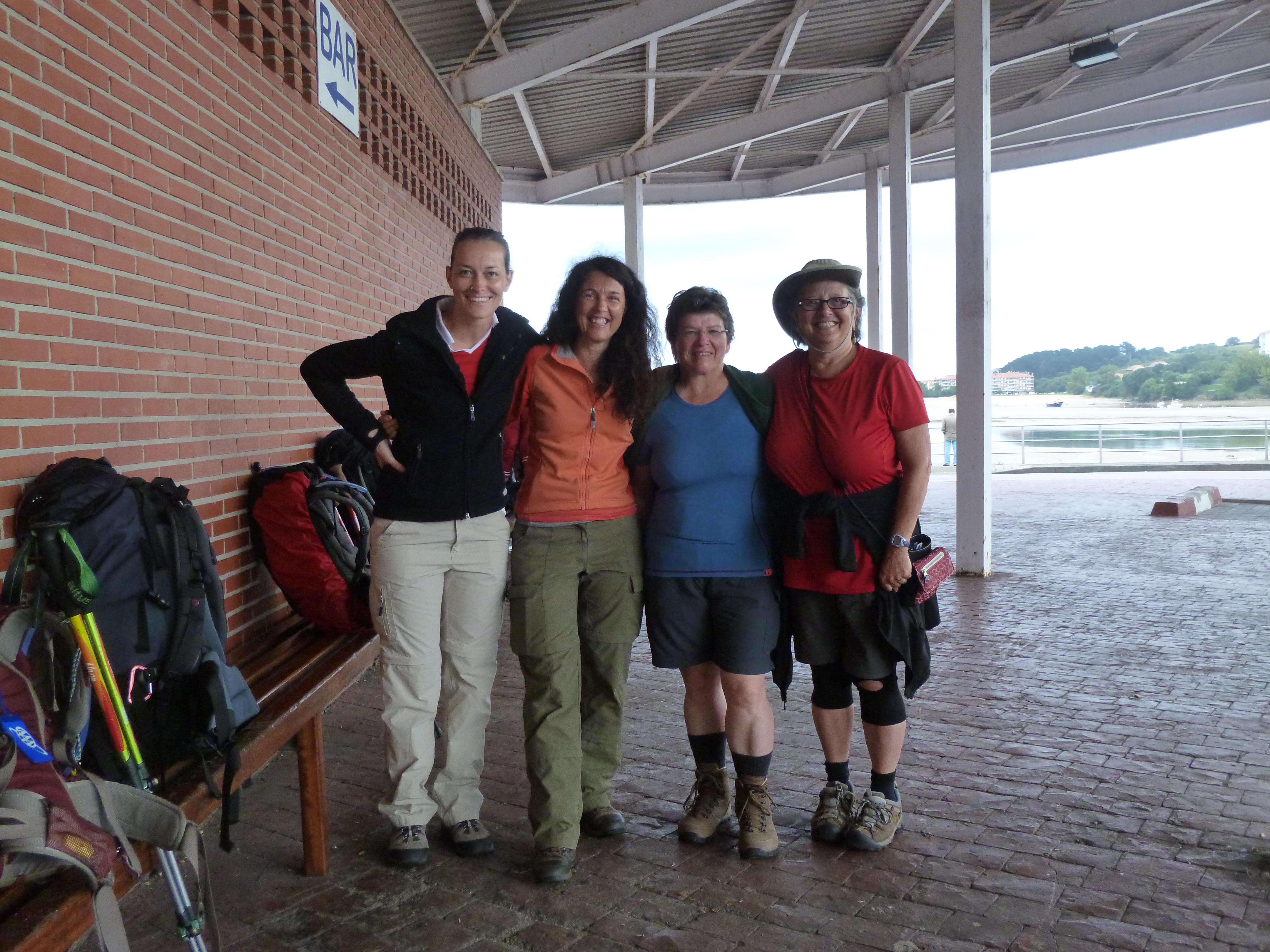
I’m sitting at a table outside when I see Ria crossing the street a half block away.  I raise my sticks, as she does when she arrives first at a place.  And as she approaches me, I see three women behind her.  Two I don’t know and the third is . .  ERIKA!  Big hug!  I meet Nicoletta or Nicolina (Dutch) and Jessie (German) with a body full of tattoos.  I’m used to that . . . both of my sons have girlfriends with beautiful tats and Jessie are beautiful, too.

Visiting is short because I’m tired and so are they.  I head up to “my side” of the building.  I’ll see them in the morning.

P.S.  Apparently much later, a woman does arrive at around 9:30 or so.  She got to Gondán and then San Xusto and it was already getting dark.  She began to think about where she could sleep for the night.  A corn crib?  A cow trough?  Under a tree, wrapped in her sleeping bag?  Clutching her pack, sticks in hand for defense against something?  Those are the things I imagined as I walked up that hill.  Would I get there?  Would the albergue be open?  Etc.

Fortunately, a man at the bar in San Xusto drove her to Lourenzá, though I don’t know where they found a bed for her, when the woman told me that side was “completo.”  And I was already asleep by that time . . . grateful I was not sleeping in great-aunt-Minnie’s room.  And I’m very sorry I didn’t take a picture . . .

Posted in Animals, Camino Albergues, Camino de Santiago, Camino del Norte | Tagged , , , , | 4 Comments

Last two days in Ribadeo

Friday, September 25, 2015.  Larry is leaving Ribadeo, and I think Ria will arrive tomorrow afternoon.  I am staying two more nights at the Hotel Linares, writing, walking a bit, sleeping late, giving my feet and ankles a break, rubbing Arnica cream into them at regular intervals.

I look for pastry shops, especially hoping for one of those swirly pastries with raisins in it. I go to the grocery store, knowing that when I leave for the next part of the Camino, there will be few or no places to get food on the way or even at some of the albergues, stuck out in the middle of nowhere.  Slices of ham, slices of cheese, croissants, tomatoes, dried cranberries, are things I can carry, and I also begin to make my own little sandwiches in my sweet room.

On one of my wanderings, I stop at a pharmacia and weigh myself.  For 50 Euro cents, you can stand on a big scale in the middle of the pharmacy, and I’m ecstatic to discover that I have lost TEN pounds, despite the bus rides.  Clearly I have been sweating my buns off!

I hope there will be more good news when I arrive in Santiago.  Today is spent in a very low-key fashion, and I think I have written three segments for this website.  I try my hand at scheduling the publication at intervals, so readers aren’t innundated with huge amounts of travelogue at once.  Seems to work, and usually I don’t have that luxury because I have several days of walking before I can actually work on this little MacAire uninterrupted.

But recounting the days is soothing when I have the time and I have chosen to take that time in Ribadeo,  Ribadeo is on the border, Asturias and Galicia.  An interesting thing happens on the Camino when you pass from Asturias to Galicia.  The shell symbol’s significance is reversed in direction, so you have to pay attention. I know I mentioned this in a previous post, but I will show it again here, if only to anchor my own understanding of what I will be looking for in Galicia.

In Asturias, the small end of the shell points the direction

In Asturias, the small end of the shell points the direction, but in Galicia, the open end of the shell is the way you must follow.  So if you are in Asturias, you turn left at this spot.  In Galicia you will be turning right

Actually in my feeble memory, I think on my last Camino, the direction was always in the open position, not the closed end, but I’ll have to check my old photos.

This day is happily uneventful . . . but for the great news about those ten pounds I somehow lost along the way.  Tomorrow afternoon, I’ll start looking for signs of Ria.

Saturday, September 26, 2015. Today is still cloudy, and I’ve wanted to take some photos of the water’s edge, the boats in this harbor, etc.  An Ascensor is housed in a stone enclosure, with its walls mostly glass.  If this elevator is open, you can walk to the water, get into the ascensor and as it goes up, it lets you see the coastline from a higher and higher perspective.  I hope it will be at least partly sunny before I leave this place

Midday I get a text from Ria.  She has just walked into Ribadeo, heading toward the center, and I tell her to come toward the Plaza de España where it meets the playground.  My hotel is full, but I’ve checked with the one next door and it is available and affordable.  So when she strolls into the Plaza, I am the one who calls her name this time rather than the other way around.

She gets checked into her hotel and we agree to meet in two hours.  The weather is fairly okay to walk to the water, so we do, and then take the ascensor to the top of the town.  The trick will be trying to find our hotels in the layers so typical in these old European towns.

P1030652

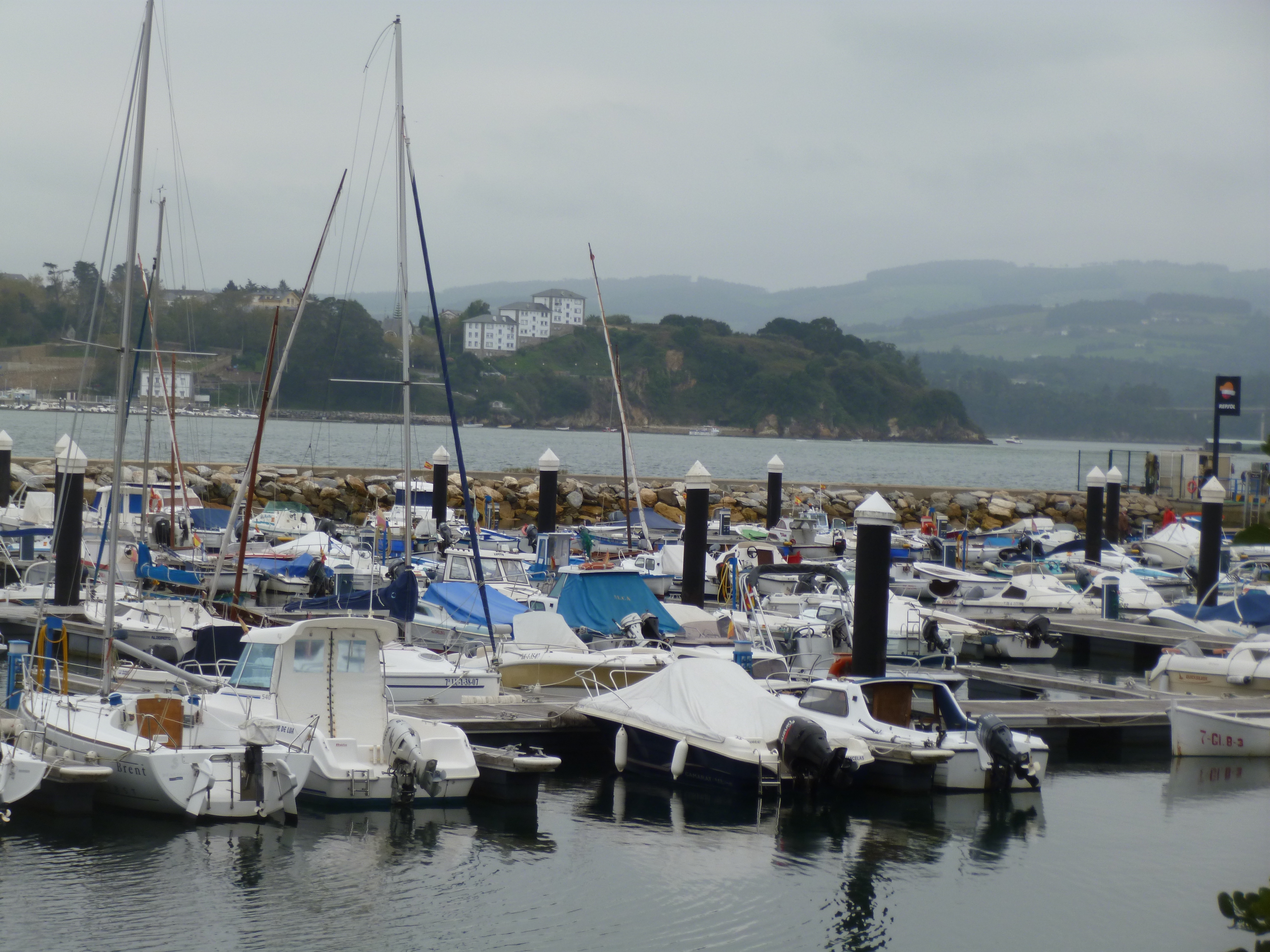
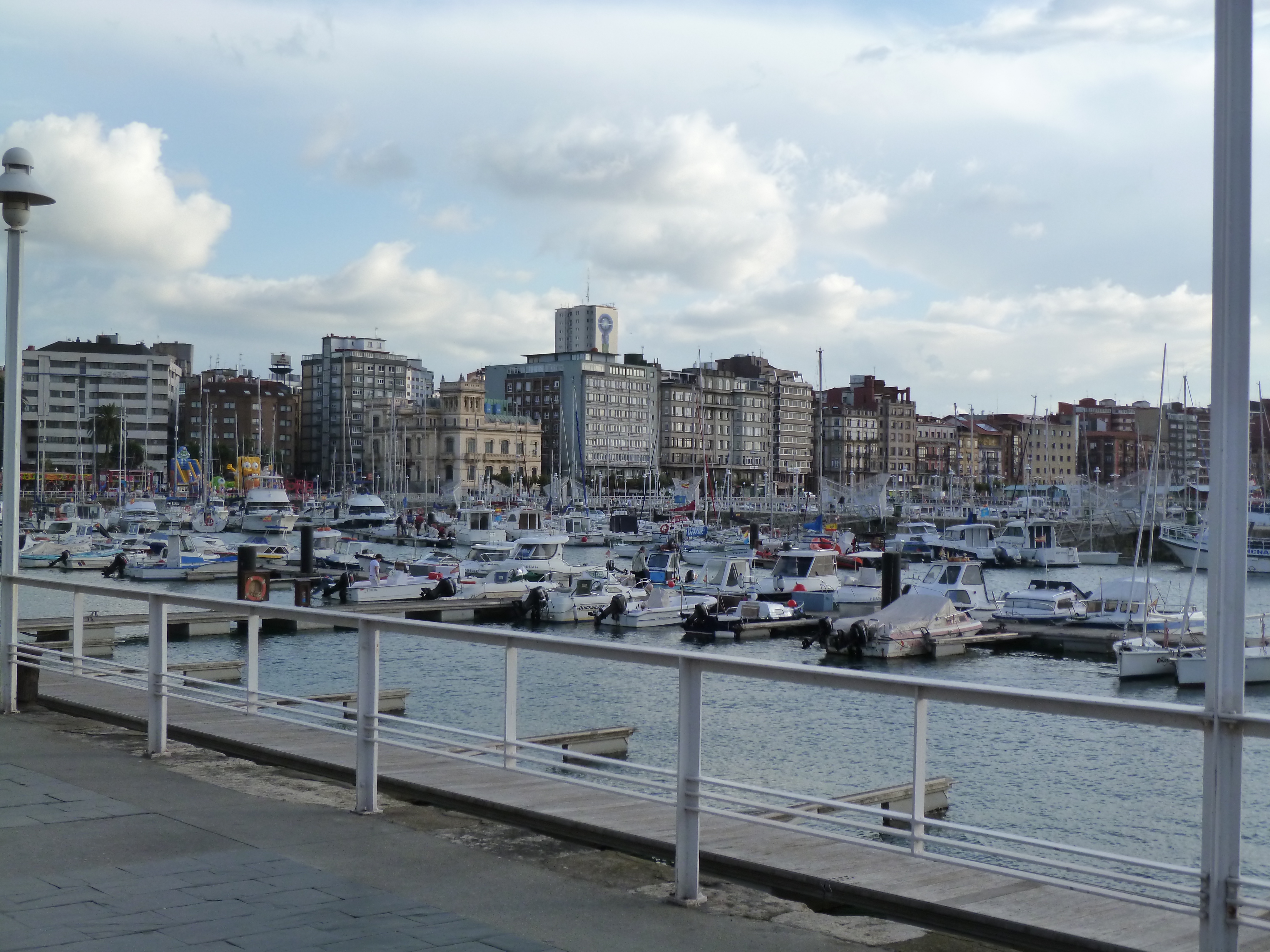
The harbor in Ribadeo, our last seacoast

P1030654

And on the way back to our hotel, I see this lovely structure . . .
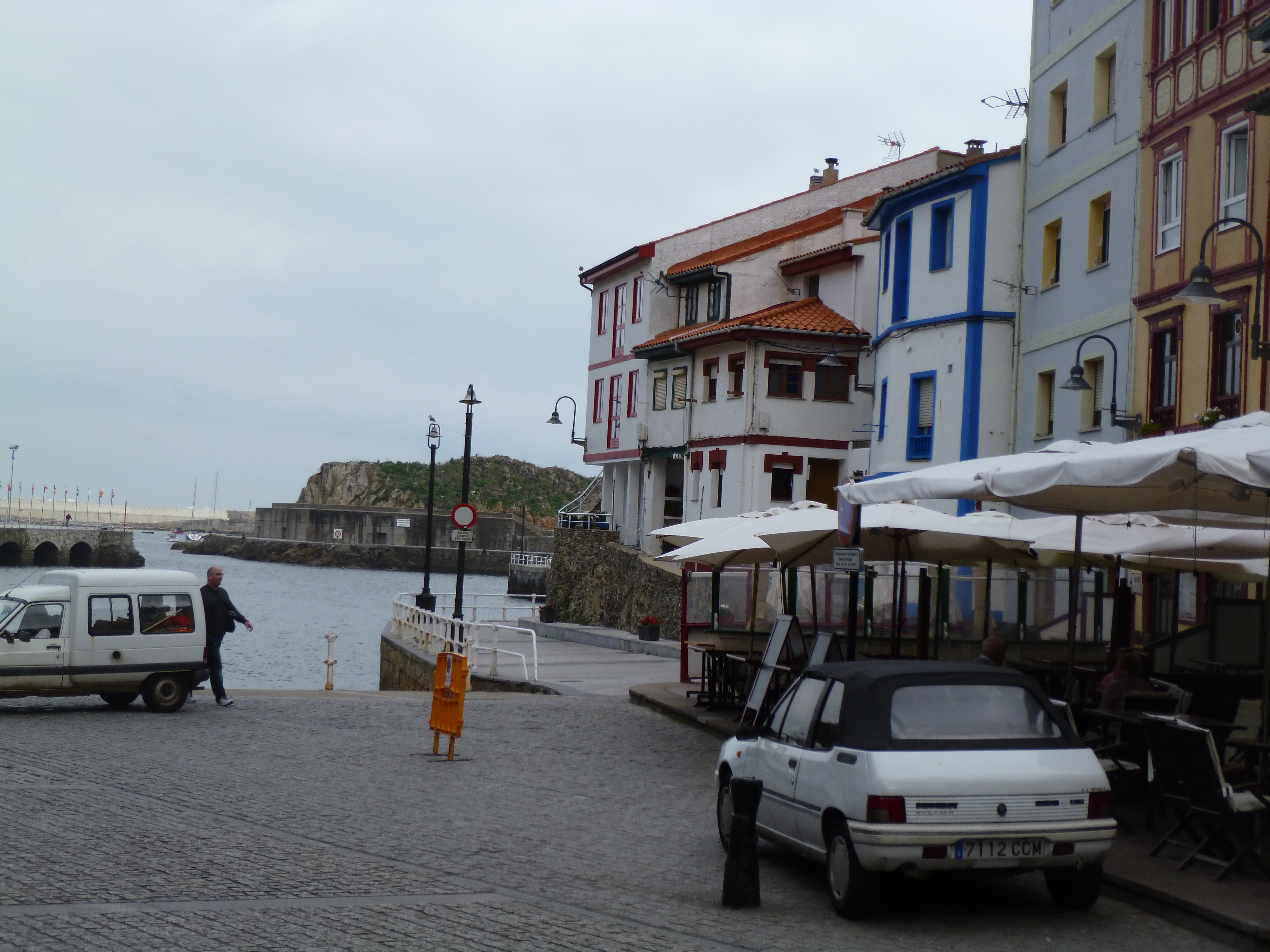
We have dinner at Ria’s hotel restaurant, right next to mine.  I have sea bass again and it is still delicious.  Packing up tonight so we can get a good start.

We will have breakfast at 8:00 tomorrow morning:  cafe con leche, croissant, orange juice  What else? I have done a trial run, tracking the way out of town, since the signs are non-existent until we are nearly past the Ribadeo limits.  Here is our first flipped-direction shell:

P1030655

Here’s our first Galician direction . . . go straight ahead (not back where you came from!) . . .

My lazy, recuperating days are over, I fear.  Hope my foot and ankle enjoyed the rest and will behave as we go forward.  Tomorrow is supposed to include a very hard climb, and we’ll end up at an albergue in the middle of nowhere.  Wonderful.

Posted in Miscellany | 2 Comments

Camino Collage – Bits and Scraps

September 28, 2015.  I have a few days of writing to catch up with but need to collect on paper some fragments.  I try to write down in a little book Gary V gave me recently (thanks so much, Gary!) some images or conversations or other little events I would otherwise not remember, and they don’t “belong” together, but I do love collage, so decided to collect a few bits and glue them down here.

*This is a quote from one of the posts on the caminodesantiago.me forum.  I am sorry I can’t find it now to give credit to the writer/pilgrim.  My comments are after the quote:

After an unscientific poll of pilgrims I had met on the Way, everybody agreed; There is no way for a first time pilgrim/walker to properly prepare your feet and legs for the first several stages from Irun to San Sebastian (to Zarautz, to Deba, to Markina, to Gernika, to Lesama). You will have blisters, blood blisters and open sores, probably foot, ankle and knee issues. You will make many visits to La Farmacia and become very well acquainted with Compeed and 600 mg Ibuprofen tablets (a 40 economy pack for Euro 1.97). Also, my world on the Camino completely changed for the better after I learned how to properly use trekking polls. All of my damage and injuries went away after three days.

So . . . I totally agree and understand (but for the “all of my damage and injuries went away after three days” statement from this person).   I guess I should be grateful I did NOT have blisters, blood blisters and open sores, though I am having more and more foot, ankle and knee issues.  I brought along most of my foot and knee protection items, but have been to the Pharmacia many times for something called Flutox, a pill supposedly to substitute for carrying a heavy bottle of cough syrup around in my pack.  Also to purchase Ricola drops (lemon and cherry), tylenol, and belatedly some anti-nausea pills for the bus, though I don’t think I will be taking the bus again unless I bus to Finisterre AFTER I arrive in Santiago.

My damage and injuries are still accumulating if you listen to my aching feet, ankles and hip sockets.  I rest for a day or two or three, and then feel pretty good in those places for a few hours.  Then I hit a long hill, up OR down, and the body parts say, “Oh, I see . . . did you think you could trick us that easily???”

*In the first week or two, I saw so many disabled people walking (not on the Camino, but just out there walking), one with cerebral palsy going at a good clip on the boardwalk at Zauratz.  Another pushing a wheelchair in that same area.  All sorts of old couples, canes in hand, walking walking walking.  What am I complaining about?  (Of course, they didn’t have 22 lbs on their backs, but still . . . )

*I know I wrote about the farmer on the hillside weed-whacking his pasture, but I’ve now seen two older women, on separate occasions, cutting down their fields with those old-fashioned long-handled scythes we used to imagine in horror-fairy tales.

*While I was waiting for the bus from Deba to somewhere, I watched a very old man shuffling, arms full of boxes, to deposit them in the proper “Paper and Cardboard Only” recycling bin at the bus/train station.  Dedication.

*Saw the Bulgarian pilgrim with the huge rucksack and the beige plastic purse again.  The purse is always tucked under her arm in a very un-pilgrim-like fashion.  She doesn’t care and neither do I, but it IS a bit of a show-stopper for me.

*Not much rain since we took the bus to Ribadasella two weeks ago.  But we are in Galicia now, and the mist is everywhere.

*Apples are an important crop in the middle part of this area, and one can order “sidra” or cider, everywhere.  There are many sidrerias, sort of like the micro-breweries around my hometown and in other parts of the US.  The “pour” is quite the thing to watch.  The waitperson holds a straight-up glass at lower than waist-height, and the bottle of Sidra overhead.  A long-elaborate stream goes from bottle to glass, but only until there is about an inch-and-a-half of cider in the glass.  If you want more but haven’t finished all of your first batch, it is thrown away.  Something about the fizz and foam and whatever.

There’s also a device to hold the bottle, with the glass underneath, which delivers an exact amount, similar to the “high-pour” that is hand-dealt.  Quite interesting to see six people sitting around a table, with this device in the middle.

*Senses – that pungent smell of wet hay, just cut, and a different, stronger smell of stacked and wrapped hay “barrels”, both black and white plastic encircling each farmer’s field.

Rich green fields produce rich hay for the animals

Rich green fields produce rich hay for the cows way out there

Manure . .  where there are my beloved cows, horses, goats, mules and sheep, there MUST be manure.  The world is their albergue bathroom, their aseo, their servicio, their W.C.

Some special smell as I round the corner toward a seacoast.  The breeze is different and the smell, sometimes of fish, sometimes of salt, augmented by the crash of waves as the tide comes in . . . nothing like it, whether it be sea or lake.  The sound of the waves brings back memories of spending nights at my Uncle Bill and Aunt Donna’s lake-house, teeming with children, at least a dozen of us crammed into two sets of bunk beds, falling asleep to the sound of water hitting rocks and sand.

Birds of all sorts call to me (or to one another . . . perhaps they don’t give a shit about me!) as I walk.  Some sound sweet and tweety, others caw and cackle, and yet others sound like buzz saws or drill bits.

The groaning made by the tall, tall eucalyptus trees as they sway in the breeze.

Those tall eucalyptus trees talk to themselves (and to me)

Those tall eucalyptus trees talk to themselves (and to me)

Of course the wide variety of surroundings on this walk.  Coastal, farmland, big cities, little villages, through the woods, up high on the mountain trails.

Some of that rolling countryside in the distance, with such a green pasture up front

Some of that rolling countryside in the distance, with such a green pasture up front

Music in bars, on buses, all around . . . in Soto de Luiñes, whatever their music source, I was hearing “C’est La Vie, Said The Old Folks” from Pulp Fiction, the song Travolta ad Uma Thurman danced to in the restaurant.  Jerry Lee Lewis’ “Great Balls of Fire.”  Tony Bennett, whose heart is still in San Francisco.

The bus driver on the way to Ribadeo had something on, perhaps a radio, perhaps the Spanish version of Pandora, and I heard Dire Straits’ “Money For Nothin’ (But The Chicks Are Free)”, one of my favorites.  And another favorite is played quite often . . . “Shut Up and Dance With Me” which reminds me that I will have many “So You Think You Can Dance” segments to watch when I get home.

*Cats.  There are a bazillion cats all around.  I’ve seen at least two or three dozen versions of my own Zelda cat, lithe and black.  White cats, Siamese cats, yellow and white, calico cats, tabbies.  Someone needs to scoop these cats up and spay/neuter them before sending them off to wander the neighborhoods. Not sure how they all survive, but most of them duck in and out of gates and houses as I watch, so they must belong to someone.

*Dogs.  Whoever said the Spanish people don’t love their dogs is crazy, and hasn’t been walking around in Spain very much.  Ria and I have talked endlessly about this, as we watch everyone walking their dogs.  Old people, young people, couples, adults pushing baby strollers, with the dog trotting along behind.  Often no leashes, but these dogs know to whom they belong.

The farm dogs are fenced in sometimes, but they still want to see what’s going on as we pilgrims walk past them.  Sometimes a bark just for good measure, sometimes just a flick of the head or ear in the midst of a nap, as the click click of my sticks slight disturbs a doggie reverie.

*Thoughts – I walk for several hours and then realize that I can’t remember a single thing that went through my head.  But that sense isn’t the same as the wide-open mind I experienced on the Camino Frances.  I felt freer to let my mind meander two years ago.  This time, my focus is on the ground beneath my feet, my breath as it coordinates with my sticks, mopping my face with a wet kleenex or my wet cloth or the corner of my jacket, or cursing that dead-straight-up-the-hill climb that might last for an hour or more.

For the first three weeks, my thoughts often were about why in the world I was even ON this walk.  Who did I think I was?  Wonder Woman?  Sure, I did it two years ago, and felt so accomplished.  Why couldn’t I have just let things be triumphant instead of voluntarily (and immediately, I must add) making the decision to do another Camino.  Granted, my first thought was to do the Frances again, but then, no, why not REALLY challenge myself.  500 meandering miles across Spain?  Pffft!  How about something really difficult?

If Neil, Pat and Tim weren’t on board to meet me in Milan on October 16, I really think I would have gone home.  But now, at 161 km from Santiago, I might as well finish.  I see that I’m three days into my FIFTH week, and there is no turning back.  Larry congratulated himself and me in Ribadeo, for still being on the trail.  We should have sung Frank Sinatra’s “My Way”, because each of us certainly did our own version of the Norte.

Larry was going to walk every step . . . until he walked his first few days, and he started in San Sebastian, so he never experienced the infamous 500 Steps of Bartholomew Cubbins . . .  And I will end up having walked about 300 miles, rather than something like 550.  But I will still, with luck, have knees, hips, ankles and foot bones when I arrive in Italy and then home.  And, might I say yet again, no blisters.

*I don’t think I will ever voluntarily taking a long hike, a real hike, again.  A couple of hours at Coyote Ridge on an autumn afternoon, without a 10kg backpack . . . maybe.  Poor Neil . . . he’ll have to bribe me with baby deer, or donkeys or cows or horses.

"Do you want to see me everywhere you go?  I'll come with you . . . "

“Do you want to see me everywhere you go? I’ll come with you . . . “

A half-day walk around New York City, absolutely.  A stroll on one of the paths around Fort Collins, sure thing.  But Bridal Veil Falls in Telluride?  Not a chance.  At least that’s what I say now.

*When you are away from home for a long time, you begin to think about little pieces of that place wondering about change.  Should I sell my cello, after 10 years owning, but not playing, it?  I took six months of lessons from a nice young woman.  A good cello player, but not a good teacher for adults.  And then Luna had her puppies and I tried to give the cello back to the man who made it and who rented it to me.

But he wanted one of Luna’s puppies, and traded me the puppy for credit on a purchase.  Luna’s puppies were expensive, but not anywhere near as expensive as the cello.  Now I own it free and clear, the puppy is 10 years old, exactly, and the cello sits in its case in my library.  Maybe time to sell it, along with the Karmann Ghia and the Expedition.

And what about all of that yarn in my art room downstairs?  I will never be able to knit 10,000 scarves, which is about how much yarn I have.  But every time I go through the skeins, trying to sort out which ones I want and which ones I could part with, I end up putting all of them back in the big tubs, sorted by color, vowing to start knitting again, even if I have to watch television in order to sit down without a book or computer.

*I don’t have my iPod with me . . . sent it on to Santiago de Compostela and hope the post office there will hold it for me until I arrive in about eight or nine days.  No iPod means no weekly time listening to the playlist of Neil reading poetry in my ear, in that wistful, lustful and passionate voice from long ago.   But I hear his voice at least once a week, thanks to Verizon’s new Global plan.  And I will see that face I love so dearly, in 18 days.

*Sitting today on a bed in a Hospidaje de Seminario de Santa Catalina in Mondoñedo writing this, I see that I have many thoughts along the way, no matter that I don’t remember them as anything like coherent.  Still, it doesn’t feel quite the same as that freeing stream of consciousness from two years ago.  I guess you just can’t count on anything being the same as anything else you remember.

And still, my friend Meta Strick’s art piece – the one I carried as my totem on the Camino Frances and now on the Camino del Norte, speaks best to me and my thoughts.  Perhaps this is what moves a person down her own life path:

Thank you, Gertrude, thank you, Meta

Thank you, Gertrude.  Thank you, Meta

Posted in Miscellany | 3 Comments

From Soto de Luiñes to Luarca and onward . . .

Wednesday, September 23, 2015.  Today I leave Soto de Luiñes for Luarca, and the sun is finally out just a bit, so here are some photos of this little place before I go.

P1030618

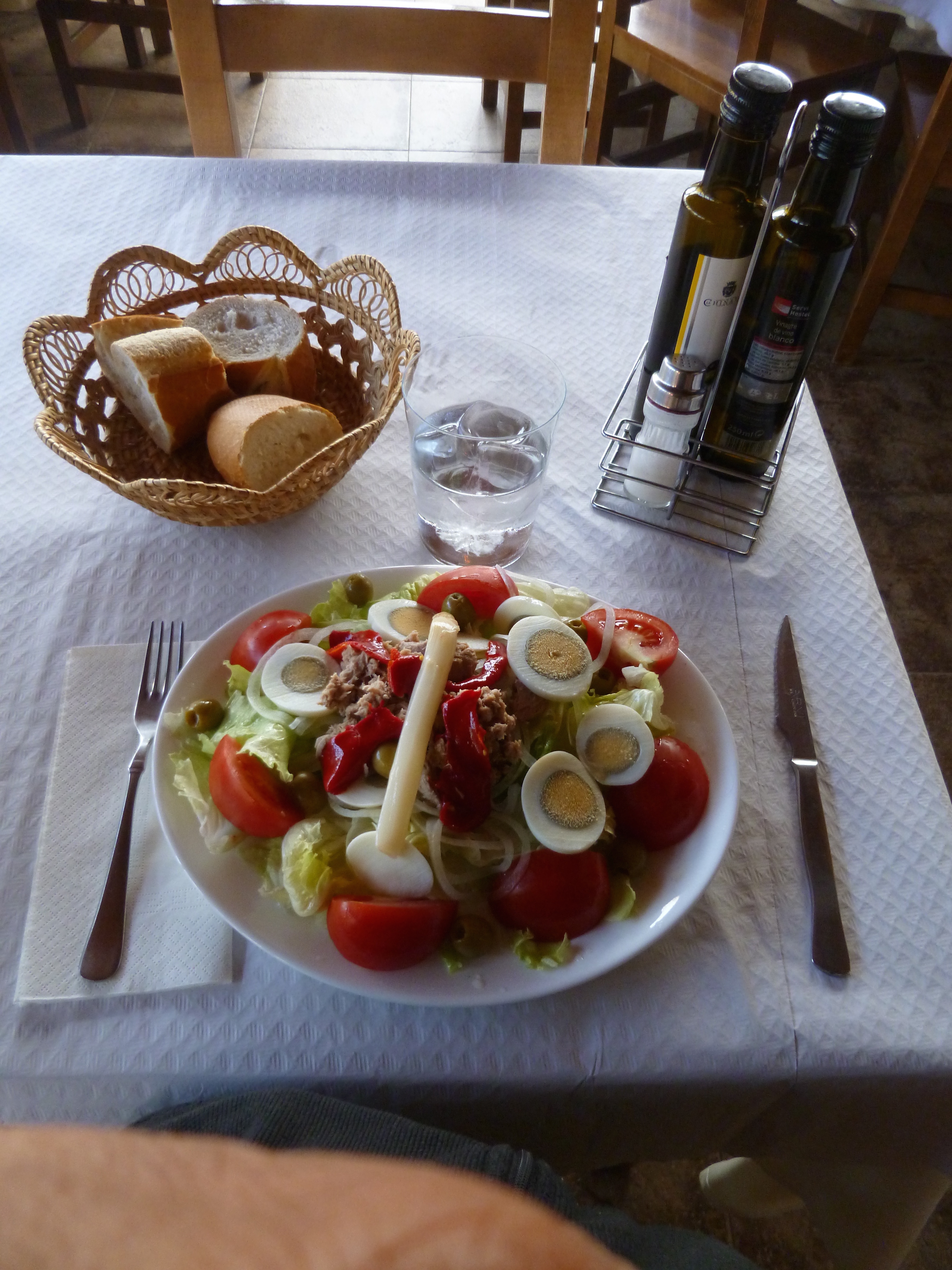
Lunch – ensalada mixta yesterday – another beautiful presentation

P1030620

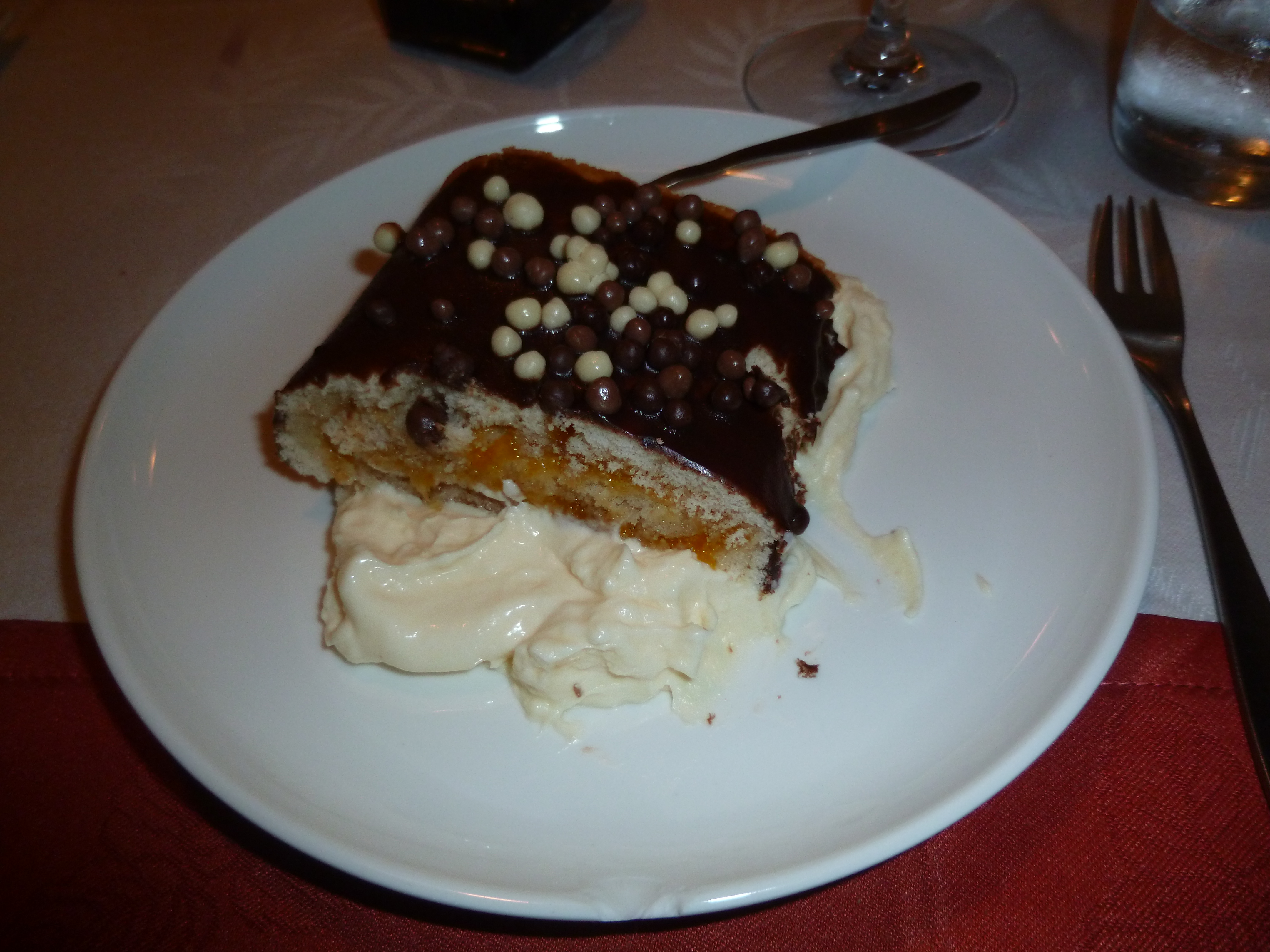
Dessert last night . . . where is Chocolate-loving Neil when I need him?

P1030621

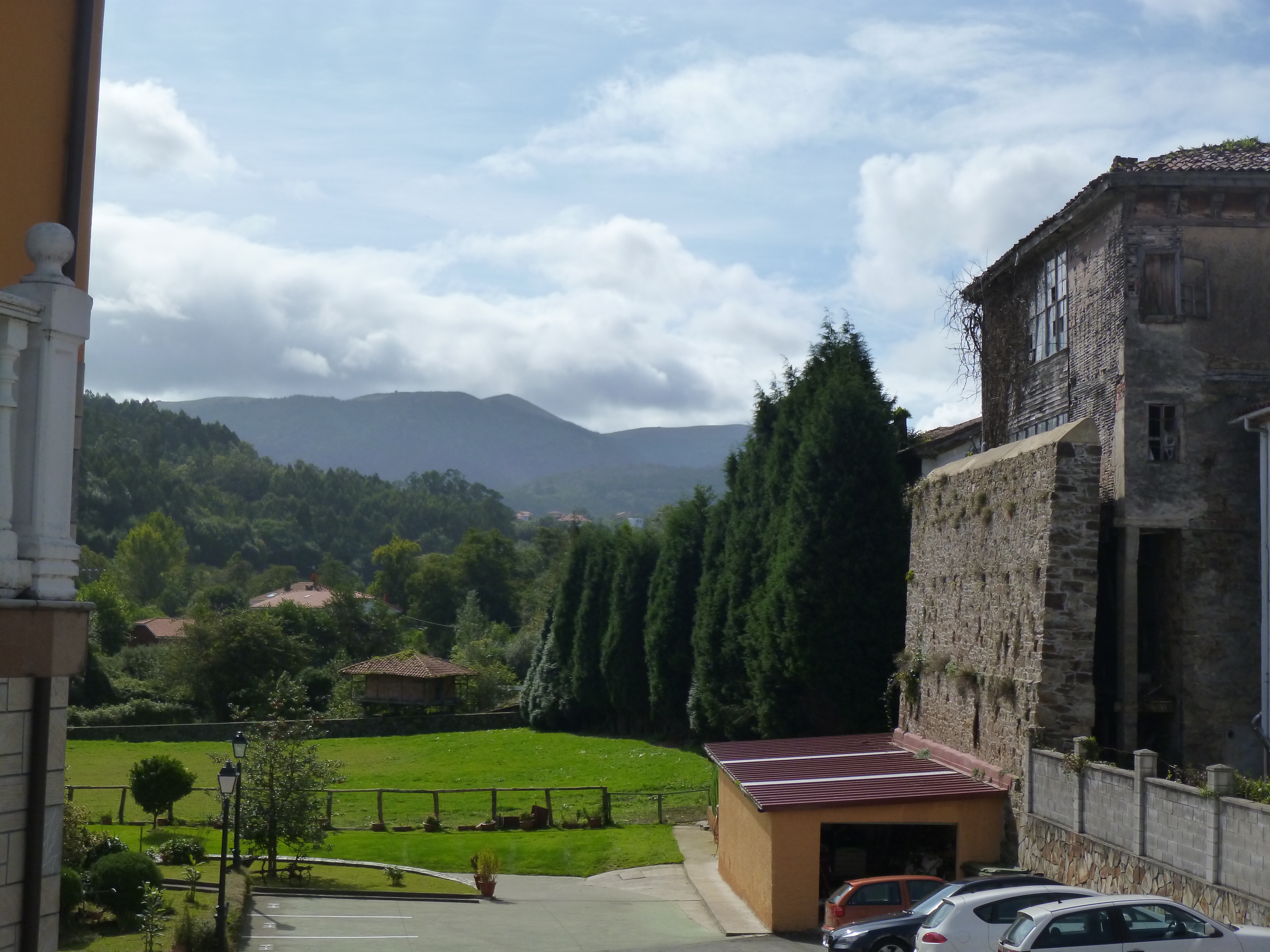
I’m sure I walked down from somewhere over “there”

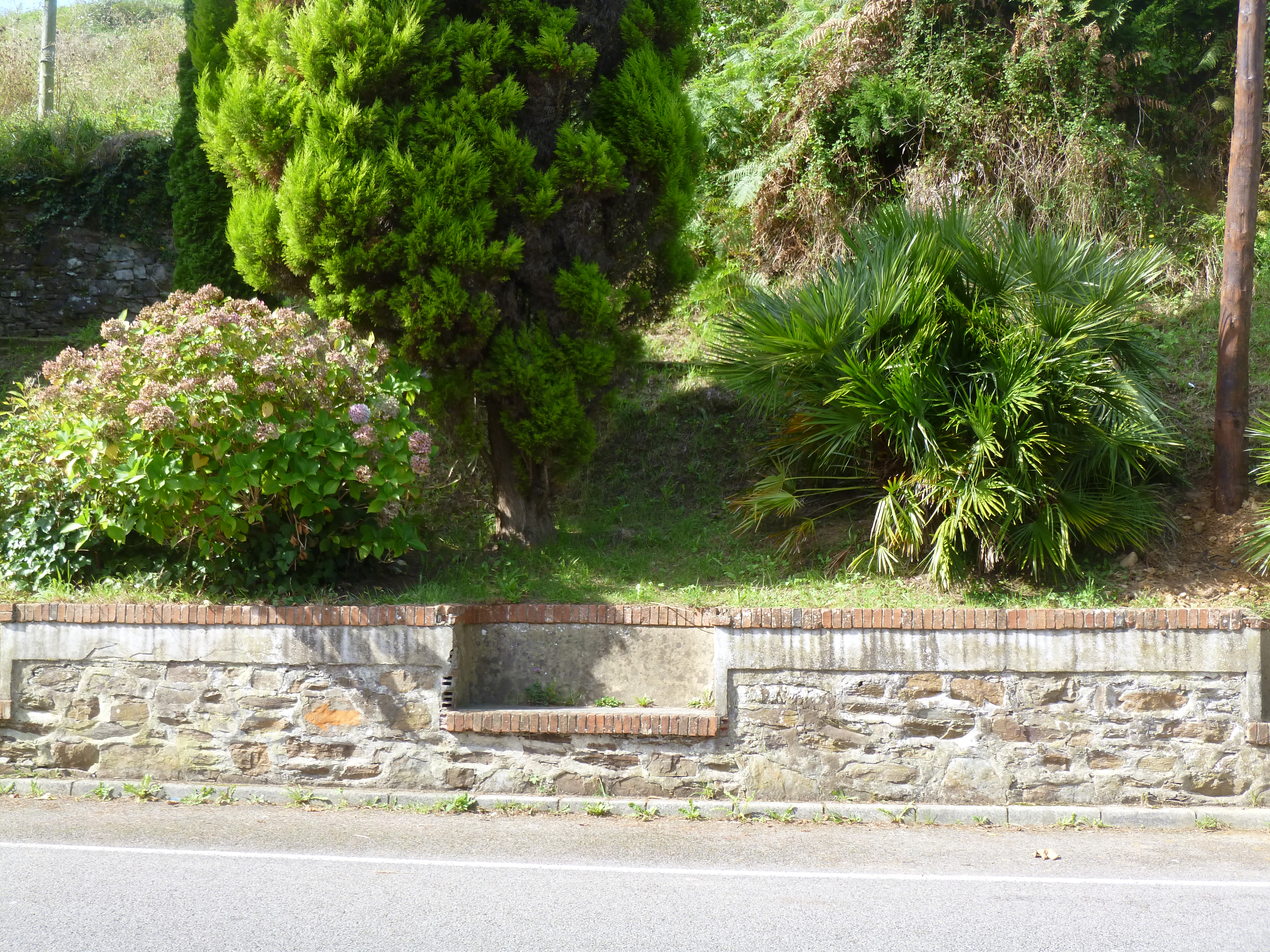
A set of benches for resting in Soto de Luiñes

A set of benches for resting in Soto de Luiñes

P1030623

Layered landscape of buildings and nature

The bus to Luarca comes on time and I forget (again) that I need to get some motion-sickness pills for these bus rides.  The driver expertly swings the vehicle back and forth over these curving mountain roads, while I fix my gaze on the horizon outside and do my old Lamaze breathing.  I haven’t thrown up YET, at least not on this Camino.  I truly walked to Santiago last time, but the bus to Finisterre really got to me and to Ria . . . several bags were needed from the bus driver two years ago on that ride out to “The End Of The Earth” . . .

I disembark in the center of Luarca at the bus station and I walk only one block before I hear my name.  Yep, it is Ria, who has come into town on her feet at exactly the same moment I got off the bus.  We laugh about the perfect timing, find our austere hotel owner, who has to come across the street to the Albergue to check us in.  He has one line he delivers to non-Spanish people.   “NO ENGLISH!”  A friendly sort of guy . . . not.

We are among the early arrivals, so we pick our lower bunks across the aisle from one another, near a window.  I decide to wander outside a bit while she takes her shower and gets a bit of a rest.  Luarca is another sea town, and the coastline is quite curvy, with boat harbor, walkways out to a point, and a set of beaches just around a couple of corners.

I stop at the Tourist Information center, where a sign says it will be closed until the middle of October.  Hmm . . . these places clearly don’t have tourists in mind when they choose their open hours and days.  So I head for blue horizon and walk through the end of the day’s open market, where merchants are taking down their tables, packing up the goods they had displayed to sell today.  Taking a left curve, I come to the first glimpse of the water, then turn a U-turn corner in order to walk back to the Albergue to get Ria.  She’s ready to wander, and we take a different path hoping to arrive at one of the beaches.

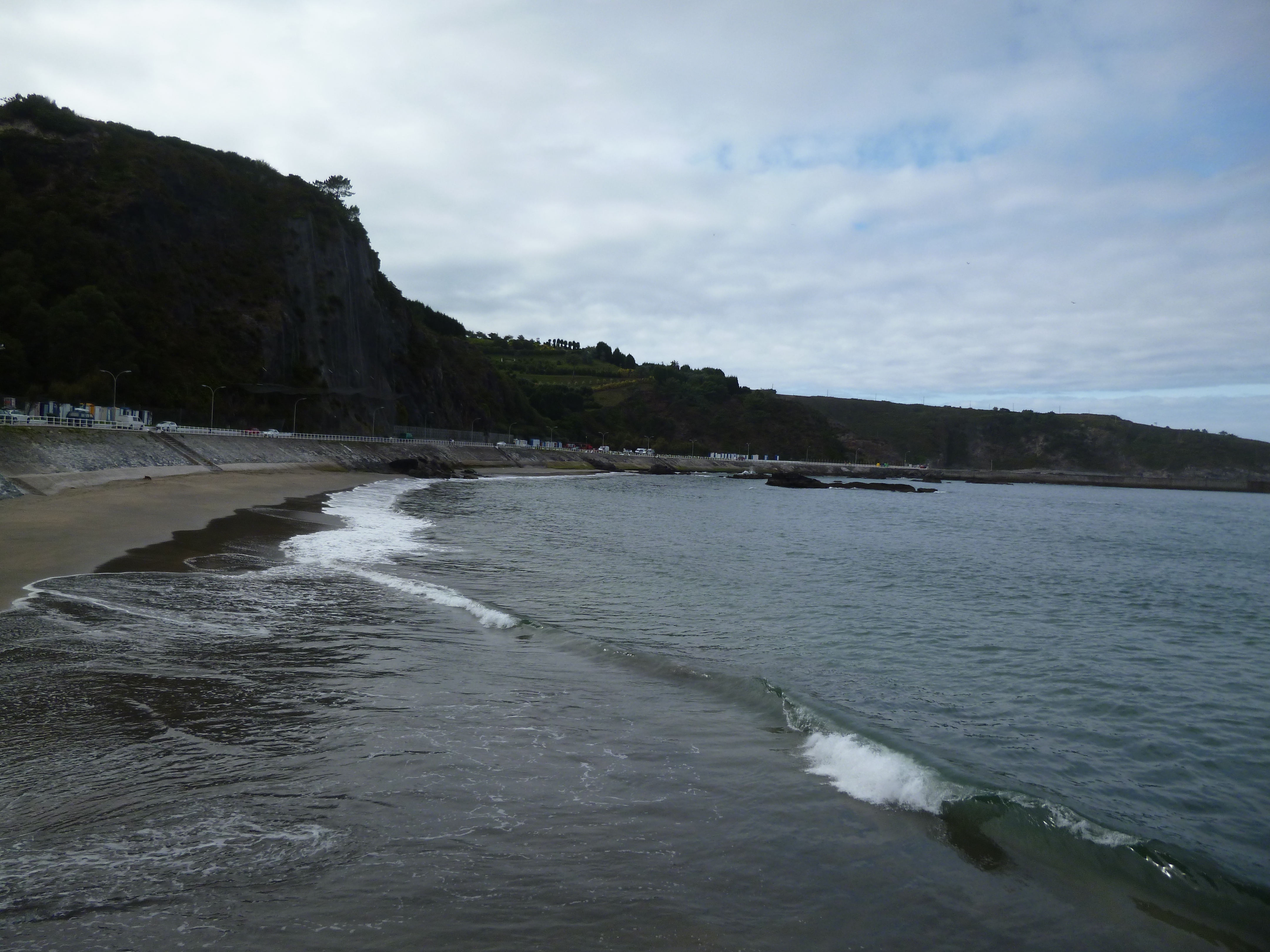
The sea's edge in Luarca

The sea’s edge in Luarca

P1030633

The small but colorful harbor in Luarca

Sitting on a stone wall, we watch an ecstatic black Labrador jumping up on the beach and diving toward the wet sand, over and over again.  His keepers are young women who have doffed their jackets and nearly as happy as the dog to e frolicking in the wet.

Ria and I make our way around the various walkways that separate the sea from the harbor, and see Dutch Carla and Danish Lene exploring as well.  But we head for the path in front of the colorful boats collected together in this little harbor, and Ria asks if I would like her to take my photo.  I almost never get a photo of myself, so I hand her my camera and am delighted that the pic actually is a good one for a change.

P1030634 - Version 2

Yours truly – Luarca harbor

We find an old bar, the kind full of old sailors, and a very old woman behind the bar.  She grins at us as she tries to find the bottle of tinto for my order.  Finally she pours, and along with Ria’s glass of blanco, tells us it will be Euro 1.40 for both.  When was the last time you got a drinkable glass of wine for under a dollar USD?

As we wander back into town, I notice that there are bakeries all over the place.  Tempting but I am trying to wait for dinner, which can’t be had before 8:00 p.m.  Eventually we each buy some luscious thing with filo dough, a sweet almond filling, and granulated sugar on top.  Ria eats hers.  I virtuously take one bite . . . no, two . . . before I go back to the same store and get two more “for the road” tomorrow.

We find a place we want to eat, but it doesn’t open at all, not even for wine, until 8:00.  So we walk all over the center of town, working up a bigger appetite. At the spot of eight o”clock, this place finally opens its doors, and we sit outside, since the soccer game is on inside the bar and the volume is so loud we can hardly hear ourselves think.

Soon two men show up to look at the menu.  They are Americans Ria met earlier today, and she asks that they join us.  The chat turns to where we all live, and these two live in Todos Santos, Mexico, on the Baja Peninsula.  I remember going there with Neil about 15 years ago, when the big deal was that the town was about to refurbish the “Hotel California” of Eagles’ fame.  Apparently that’s been completed and was a good job.

But they begin to talk about Fort Collins and a very controversial project involving Colorado State University and some big developers.  I googled it and it reminds me of the great controversy in Fort Collins about the stadium, which has apparently broken ground despite strong opposition from townspeople and many faculty members.  Sigh . . . can’t escape my local politics, even in Spain.

Check out the site called truthsantos.org/csu as well as todossantos.colostate.edu if you are interested.  Most of you will understandably not be interested if you’re not locals, but it looks like our tax money is being thrown in a bucket AGAIN.  I hope I’m wrong about that, but I’ll check it out more closely when I get home.

For now, dinner in this restaurant was okay, though the Tarte de Santiago, one of my favorite things on the Camino, was dry, dry, dry. Things WILL get better, since in a couple of days we will be in Galicia, where I can get more of this delicious dessert.  And I will be looking for Caldo Gallego, a Galician broth and hearty soup made with cabbage, collard greens, potatoes, sometimes white beans, and a vegetable or chicken broth.  But that’s for later.

After dinner, Ria and I return to our albergue and settle in with the other 30 or so pilgrims, and we’ll be up and out early in the morning.  I passed a bar just down the block earlier today that advertises breakfast with EGGS, and they told me they’d be open by 7:30 a.m.  Can’t wait!

Thursday, September 24, 2015.  Ria bolts out of the albergue and I am not sure why, but I will see her on the trail.  I get ready to go, and walk over to the breakfast place.  The one that is supposed to be open by 7:30.  It’s now 7:40 and there is no sign of life behind the glass doors, so I go back to the corner and follow Carla and Matthé (he had dinner with us the night I met Erika) and another man out of town, since there are no signs yet.

My book says the day is relatively flat (do I dare trust it?) but that the climb out of Luarca itself will “break a sweat”.  It does do that, but luckily it is still almost dark and a bit cold.  Plus I’m fresh from a couple of days of rest, and I manage the steep climb uphill quite well, thank you very much.

Aa I turn back at the top to look at the city far below, I also see this, and the color is just as I shot it, with no enhancements from iPhoto:

Sunrise over Luarca

Sunrise over Luarca – ribbons of salmon and pink . . .

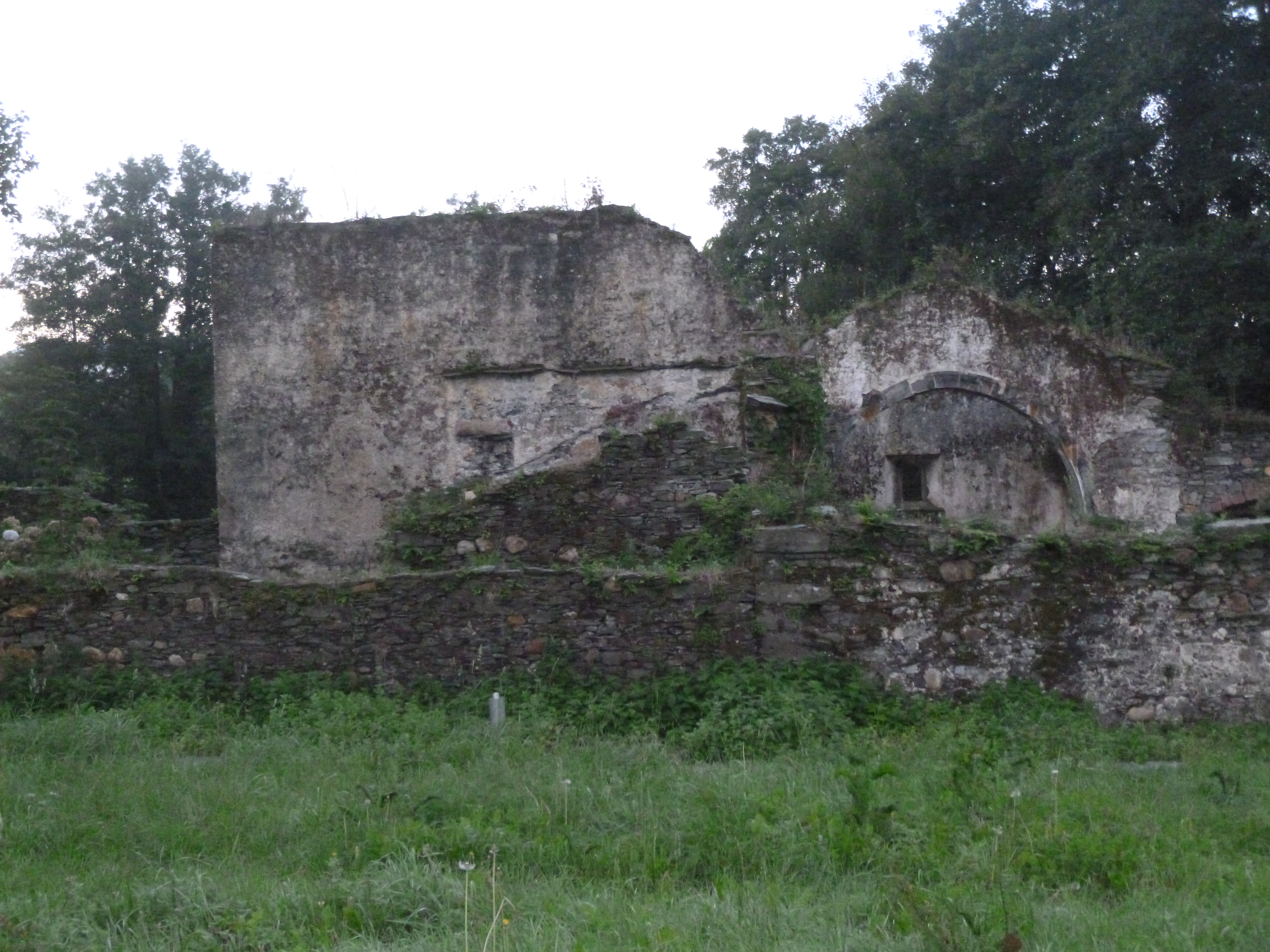
The sun comes up over the little villages outside Luarca, and I see a crumbling stone building.

P1030639

A crumbling building in the countryside

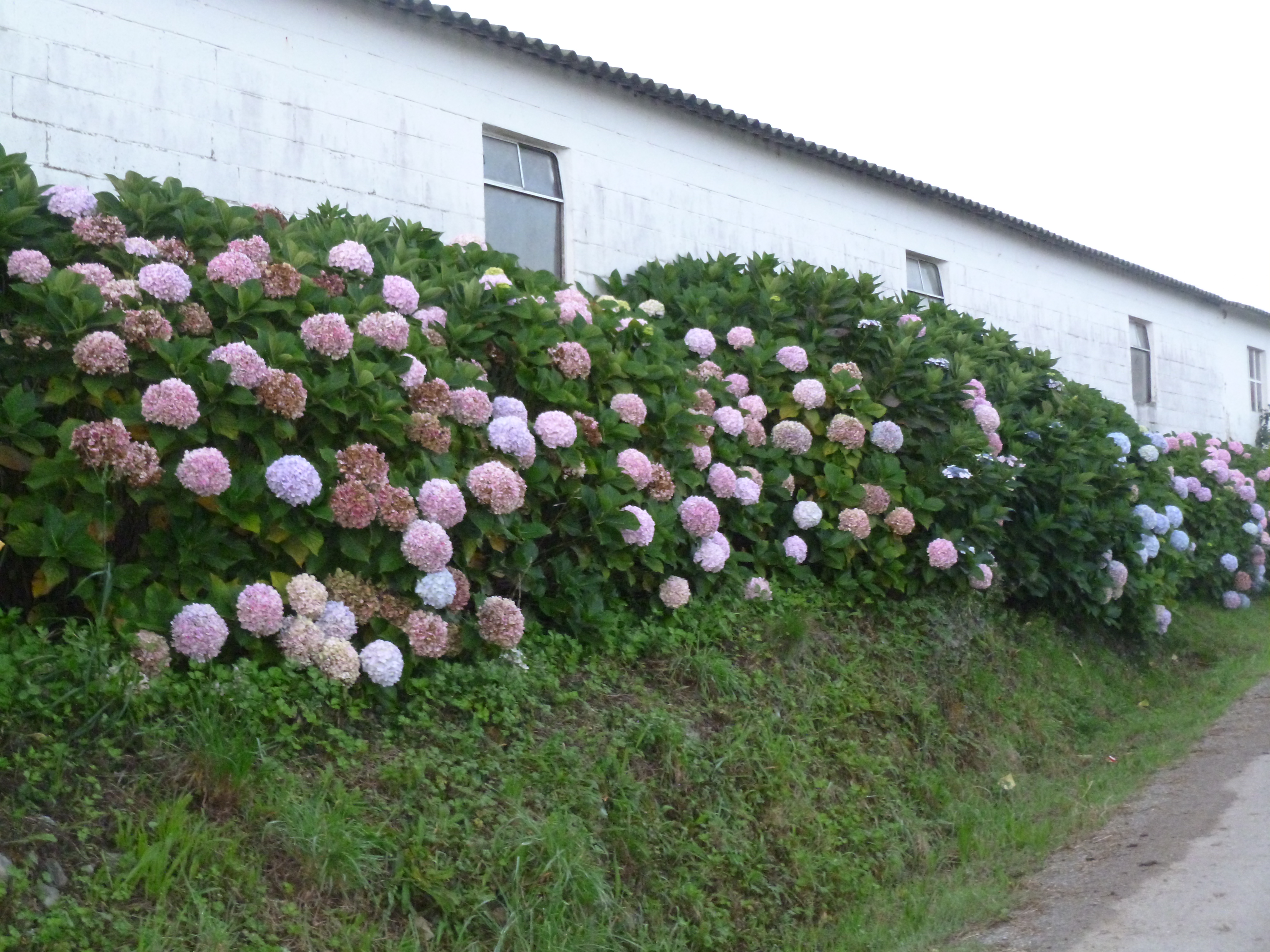
Next comes a big farming operation, with loud machinery even at this quiet hour, but on the side of the huge metal building is this sight . . . I think these are peonies . . . one of my daughter’s favorite flowers.  If I’m incorrect, please let me know.  Marilyn M?

P1030642

I see these everywhere in this part of Spain, but this long stretch is quite impressive

The path is indeed fairly easy, though not too flat, but I realize there will be NO bar to get food or drink for several hours and I didn’t buy anything last night at the grocery store.  Add to that the fact that the breakfast place was closed, and I realize I have had nothing since last night.  I have plenty of water, but nothing else but half of my sweet from the pastry shop and that’s not a good idea without some protein or fruit at the beginning of the day.  I pass fence posts with wire wrapped around them.  And encircling the tops of every post are snails, clustered together.  Where do they think they can go from the top of a cut tree stump?  I thought snails only hung around water, but these must be on their own Camino de Fencepost, and they all feel as stuck as I did the other day walking down to Soto de Luiñes!  Sympathy floods through me.  I am a snail, yes indeedy.

The girls who started the “closet” conversation way back at the Covento in Zumaia pass me, and one of them offers me her nectarine.  I take it gratefully.  Someone else offers almonds, but I decline.   I walk through several little villages with no bars, and then find myself out above the highway on a ridge that looks pretty new.  Did I miss an arrow or shell?  After about a mile, I begin to worry that I’m really on the wrong road, because I see the sea off in the distance and the book says nothing about the sea on this stage.  So I walk back to the last marker, perhaps nearly that mile, to make sure.  An older man is walking his dog, and I ask whether I’ve made a wrong turn.  My book says nothing about this road high above everything either.

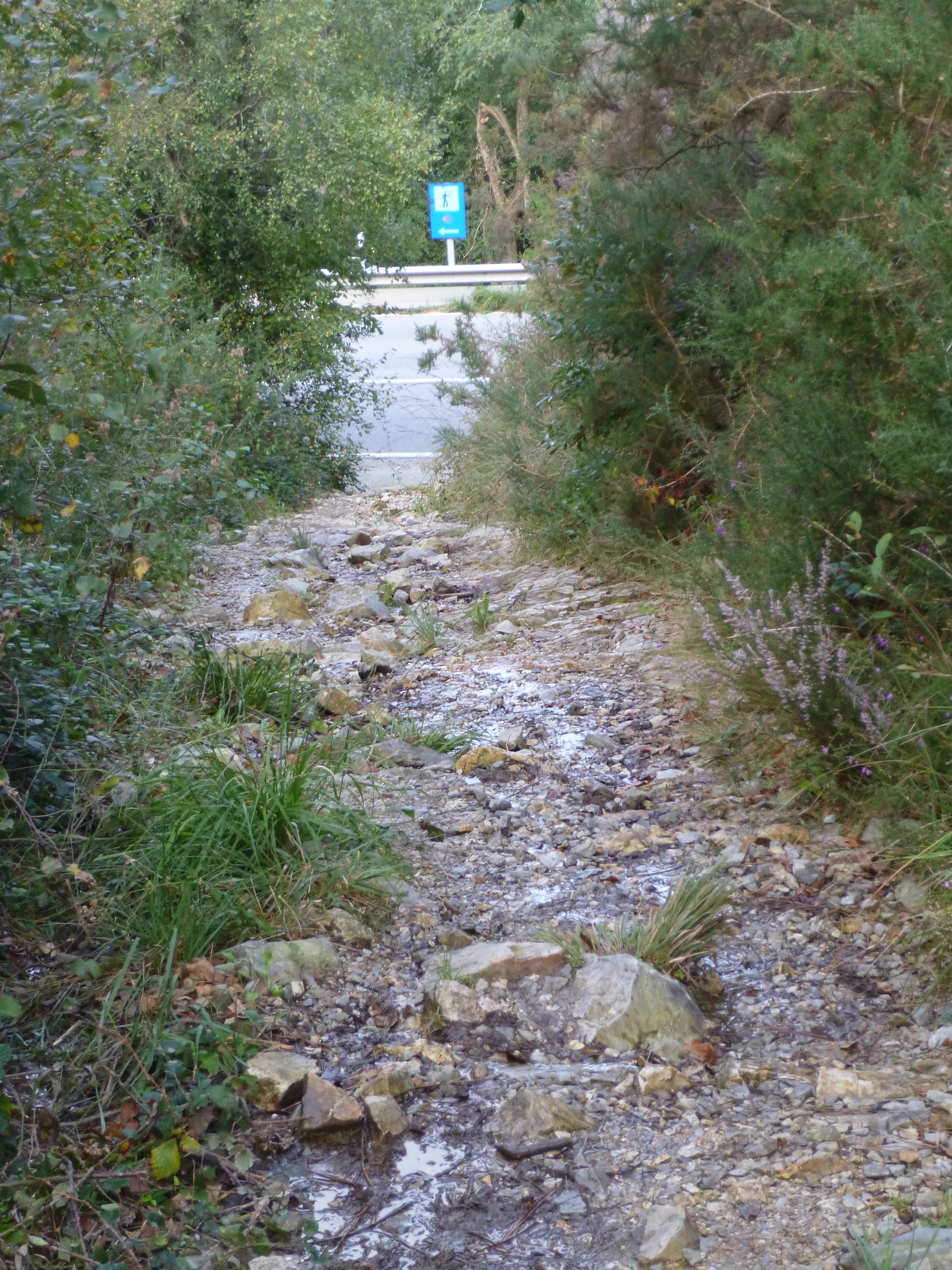
The man assures me that this road is new, that the construction the book talks about has been completed, and this is the “new way”.  So I retrace my steps again and continue up and up, and then down and down, a series of switchbacks that makes this easier than it might have been in another form.  A narrower and narrower path, more stony than the rest of it, and then I see the highway and my signs.

You can see the blue sign at the end . . . it holds a shell AND an arrow

You can see the blue sign at the end . . . it holds a shell AND an arrow

Cross the highway, climb a hill into a small settlement community (or take the road, but I am not crazy about the road in this case), and at the top is a house whose occupants must think very kindly toward the pilgrims.  There is a series of benches across from their house, and a few steps later is a fountain with a sign that says “Agua Potable”.  I have enough water, but I was sad to leave that generous little area.  After the community, the path goes through farmland.

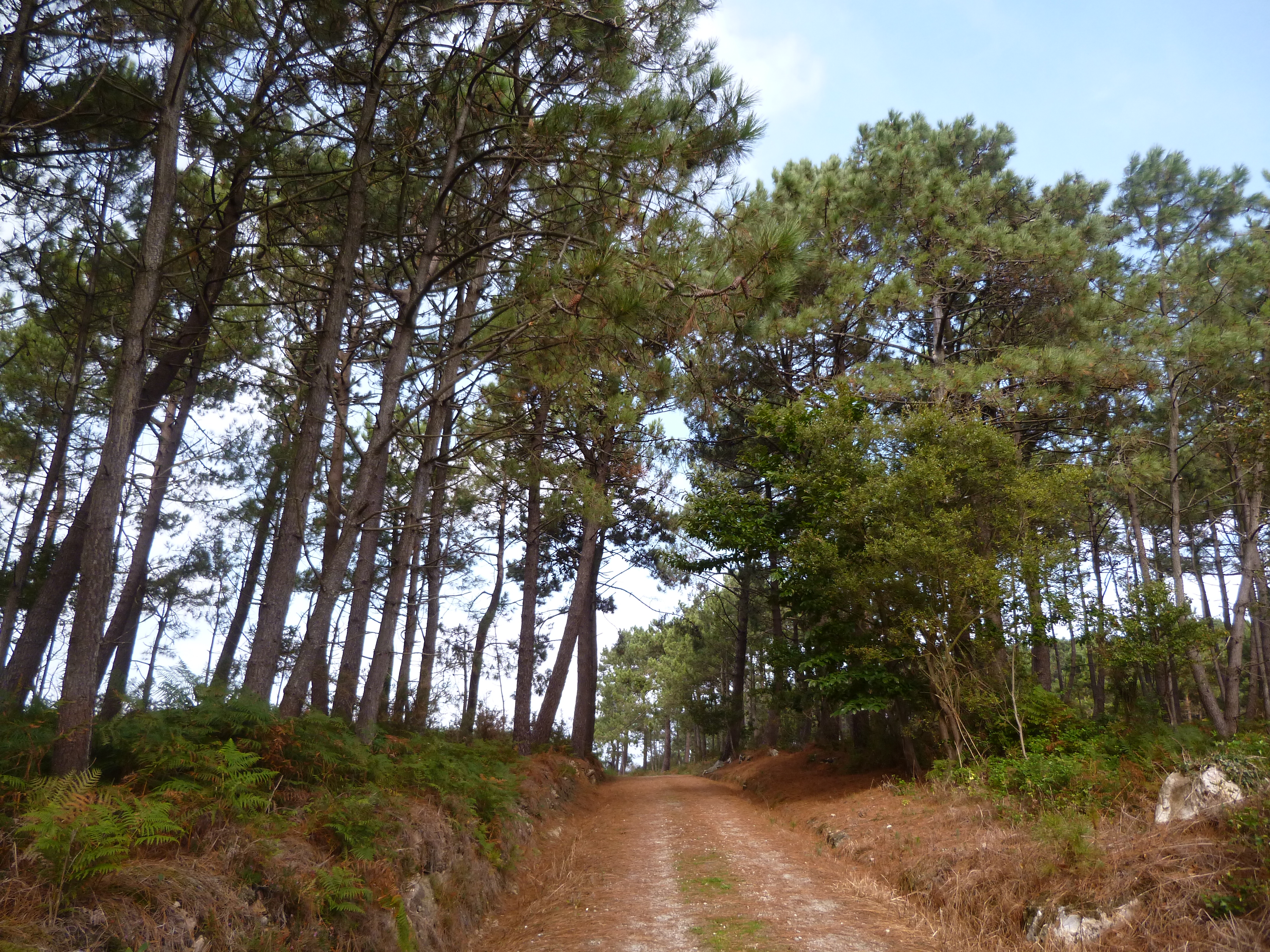
Wish there were more paths like this one!

Wish there were more paths like this one!

When I meet the road again, I am nearly in Villapedra, only 3 km from my planned stop for the day.  My right foot is beginning to ache badly, as is my ankle and hip joint.  These are new problems, just since this Camino.  I had hoped an extra day in Soto de Lueñes would help, but here we go again.  Ria had passed me earlier, after the nectarine but before the new road, and we agreed to meet in Piñera, where there is supposed to be a grocery store but nothing else.  The woman who gives you the key to the albergue supposedly will make a dinner if you ask. It’s a short day this way . . . about 15-16 km of pretty good pathways.

But then as I get to Villapedra and head for the restaurant, I get a text from Ria saying she arrived in Piñera and it’s too early for her to stop so she’s going on, another 10 km.  I don’t think I can do that.  Food first.

The couple who own the bar are so sweet.  The husband hears me coughing and coughing, and hands me a half roll of Halls mentholyptus drops.  The square ones, individually wrapped inside the tube.  The wife tells me there is a bus stop just next to the restaurant.  The waitress brings me just what I asked for . . . a plate of jamon and queso, no pan (no bread), and some orange juice.

The American men from last night show up at the bar, with reservations here in this town.  They don’t stay in albergues because they don’t have to, and they can share a room. I decide I might as well just go to Ribadeo, stay for three nights, catch up on whatever, and give my right lower limb all the Arnica cream it can handle. But the bus doesn’t come for another 90 minutes.  I get out my computer.  The husband hauls out a huge extension cord, climbs a ladder to plug it in somewhere, and drapes it over the chair next to me at my table, offering the female end of the cord for my computer plug.  He and his wife are so accommodating, I want to take them with me.

When it’s time for the bus, I walk to the stop, but when I say, “Ribadeo?” to the bus driver, she shakes her head.  “Navia” she says.  The bus to Ribadeo doesn’t leave for yet another 75 minutes.  So back to the restaurant I go and order a cafe con leche until the time passes.

When I get to Ribadeo, I go to the Tourist Information Center, this one actually open, with a very helpful young woman working.  She gives me a list of pensions and hotels, and calls one of them, the Hotel Linares,  just across the Plaza de España.  They have a pilgrim’s rate of 22 Euro per night, and an extra 3 Euro for breakfast.  I walk across the Plaza and one of the hotel employees gets me settled.

Larry is at the Hotel RosMary, just down the street.  I saw the sign there, and was tempted, since my mother’s name is RosMary, but Larry said the room was “adequate” and a bit run down, and I didn’t want to stay there for multiple days.  Hotel Linares will be better.  We agree to meet for wine at 7:00 at the outdoor tables that belong to my hotel.  I take a shower and settle in.  Same drill, different town, better room.

When I walk out to meet Larry, who is sitting across from the hotel but the three young people I met in Soto de Luñes.  They live in Cambridge, the boy, Thomas,  is British with an American grandmother, I think, and the girls, Monika and Olga, living and working in Cambridge for the past five years, are from Lithuania. They drink their coffee, Larry and I have wine, and then I offer to buy a round of wine for everyone.  Unless they are tired of hanging out with oldsters.  They seem genuinely interested in staying with us, more wine or not. And here in Spain, a round of wine for five people costs me about 11 Euro.  Comes with trays of good salted peanuts.  Such a deal.

Eventually, we wander to the water’s edge (yes, Ribadeo is another seacoast town) to see about a decent restaurant, one with more delicious varieties than the Menu del Dia, and we find one.  A big long restaurant with glass all around, and they have . . . caldo gallego!  A delicious version of it, as well as not-stale Tarte de Santiago!  Monika chooses the wine, I order sea bass, the others a variety of things like pulpo soup (octopus), pulpo salad, ensalate russo (potato salad), and on and on.  The entire bill is just barely 20 Euro each, and we have a fabulous time.  I feel as though I am having dinner with my kids and their friends.

A very good seaside restaurant in Ribadeo

A very good seaside restaurant in Ribadeo

We begin to walk back up toward the centro and pass one of many bars.

Larry says, “Let’s go in and have a glass of rum” and everyone nods.  But me.  I’ve already had three glasses of wine, more than my usual, and rum is the very last thing I want!  So I say good night to all of them, we exchange hugs, and Thomas kisses me on the cheek, like a good son.  All is well.

Monika,Joannah, Olga, Larry, Thomas - everyone's last night in Ribadeo but mine

Monika, Joannah, Olga, Larry, Thomas – everyone’s last night in Ribadeo but mine

Posted in Ailments, Camino de Santiago, Camino del Norte, Snails, Spain, Women Walking | Tagged , , , , , , | 4 Comments

Soto de Luiñes – Part Two

Still Monday, September 21, 2015.  The highlight of my downhill slide into Soto de Luiñes is meeting three young people who are ready to pass me on the trail.  A blond, adorable young man, and two young woman, one with light brown hair, a quiet person, and the other, that red dye that is almost magenta, and she is quite vivacious.  They seem fairly energized even during this endless walk (hey, they were young), and I ask what they thought of this “walk”, whether they forked left at the church, where they had started the Camino, where they started today . . . the usual questions we all ask one another.

They had started in Muron de Nalón this morning, just as Ria and I had.  I ask whether they had stayed at the Casa Carmina, since I hadn’t noticed them there.  The guy says rather sheepishly, “Well, we took the train from Ribadesella to Muron and this is our first day.  We have a week to do part of this.”

We talk for awhile as we walk, and they go on.  Of course they do.  I’m not a tortoise, I’m a snail.

I reserved two rooms the other day, one for Ria and one for me.  At 12 Euro per person (shared bath with others), it’s worth getting a room by myself.  Ria agrees, though we have shared rooms when they are 30-40 Euro.  But when the albergue rate is 10-15 Euro, I’d rather have a single or twin-bedded room.  And when the albergue rate is 5 Euro, I feel WAY too old to stay there.  So we are deciding to get our own rooms when they are affordable. This is a perfect time to pass on the albergue on the other side of this town.

When I get to the Hostal Paulino, a sign directs me to go next door to the reception desk in the regular hotel.   I ask whether my friend has arrived.  The woman says, “Oh, yes, about three hours ago.”  Hmmm.   Of course, says the snail.

I go back to the other building, put all my belongings in Room #1 and walk to the far  end of the hallway to #9 to knock on Ria’s door.  She opens it with surprise and relief.  I say I will tell her about my missed direction later.  Now I need a shower, and I can hardly walk on my feet.  Hobbling has not ended yet today.

After an hour or so, we agree to walk up the street to the only real restaurant in town.  Remember that the bars and cafes only serve coffee, drinks, tapas or pinxos, some form of breakfast with no eggs, and “raciones”, (appetizers), (bocadillos).  But no real dinner.  And real dinner isn’t served until at least 8:00 in most restaurants.

This particular place is attached to a hotel, and we order our Menu del Dia, of course. Another really strong fish soup, and a main course of something the waiter translates as “blue fish”.  Cooked to death, curled up like a crispy critter.  The dessert might have been good, but I can’t remember.   At the next table are the three new young people, and they greet me warmly.  I ask how they liked the trail.  The girls say they thought it was fine, no problem.  The young man, however, says, “Did you ever think it would end?  We get a glimpse of that concrete bridge for the highway, and then everything disappears again.  I thought we’d never get here!”

My sentiments exactly.  We eat, talk, pay our bill, say goodbye to the young trio, and walk back to our rooms.  I think those three are staying at this hotel.  They can split the room and the cost among them easily.

I decide to stay an extra day, let my feet and ankles rest, and try to write a bit, sleep in, get ready for the next week of walking. Ria will walk to Luarca.  I will take the bus to Luarca on Wednesday and catch up with her.  We plan to stay in the Albergue right in town in Luarca, two days from now.

I can’t sleep that night.  One of those nights I know so well at home.  But now some of it is because my feet ache, my ankles ache, my knees ache, and in dismay I see that my hip-sockets are also on the list of achy-breaky body parts. Every hour or so, I look at the time on my phone. I still can’t sleep, and know this doesn’t bode well for tomorrow.  And every time I get up in the middle of the night for my now-frequent bathroom trips, it takes me awhile to get steady on my feet.

Hobble, hobble, hobble.

Tuesday, September 22, 2015.  In the morning I am exhausted.  Ria knocks on my door to say goodbye and to confirm our plans for two days from now.  I putz around in the room for a few hours, still hobbling, until one of the owner-family members comes to my door, wanting to clean the room.  I walk over to “Reception” to tell the receptionist I will stay another night, and then I head for the bar up the road with my computer, to work on some of the last few days.  Coffee con leche, of course, and a croissant make up my breakfast.  Sadly, no eggs anywhere in sight.

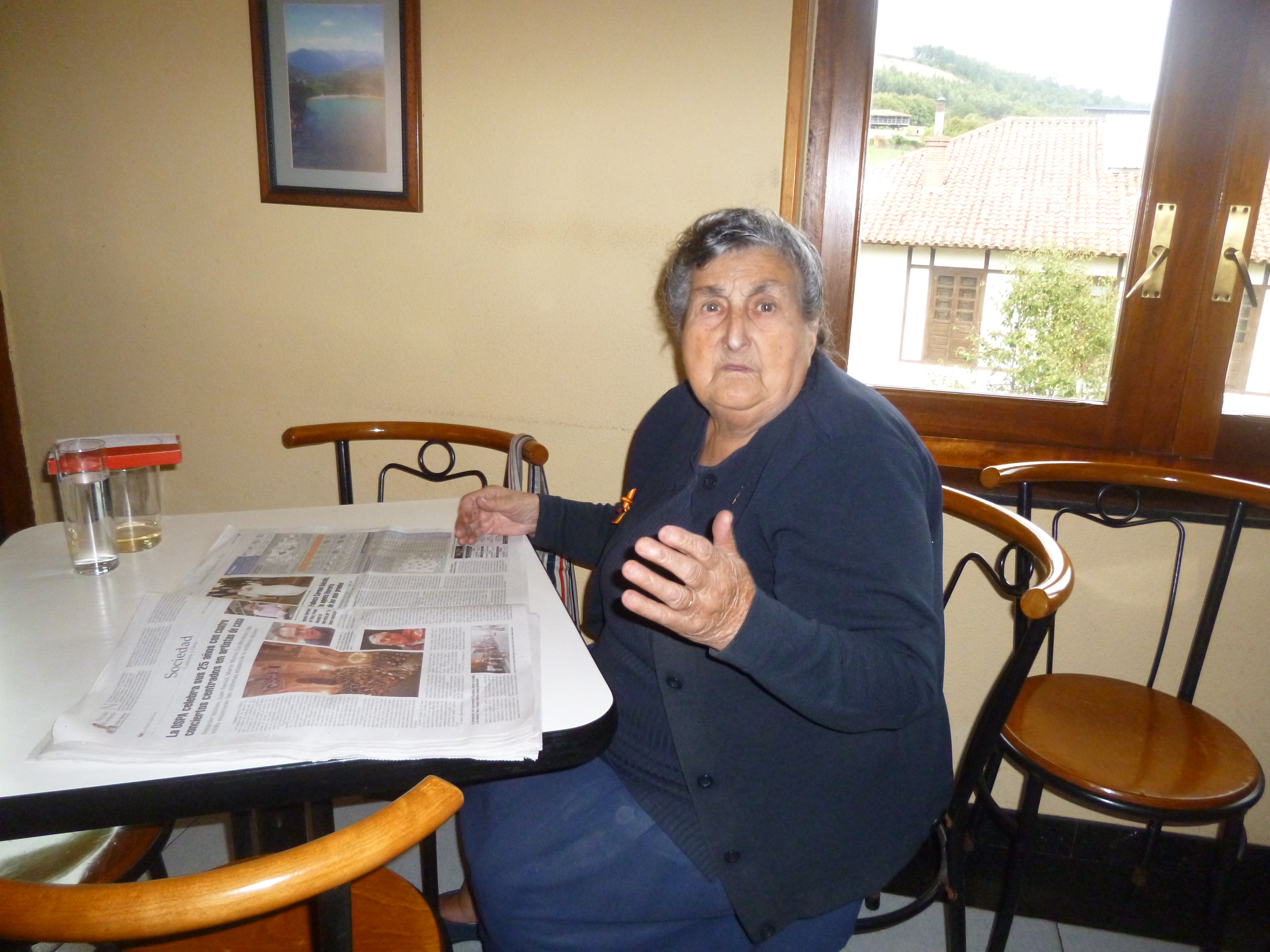
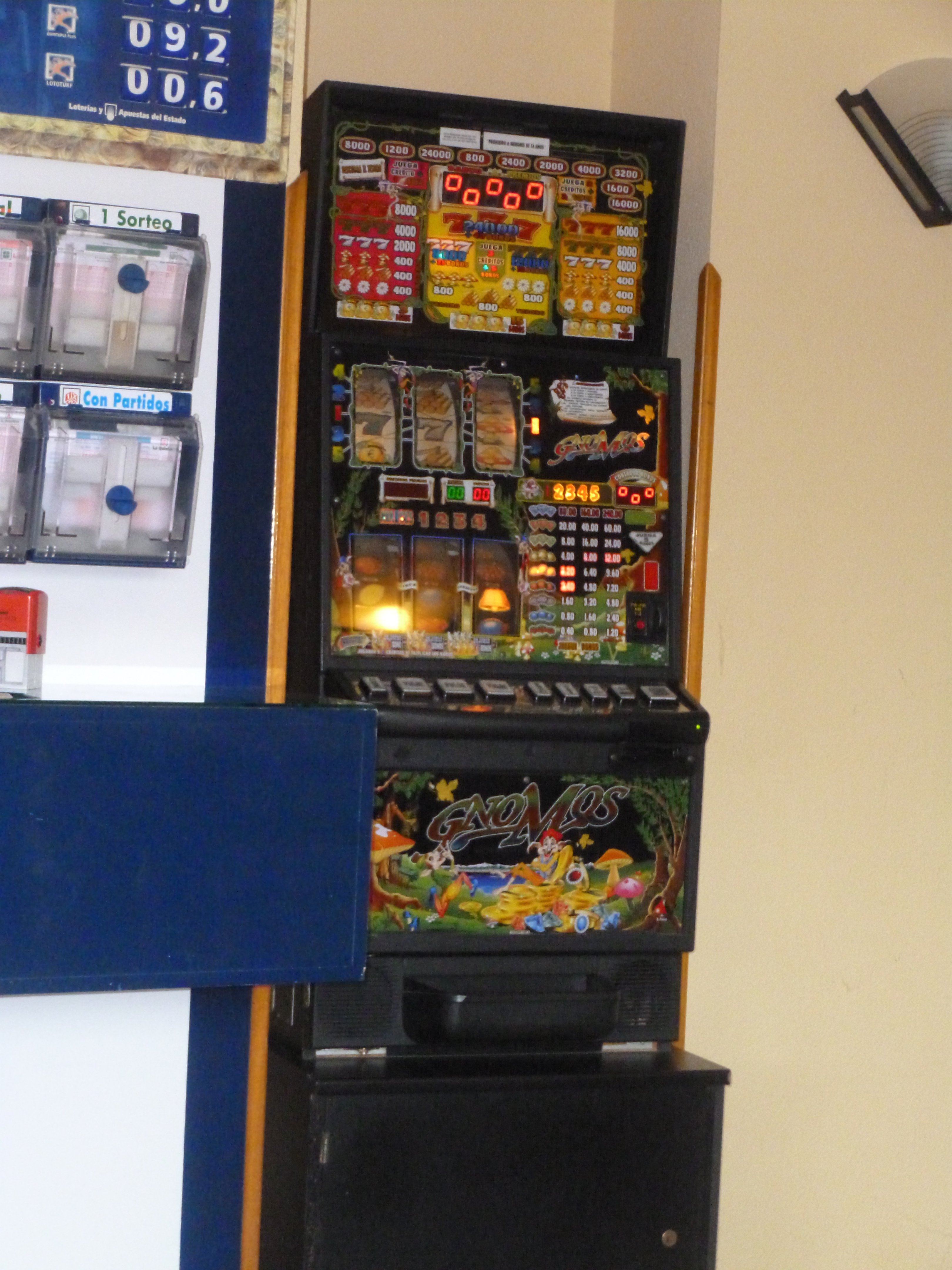
An old woman sits at the next table, reading the newspaper, cackling to herself as her fellow village people come in and out of the bar. Intermittently she goes up to a slot machine in the corner, puts in a coin or two, and I hear the payout . . . incredible. She cackles again. A man standing next to her shakes his head, looks at me, says something in Spanish, and shakes his head again.

After a couple of hours, she is still there, still cackling, still pumping the slot machine.  Still winning.  When I leave the bar, I gesture and ask her if I can take her picture.  She shrugs as if to ask, “Why?”  “Why would you want to take my photo?”

I can’ answer her, but just want to know she has no objection.  She can be as puzzled as she wants to be, but I just want her permission.  She shrugs again.

A real winner in Soto de Luiñes

A real winner in Soto de Luiñes

And this is her plaything . . .

And this slot machine is her plaything . . .

I decide to go farther into town, get some cash, visit the pharmacia and buy a banana.  As I come to the grocery store, I literally run into Larry, who has come from somewhere, Avilés, I imagine.  He’s staying at the hotel where we ate dinner last night. We talk for a bit, he takes off for a walk around the town, and I go to the hotel restaurant to get a salad for lunch. Larry joins me with a glass of wine in his hand, and I, everyone’s travel agent, get him a plane ticket from Santiago to Madrid for early October.

This is such a different Camino experience for me, and he talks about it, too.  We will have more conversations like these, with one another and others as well, over the next days and weeks.  And I have to think more about how it is different and what that means, but my impressions have been quick to come but slow to develop this time.  I realize that I don’t have those free-flowing days, where the thoughts float in and out in the way they did on the Camino Frances walk.  More like intense concentration on where I put my feet with every step, regrouping my energy after a coughing bout, as well as enjoying the company of some of the people I have written about in the past few weeks.  The views on sunny days are often spectacular, for at least some part of each day’s walk, and there is always a cow, a dog, a cat, sheep, birdsong, some live thing that makes me glad to be among the creatures of the earth.

Now I want to go back to my room and rest a bit, write more, and begin to get things packed up for leaving tomorrow.  The bus to Luarca doesn’t come until early afternoon, so I will have a half day to continue my writing work before I begin again with the walking work.

I feel sluggish and that’s not a good thing when you are walking across a country, no matter whether you augment with buses or not.  I need to give myself a good talking to.  It’s a gloomy day, threatening to rain, and perhaps that affects my mood as well.  No sleep last night didn’t help.

Tonight I will eat the dinner at my hotel, and the manager tells me I can have two “starters” rather than a starter and a main.  I see a lentil soup and pasta bolonese on the menu and perhaps a good warm meal will help bring on some sleep tonight.

I will wish myself a Buen Camino for tomorrow, no matter what that will look like, and will crawl into bed, a fleece blanket wrapped around me.

Posted in Camino de Santiago, Camino del Norte, Eucalyptus trees | Tagged , , | 6 Comments

Muros de Nalón to Soto de Luiña

Monday September 21, 2015.  Well, today is to be a nice short walk . . . well, 15 km, apparently, but I will make short work of that bit of relief at the beginning of the day.  And at some point here I will also rework the book’s description of the second half of the walk, writing what they SHOULD have told us, though I won’t blame them for my missing the left turn in Il Pitu.

The book’s “stage” is twice as long as today’s walk for me, because the “stage” officially begins in Avilés, and goes to Soto de Luiña, but I did half of that yesterday.  Today will be fun.

This is a long walk, with few opportunities to break it into shorter stages. Departure from Avilés follows a circuitous route, remaining primarily on minor roads through a series of suburbs . The middle of the stage passes through a mix of more interesting towns, beginning with El Castillo’s fortress and concluding with El Pito’s Renaissance gardens.

Okay . . . we did all of that but for El Pito (or Il Pitu) and its Renaissance gardens.  Not relevant for today.  Here’s what the authors summarize about the half I will walk today.

The final stretch drags a bit, and has been shaken up by road construction, but it moves through a lush, expansive valley and concludes in pilgrim-friendly Soto de Luiña.

And I’m giving credit where credit is due . . . but only once in this write.  Here is the formal information about “my book.”  Whitson, Dave; Perazzoli, Laura (2015-01-03). The Northern Caminos: The Caminos Norte, Primitivo and Inglés (International Walking) (Kindle Locations 1892-1896). Cicerone Press. Kindle Edition.

Now here we go:

Keep straight on the road out of Muros, transitioning to a picturesque footpath that winds through densely forested hills into Il Pitu/El Pito.

Fair enough.  A long, perhaps 3 km downhill path through more eucalyptus forests.  For the most part it is a good, dry path without the typical horridly stony surface.  My feet like it.  Then for a time, it is inordinately muddy, and if I didn’t have my hiking sticks, I’m not sure how I would have negotiated that part, up to my ankles in tar-like mud.

I don't think any photo would do this path justice

I don’t think any photo would do this mud-path justice

But the muddy part isn’t too long, and as the path begins uphill again, it is dry, and I emerge in Il Pitu, head for the bar and have coffee and a croissant.  Easy-peasy as one of my sisters often says.  I leave the bar and happily move on.  Keep straight on along the CU-2. Fork left after the church onto a road that quickly becomes a dirt road, and then a footpath. Turn right on a paved road, then fork left.

Now here’s the deal.  I’m being paid back for being happy walking today.  I miss the “Fork left after the church.”  I even NOTICE the church for a change.  But I do NOT “fork left after the church.”

I walk and walk through this small town, and then stop, turn around, and wonder whether I’m in the right place. An old woman, a very old woman, is walking toward me with her cane.  I ask my usual question:  “Donde esta Camino?”  She breaks into a creaky little smile and begins her rapido Spanish, gesturing first one way and then another, nodding.  I think that might mean it doesn’t matter which way I go . . . I’ll be on the Camino.  Dubious, I continue walking.

A bit farther on, I see an old man (but not as old as this woman) rushing past me with a key in his hand.  I stop him and ask the same question.  He nods and tells me (in Spanish, of course) that yes, this is the way.  I’m just fine.  Yes, yes.  So I keep walking.  So does he, and when he passes me again later, after having stopped to chat with some of his neighbors, he nods comfortingly and waves me on in this wrong direction.

Soon, I am in the beginning of another town, Cudillero as the sign announces, and I’m going down down down, though not too steeply.  I get out my phone, which has “my book” on the phone’s Kindle App.  I scroll to this part of the map and see that “Cudillero” is not on my Camino path, although I do see where it is.  Hmmm.  I keep walking.  Maybe eventually, if I follow the road long enough, I’ll get with my connection.  And that will be true . . .

When I reach the middle of Cudillero, with people bustling about, I realize that it is another seacoast town, and a pretty one.  But I’m not supposed to be on the coast.  I hear a greeting and see a peregrina from Austria, someone I’ve met a few times along the way.  I ask her what I should do.  She tells me that she is staying here for a couple of days before she gets a train or bus to some bigger city so she can fly out of Bilbao in two days.

“You’d really like this place . . . it’s lovely,” she says.  Yes, but I’m not to be here!  She sends me to the tourist information office two blocks up, and as I turn the corner, I see:

Cudiellera . . . a cute place, but the wrong place

Cudillero . . . a cute place, but the wrong place

P1030604

And a few steps more . . .
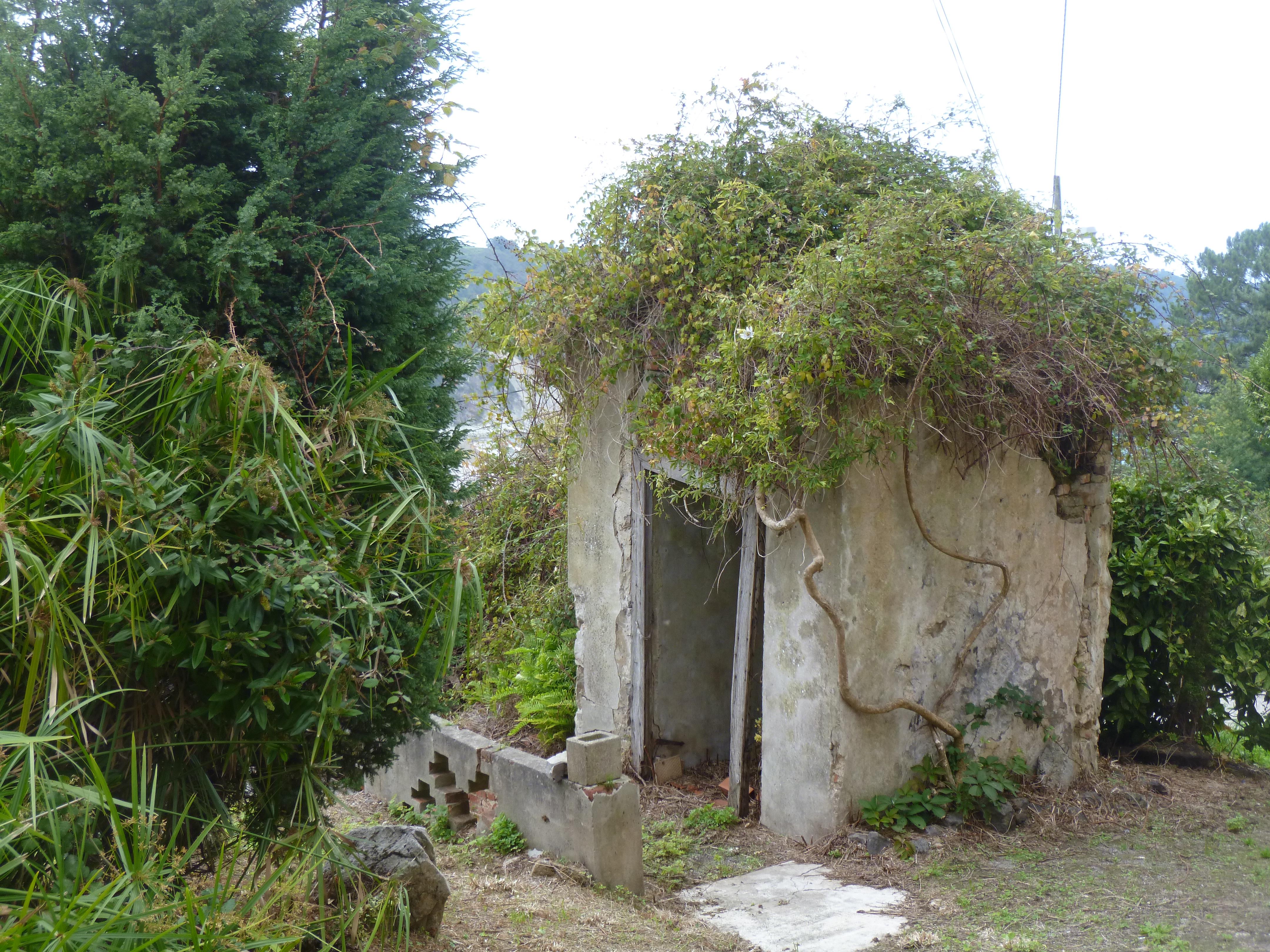
Now, in addition to going the wrong way, are the instructions I would have been dealing with if I’d gone the RIGHT way.  Sometimes the descriptions in this book can make one’s eyes cross.

Keep straight on along the CU-2. Fork left after the church onto a road that quickly becomes a dirt road, and then a footpath. Turn right on a paved road, then fork left. Before reaching Hotel Lupa (singles 24– 30 €, doubles 45– 50, breakfast, 985 *** ***), 1.6km later, watch for a poorly marked right turn. Soon after, join the N-632. While the camino has traditionally gone to the south side of the highway, major construction projects have forced a detour, which will probably be in effect for the foreseeable future. Follow the N-632 for 600m. Fork right on the N632a. Keep straight on for 3km, pass the Hotel/ Restaurant, then make a sharp right downhill.

Easy at twice the price, yes?  Well, the tourist information woman looks at me with great sympathy.  Yes, I can get back on my path going this way.  I can simply follow the road for about 3 km, get to the next roundabout, look for the BROWN sign, a little one, that follows the right turn on the traffic circle.  Turn right there, and I will immediately begin seeing the yellow arrows again.  I smile with relief.

She returns my smile, but sort of shakes her head in apology.  “But the road . . . you have to go up.  And up.”  I ask her what else is new.  She nods and wishes me Buen Camino. I follow the road.  Up.  And up.  Switchback after switchback, sort of like the approach to Red Mountain Pass, but not at that elevation.  Still, probably as steep and windy, with no real shoulder to walk on.  I face the traffic and hope everyone sees me as they whiz by, headed for Cudillero.  I, however, am headed for a little brown sign on the big billboard for the traffic circle . . . 3 km. UP.  On the way, it IS pretty, I must admit . . .

P1030606

And on the way out of town . . . the hard way . . .
I’m not sure when the book and my little brown sign (which indeed takes me to my yellow arrows about 90 minutes after I leave the village) converge, but I’ll continue with the book’s official directions.

Proceed 600m to the bottom of the hill, where arrows point in three different directions. The official camino proceeds straight, but construction once again interferes . Detour signs point left. Follow the detour 1.1km, joining the N-632a into Artedo (bar). After 600m, fork right onto a dirt track shortly before [though it actually comes AFTER] a small bridge. Wind along the hillside for 900m until arriving in small Mumayor.
I can never measure 600 m. or 900 m. or 5 km. for that matter, so I just follow the now- beloved arrows, no matter where they go.  I don’t get to Artedo, though that was the name on the brown traffic circle sign.  Maybe I would have gone through it if I had only “forked left at the church” in Il Pitu.  I do see the hill, I do see the small bridge, and I can make sense of some of the directions.  When I think I should be arriving in Soto de Luiña, LONG after I’ve been on the road for the time it would have taken to go 15 km, I see the rooftop evidence of “small Mumayor” and it is a lovely tiny village.  Bean trestles and HUGE tomato vines, and families out with their kids along a very windy “road”, an old man picking the last of the beans in his garden, etc.

I check my book.

Fork right at the end of town, then left along a footpath. Return to the N-634a for the final stretch into Soto de Luiña (11.3km)

Now doesn’t that sound like the end is REALLY near? Fork right, then left along a footpath.  Return to the road for the “final stretch”, 11.3 km from where I didn’t “fork left at the church.”

Now let me say that once I was back with my arrows just after the traffic circle, the views were lovely, sometimes spectacular, out and over the valleys below me.  The farmland was peaceful, the animals gave me loving gazes, and I was really ready for the “final stretch”.

P1030609

The cattle are relaxing . . . and have two babies with them

P1030607

Another little hut . . .

On the way to Mumayor

On the way to Mumayor

Here’s a more truthful version of those two italicized sentences above, from someone (me) who has JUST been there:

Okay, sucker, fork right at the end of town, then left along a footpath. Continue down and down and down the footpath in a never-ending fairly gentle spiral.  When there is still nowhere to turn and end this endless journey, you will see TWO sets of shells and arrows, as if you can’t believe your bad fortune.  Someone has put these double markers on your one-and-only path just so you KNOW you haven’t missed the turn, you idiot.  But you are still paying for your earlier error in Il Pitu, you pitiful pilgrim.

One of two sets of shells AND arrows on a never-ending trail

One of two sets of shells AND arrows on a never-ending trail

Now you will hear birds.  You will hear cowbells and traffic sounds, and you will have hope that you are approaching your destination.  These are teasing reminders that there IS civilization out there . . . somewhere . . . cow bells, car noises, but we’re only teasing. You will even get a a glimpse of a tile-roofed town, but you’ll never really get there . . .But then all those sounds will go away, and the only thing that doesn’t go away is the downward path, with the lovely swaying eucalyptus trees high above you, and the mass of ferns everywhere, kissing your ankles, those parts of your body that are beginning to whimper.  Oh, and your arms and hands will also begin to join this whimpering chorus because you are clutching the handles of your sticks with a death grip.

In another twenty minutes, you will again hear cowbells and traffic.  You will actually see the HUGE concrete structures that are the A-8 or the A-7 or one of those superhighways you will never have to walk on.  You will EVEN see more tile roofs and some parts of actual exterior house walls, so now you will be SURE you are coming to your village.  But you will be wrong.  Continue to walk downhill on not-too horrid pathways, for at least another hour.  The high, concrete bridges of the A-8 or A-7 will appear and disappear as if they were the guests in David Copperfield’s magic show. 

Your limbs continue to ache, pretending not to complain, but now your ankles feel like you have been stuck with boning knives, criss-crossed carefully, a pair for each ankle, inserted like the X of swords.  Shish-kebob skewers have been implanted into the top of each foot.  The skewers don’t go all the way through.  They just sit straight, handles up, in the bony part of the foot.

The bottoms of your feet will feel beaten, as though armies walked on them upside down.  But since you are so lucky, you will have NO BLISTERS. Now you will be hobbling, and at least you won’t have to face any decisions about which way to go for the duration.

I, the author of this unadulterated, realistic version of the Norte guide book, can tell you honestly.  This little path will never engage with Soto de Luiña.  You will need to begin looking for a Fern Grove Albergue.  And there are many on this path . . . all donativo.

When you know there is really no hope, you will, if you can, as the official authors say::

Return to the N-634a for the final stretch into Soto de Luiña (11.3km), compliments of the authors of the official Camino del Norte book.

More to come . . .

Posted in Miscellany | Tagged , , , , , , | 5 Comments

Gijon – Aviles – Muros de Nalón

Friday, September 18, 2015.  In Gijon we each wake up in our little cubes in what Ria has come to call the “Spooky House”, Pension Gonzales.  We take turns in the not-so-clean bathrooms, and quickly go out to the vegetarian restaurant, which has ham and eggs for breakfast . . . go figure, but I’m happy.

I MUST get caught up with these posts, because I don’t like being too behind.  My actual journal is catching some of the details, and when I look at those, I can remember much more.  But today I’m looking for a real place to sit, one that has wi-fi and doesn’t require that I continue to buy coffee all day.  A library would be good.  I ask someone who points the way to the Cultural Center.  Next door is a biblioteque, and I enter the large doors, ask for what I need, am sent to the fourth floor where people are sitting with their computers.

Password, all is explained, and I cannot get onto the internet without getting that dreaded message:  “THIS IS AN UNTRUSTED CONNECTION . . . ”  I try again and again, and none of the librarians speak any English, so I can’t really make myself understood  A young man tries to help, and asks some of the other men who are working on PC computers.  They tell him the wi-fi in this enormous, official Biblioteque does NOT work with Macs.  WHAT??

I have spent nearly an hour trying to solve an unsolvable problem.  I pack up my toys and move on.  Around the corner there is a Mac store, with the Apple prominently displayed.  I walk in and explain my dilemma.  The employees are astonished, as I was.  One of them tells me about a restaurant/cafe two blocks away.  He knows the owner and I can surely go there, buy one coffee or water or something, and work all day.  I go in search of the place and actually find it fairly easily.  When I explain my situation to the owner, he is so gracious and tells me I can go upstairs where it is much more quiet.  I do so, and spend three hours writing.

It is now 3:30 p.m. and time to go back to the Spooky Pension to see where everyone is.  Ria has been napping, since she feels like shit (I know the feeling from days before).  Larry is ready to go back to an outdoor store to buy a new backpack.  Erika wants to go as well, and now Adriana, who has shown up this morning, has yet another agenda, which I won’t even begin to describe since I ducked out of the search at the backpack store.

Ria and I tag along for awhile, and then find a nice quiet place to get dinner.  Delicious “sopa de ave”, I think.  “ave” is “bird”  but sure tastes like chicken.  Lots of noodles and rich broth, and enough in the serving bowl for five people though we are only two.  Sorry we ordered a salad, since it’s way too much for me.

I want to get a good start in the morning, so I pack up most everything tonight.  On to Avilés tomorrow.  But here are some retro photos for you, taken as we walk back to the Pension Spooky:

A restaurant sign in Gijon

A restaurant sign in Gijon

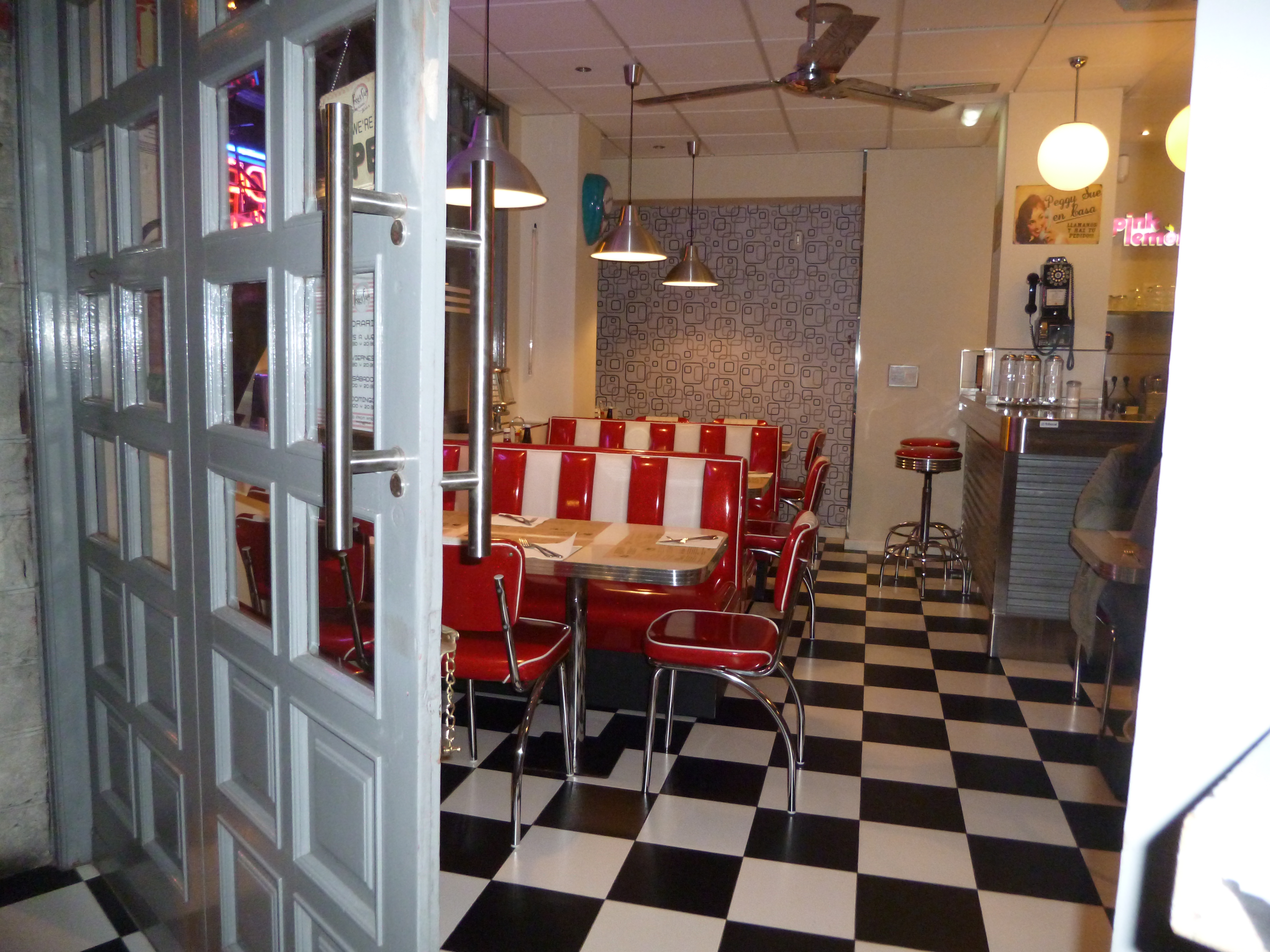
The interior of Peggy Sue's restaurant

The interior of Peggy Sue’s restaurant

And when was the last time you saw one of these?

And when was the last time you saw one of these?

Saturday, September 19, 2015.  Today begins and ends with those unlovely industrial areas, first out of Gijon and then into Avilés, but the walk is pretty manageable, and meanders through the countryside.  We pilgrims are much slower than the participants of the bicycle race that seems to be running here and there as we walk.  The last one was in San Vicente de la Barquera last weekend, and today the bicyclists zoom past us, occasionally yelling, “Buen Camino!” as they ride. Then the countryside is peaceful and I walk with ease for a change.

Bicycle race outside of Gijon, with cyclists zooming past Ria and me

Bicycle race outside of Gijon, with cyclists zooming past Ria and me

And we are left with this lovely terrain for awhile

And we are left with this lovely terrain for awhile

I feel something on my right upper arm and swat away what I think is a normal fly.  Immediately after that, Ria swats at one on my left upper arm.  Those flies with the grey lined wings . . . at the time, I think she caught that one before it bit me, but by evening, this is what it looks like . . .

A creeping rash from some weird fly . . . by the next morning it will nearly encircle my upper arm

A creeping rash from some weird fly . . . started on the OUTSIDE of my upper arm but by the next morning the itching rash will nearly encircle it.

After a long walk through easily rolling hills, I look for a place to stop, though I know there is only one bar along the way.  I approach it and Ria is waiting, boots off.  I remove mine as well, to let my feet breathe.  The old woman who runs the place apparently lives there because when I ask for the bathroom, the woman shows me THROUGH what must be her bedroom to her bathroom.  Geez!

She is so sweet . . . giving me cookies with my cafe con leche, as she did for Ria, and Ria got some sort of chips with her snack.  When we leave, looking for the arrows, this is what we see:

The most casual exit from a bar in the middle of nowere

The most casual exit from a bar in the middle of nowhere

And as we pass through this overgrown space, we look more carefully at the arrow . . . some enterprising soul has been here with his little stickers:

Where is this guy when we need him? On a very difficult day? Today isn't one of those

Where is this guy when we need him? On a very difficult day? Today isn’t one of those

As we cross the road to continue, our first steps are crumbling ones.

The entry to the second half of the walk to Avilés

The entry to the second half of the walk to Avilés

But again, the way is smooth today.  I continue to move in the direction of the shells and arrows, though I laugh when I see THIS sign:

Didn't know this company is international

Didn’t know this company is international

Generally, what I see to guide me is something like this:

In Asturias, the small end of the shell points the direction

In Asturias, the small end of the shell points the direction

There’s one important detail to make note of. I had heard about this but wanted to check it, and on someone’s blog whose name I couldn’t “get”, this is written:  “In Asturias, [where I am now,] the camino points in the direction where the shells converge. In Galicia it’s the opposite. So in Asturias this means take a left but in Galicia it means take a right.

It’s a little nutty isn’t it?  I guess if one didn’t know this, they could spend their entire time going back and forth on the bridge that separates Asturias from Galicia.”

I will have to pay close attention as I walk out of Ribideo in a week or so, to make sure I take the right path!  But today, I’m still getting to Avilés.  While the second half of the day is mostly flat, it also takes me on the road, the sidewalk, concrete and asphalt, again hard on the feet.  And as we approach Avilés, we smell the oil and gas industry’s “perfume”.  I see the sign ahead for the pension where we have reserved rooms.  We skip it, and when we get to the old center, the Plaza de España (almost every city has one of these), we find something nearby and cancel the Pension Puenta Azur on the outskirts.  Ugly.

As we walk into the center, whom do we meet but Larry . . . he too has canceled his room at Pension Azur and found something in the old center, and once we are each settled, we meet in the Plaza for wine.  Ria has also found an Italian restaurant around the corner in a beautiful little square and I have pasta bolonese and ensalata caprese for dinner!  Yes, I know I will be in Italy in three weeks, but I really get tired of the general fare in the Menu de Peregrino, as I’ve said in the past.

A street musician is fiddling just outside our patio table and Larry is mesmerized.  He goes out to talk with the man and comes back grinning.  They will meet for coffee tomorrow morning and Larry will spend another day here.  Not a surprise.  His plans change minute by minute, and he is such an affable man, he makes friends everywhere.  I know where I’m headed tomorrow . . . to Muros de Nalón and a highly recommended private albergue called Casa Carmina, about 25 kilometers from Avilés.  Tomorrow will be a much longer day, with no stopping places for the first long while.  These are the tough stretches and there will be many more down the road.

Sunday, September 20, 2015.  The Camino path out of this city is no easier to find than almost any other I’ve encountered.  Ask five locals and you’ll get four or five slightly different answers.  But as we leave the old section, the beautiful walkway leads us out past some historic architectural structures.

The walks and streets in the historic center of Aviés look like this

The walks and streets in the historic center of Avilés look like this

The historic government building in the Plaza de España

The historic government building in the Plaza de España

It’s hard to find coffee at 8:00 a.m. in Avilés, but a bar across from the train station is open.  We see some young people getting ready to board the train with their packs, and today I feel virtuous again.  My cough is still wholeheartedly with me, but not the illness, and my feet are doing well so far.

It takes more than an hour just to get out of town, but then the path meanders up and through the suburbs, through very nice middle-class neighborhoods with tile roofs and lovely landscaping, one after another.  Once I’m back in the countryside, the “meandering” takes on a sharper meaning, though the elevation drawings in my book don’t seem as hard as the rise actually is.  Still, I walk and the 25 km day is sunny, which means hotter than the temperature would suggest.  I trudge up the wrong hill at one point, only to come up against three houses clustered together, four dogs chained outside, and no way through.  Down the hill again, and up the one ten feet away.  I saw the arrow, but it was between the two roads, and I . . . well, I guess I had taken the one “less traveled by.”  (And I’m telling this with a sigh.)  I would love to have some fresh water so I can soak the “magic cloth” I bought at Target before I left.  “Ask and ye shall receive.”  I turn a corner and see:

Finding fountains along the way is always delightful

Finding fountains along the way is always delightful

Just as I’m beginning to get tired, I see a long caterpillar or centipede, about the length of my middle finger, on his own Camino.  I can just hear him . . . “Geez, can this get ANY harder?  And now someone has put a boulder in my path!  How does anyone expect me to get around that?”

To each his or her own Camino . . .

To each his or her own Camino . . .

About 9 km from my destination, I meet three women who have just begun a week’s worth of walking.  They’re marching along, having the rested time of their lives.  And of course they’re about 25 years younger than I am.  But I perservere.  Another 3 km to El Castillo San Martin, over an ancient stone bridge, up another hill, and yet another, and I meet them again at the only bar on the whole stretch, 20 km from Avilés, and 5 km from Muros de Nalón

After walking another 4 km UP, I see Muros off in the distance. Also UP.  Trudge trudge trudge . . . and I begin to see signs for Casa Carmina.  Today has been a very long day for me (have I said that already?), and I’m relieved to see that the Casa is at the early edge of this uphill village.  I walk into the reception area and am greeted by a man about the age of my children, with the demeanor of my adorable son-in-law, Justin.  He smiles at me when I say, “I’m Joannah . . . ” and he says, “Yes!  From Colorado!”  Apparently I had made my reservation with him yesterday and he had asked where I am from.  I’ve forgotten, but then I’ve forgotten many things lately.

Ria is already here, of course, but the man, Jesus (yes, that’s right), has put us in a six-bed (three bunk sets) building by ourselves, so far.  There is also another building, right next to ours, with eight bunk spaces, all full.  And then I see what everyone has been raving about when they write about this place, in addition to the absolutely warm and friendly atmosphere.  An enormous grassy yard, perhaps half an acre, with lawn chairs all around, clotheslines, and a large tee-pee (like the kind you can buy in southwestern Colorado).

Looks like a family reunion, with everyone relaxing after a day of walking.  The Casa set -p is new, though the property is clearly old family property.  The parents are on the premises, and Jesus says this venture is his and his sister, Sara’s.  Mom serves breakfast in the mornings, wet clothing can be hung in the furnace room so it will be dry and warm in the morning, and everything has been very well thought out.

Each bunk space has its own little reading light and its own plug. The bathrooms are immaculate, with two showers and three stalls, two sinks AND paper towels!!

Such a delightful place, and I’d love to lie on the grass and eat apples.  But it’s dinner time, or nearly so, and it is Sunday, so almost everything is closed.  All but one restaurant WAY up the hill at the top of the town.

I wish I could describe how I feel at the end of my longest day, looking up high in the sky toward the church steeple, and realize that if I want anything to eat at all, I have to go there.  Changing into my sandals after my shower, I walk up with Ria and a French man named Jilles.

Of course the “restaurant” part of the establishment doesn’t begin serving until 8:00 p.m., but the “bar” part will surely bring us some wine.  The owner is very happy to accommodate us, and it’s 7:45 so after our wine, we go inside for the Menu del Dia.  A decent but very overly-fishy sopa de pescado, some sort of main dish heaped with french fries, of course, and a delicious peach tart for me as dessert.  Wine, water, and bread accompany the meal for 9 Euro per person.

At least after dinner I know I only have to go DOWN the hill to my bed, and when I arrive, I see Jesus has put two male bicyclists in the bunk room with us, one younger, one older.  I’m asleep very soon.  Sorry I didn’t take any photos of this place, but I was too tired.  Perhaps I didn’t mention that enough.

Tomorrow, a promised shorter day, about 15 km and one really big hill part, another smaller one, but after today, manageable.

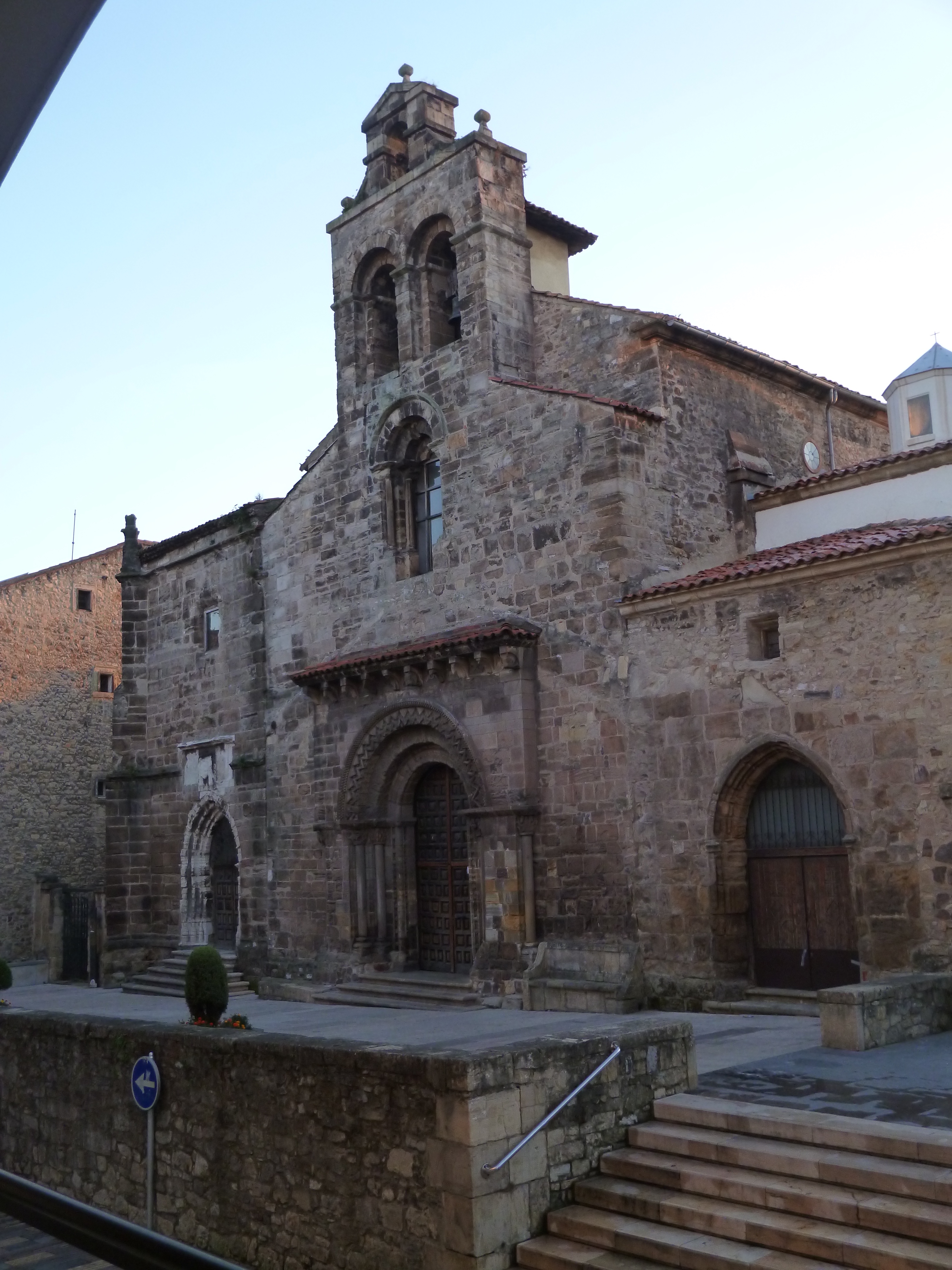
A historic church (aren't they all in Europe?) as I exit Avilés

A historic church (aren’t they all historic in Europe?) as I exit Avilés

Posted in Miscellany | 2 Comments

To Ribadesella – La Isla – Colunga – Gijon

Tuesday, September 15.  Erika, Ria and I wake up in our bunk room, listening to a downpour.  We quickly finish our morning rituals across the hall in the women’s bath and shower room and pack up, heading for coffee and any sort of breakfast.  We pass the building in which Larry  is staying and call up to him, reverse Romeos to his Larry-ette, but there is no response from the third floor, no window opening.

After breakfast in one of the only open cafes, we walk to . . . (it’s raining, remember) the bus station, headed today toward Ribadesella.  These rain days do make figuring out how to chop that 225 km off my walking distance.  The bus station is easy to find, and soon we are on it, with some other wilted pilgrims.   We watch the sodden walkers bravely march on as our bus passes them, first one small group, then a solo pilgrim, then a few more, dotted poncho-covered figures.  I am happy I am not one of them.  I’m still coughing, though it’s residual now, and don’t need more wet if I can help it.

In Ribadesella, we walk to the harbor, an inlet at the middle of the town.  The Tourist Information office gives us a list of pensions and I call Pension Aridel to see about rooms.  They have some.  We three woman walk a few blocks to see what’s available and at what cost.  Ria and I decide to share a room, a very nice little room with private bath, at 20 Euro per person, but Erika isn’t so sure she wants to stay here.  She’d rather be at the Albergue, so we settle our packs on the floor of our room and go with Erika to find a place for her.

The Albergue is a Youth Hostel, and is booked completely for the next week to a large group of military young men.  So Erika will walk to an albergue in San Esteban, not far away.  Perhaps we will meet her somewhere down the road.  She sends me an e-mail so I will have hers, and Ria and I walk back to town.

Larry sends me a message:  “Where are you?”  I respond, and he asks whether I can get him a room at the Arbidel as well.  I call, reserve the last room, and e-mail him back.  He’ll arrive later today since he’s been walking but will pick up a bus somewhere along the line.  This day would have been nearly 34 km, from Llanes to Ribadesella, and no one loves a long day in the rain.

Back in our room, Ria reads and I write for awhile.  It’s a day of hanging around, since it’s still raining, and in the early evening we gather with our male compadre for wine, cheese and crackers, and eventually dinner.

The only photos I take are these . . . apparently it’s a tradition in Ria’s family never to pass up one of these little characters, so we both play with it.  I love that little left foot, toe turned up.

Ria!

Ria!

Joannah!

Joannah!

We will walk somewhere tomorrow, separately.  La Isla or Colunga, and perhaps one or the other of us will meet up with Erika  Not a terribly long day and it looks relatively “flat”, if anything in this neck of the woods can be called flat . . . 16-20 km.

Wednessday, September 16.  Right out of Ribadasella, I meet a peregrina walking toward me.  She says something about looking for a laundry, but we are already in the middle of the countryside.  She turns around and begins to walk with me.  Great. If I slow down, she waits for me.  If she stops to fix her shoe, I walk on, and she catches up.  I finally get to the one bar on the entire trail (this will be an upcoming trend for the next 50 km or so after Colunga . . . almost nothing) and she joins me.  Her name is Rain and she’s from Ottawa, Canada, though her book is in French.

After the bar, I’m gratefully alone again, and the path opens up to another beautiful beach, with strange “crop circles” in the sand below me.  I can’t figure it out, and my photos don’t really do justice to the vision.  I see a few young pilgrims, mostly from Germany or Holland, from the sound of their conversations, and the day is easy.

A different approach to the coastline

A different approach to the coastline

Cactus? Here? And a sort of pagoda , . .

Cactus? Here? And a sort of pagoda , . .

One of my favorite sites . . . a pretty gate to somewhere

One of my favorite sites . . . a pretty gate to somewhere

And these crop circles on the beach . . . all along this particular beach

And these crop circles on the beach . . . all along this particular beach

Though I wanted to get to Colunga, I begin to look for the albergue in La Isla.  Three different construction workers try to direct me to it, but each has a different version of where it is.  I get to  the Hotel Monte y Mar, where there is a woman waiting for a bus, the manager of the hotel at the entry door, and a pilgrim on her balcony in a room on the second floor, all trying to help.  The pilgrim says, “I know where it is.  I’ve been there.  But consider staying here.  It’s nice here. ” I ask how much.  She and the hotel manager say, almost in unison, “25 Euro, desayuno incluso.”

“Sold!” I say.  $25 per night for room and private bath, and breakfast! Walked 7 hours today, and I guess that is enough. I find cafeteria/diner sort of place down the way from the hotel, and I order a Plato Combinaçion for 9 Euro. Ask the waiter/owner what Tenera is. He says “beef”, but actually it’s veal, though I don’t know that when I order it. I don’t eat veal. But apparently I do on occasion, when I am clueless as to what’s really on the plate. As my friend Larry says, “It might as well be donkey.”   The rest of the plate is: A high pile of French fries. The filet of veal. A quite large salad with tomatoes, lettuce and cubes of cheese. And a fried egg. Go figure. I can’t eat more than half of it, and I leave nearly all the potatoes. EVERYTHING comes with patates frites.

Dinner in La Isla . . . tenera is NOT

Dinner in La Isla  . . . tenera is NOT “beef” . . . it’s baby cow

Thursday, September 17.   La Isla – Colunga – Gijón The walk from La isla to Colunga is easy, after I get out of the cornfields, obviously a wrong turn. Scurrying through brambles (the book warned of brambles), I realize that book or no book, I am in the wrong place. I climb over two wire fences, happy they aren’t electric fences, and find myself in a ditch behind someone’s back yard. Clambering through and over the ditch, I walk into the neighbor’s back yard, hoping for an exit, and find a nice tall, official looking iron fence and gate. Closed. A dog begins to bark, and the owner comes out, ready to load some boxes into the back of his car. He looks at me, gives a small smile and a shake of his head, and opens the gate for me, pointing left down the road. “Camino . . . “ he says helpfully.  After that, getting to Colunga is easy.

Erika has e-mailed me to tell me she was in Colunga but will head to Gijon by bus today. She gives me the name and phone number for the Pension Gonzalez, 12 Euro per night. I in turn e-mail Larry, who has met up again with Ria, and they too will head there. To spend two nights in Gijon is worth the bus ride, since the walk from Colunga to the next stop, Sebrayo, is long and empty. Not a town, a bar, a restaurant, a store for any sort of food, ends at the Albergue Sebrayo, where there is also no food of any sort. And facing the next day, the walk from Sebrayo to Gijon is the same story. A very peaceful route, which sounds inviting, but our books all warn that there is no support of any kind, and no albergues any closer than 35 km. from Sebrayo.

Since I’m still trying to cut out more of that 225 km, this seems a perfect place. The fact that Larry and Ria are already on a bus to Gijon is comforting. We all arrive at the Pension Gonzalez at nearly the same time, and the woman who lets us in seems unable to comprehend even Larry’s pretty damned good Spanish. She greets us with a blank look and some keys in her hand. We all nestle into one corner of the building. Ria and I are in #1, Larry in #3, and apparently Erika is already situated in #4, though she is not in her room. Probably at the beach. She has a touch of the flu, now that her knee is healing. Ria is getting a sore throat. Walking wounded, all but Larry.

Larry heads for the beach, and Ria and I get settled, then do the same a half hour later.  This Pension is very weird, and the bathroom floors are filthy (two bathrooms for seven rooms in this corner of the place).  The woman and her husband must almost live here, and the smells of old garlic and musty socks pervades the hallway.  The beach is one block away.  That and the cost are the only pluses in this place.

As we approach what was a long, deep beach before the tide came in, we hear a familiar laugh down the walkway.  Erika had been lying on the sand w-a-a-a-a-ay out around the bend, and saw Larry gazing out to sea.  She called to him and then ran up and gave him a huggy greeting before they walked back up the boardwalk and found us.  The Four Muskateers are back in business for 36 Hours in Gijon.

Larry, Ria and Erika in Gijon

Larry, Ria and Erika in Gijon

We walk to the end of the water’s curve, above the crashing waves on the stone wall below us, wander into a beautiful church for awhile, and find a place for wine and dinner.

At the water's edge in Gijon

At the water’s edge in Gijon

Gijon

Gijon

Inside Iglesias de San Pedro

Inside Iglesia de San Pedro

Gijon at sunset

Gijon at sunset – looks prettier in person

The Gijon harbor against a big city skyline

The Gijon harbor against a big city skyline

Posted in Camino del Norte, Gijon, la Isla, Ribadesella | Tagged , , , , | Leave a comment

A Camino Reunion On The Way From Buelna To Llanes

Monday, September 14, 2015.

Last night I got an email from Larry, astonished that he and I have each met Erika!  He writes that he’ll be in Buelna by 10:00 am. today, but we don’t want to wait to start walking.  Besides, he will definitely catch up with us, at least with me, on the way to Llanes, and I e-mail him that message . . . “See you on the trail somewhere.”   Ria, Erika and I begin the walk along the coast to Llanes, rather than on the road, again, each at our own pace.  But first we walk through Buelna and realize that our albergue is just on the edge of a delightful little town, and the sea is on the other edge.

Historic buildings in the center of tiny Buelna

Historic buildings in the center of tiny Buelna

Colorful newer houses on the edge of Buelna's seacoast

Colorful newer houses on the edge of Buelna’s seacoast

And here I am again, on the way to the Bufones

And here I am again, on the way to the Bufones

The day is again beautiful. So few days of walk-stopping rain here, though more than on the Camino Frances when I walked that trail. And with the coast to my right on much of each day’s walk so far, it’s a joyous thing, no matter how hard the actual walk might be. I have to remember that some days, and pace myself, as we have all encouraged Erika to pace HERSELF.  But we know we will meet in Llanes this evening.  We have beds tonight at an Albergue in the middle of town.

On this part of the coast there is a phenomenon called the Bufones (the Jesters), and there are two or three separate locations, I think.  Over centuries, most likely, a specific pattern of waves has made holes in the rocks on the coastline, and when the tide is highest, the water shoots up under these holes and through them, causing mini-geysers, or so we’re told.  Erika looked for the first set yesterday, but was walking when the tide wasn’t high enough.  This morning we want to walk to the next location of the Bufones.  Within ten minutes of leaving Buelna, we are each on our own course, at our own pace, but all moving along the same path, following the shells, the arrows, and the sea.

I get to a Bufones site, read the information on the very large poster, and walk as near the edge as I dare, because there are warning signs everywhere.  I can see that the sea isn’t at high tide, so I just watch the dramatic coastline and the waves, and try to imagine how long it took for these holes to become Bufones.

Coastline near the Bufones

Coastline near the Bufones

You can click on this YouTube video if WordPress will let you, and see for yourself.  I too have only seen them on YouTube just now.   Below that link is one that tells how they came about . . . so interesting, and I’ve never heard of these before.

Bufones en la costa oriental de Asturias

I continue on my walk and begin to get into hills and valleys.  Cows pepper this hillside as well and I come upon a multiple of something I’ve seen before only in singles . . . watering tubs for the animals.  Bathtubs lugged up the hillside, to catch the rainwater for the cows (and horses and sheep, I imagine).

A quadruple watering hole for the cowsies.

A quadruple watering hole for the cowsies.

As I walk fairly easily but slowly uphill for a time, I hear a friendly voice behind me . . . “Could you walk any slower and still be moving forward?”  I turn, and there is Larry.  He gives me a big hug, and we walk together for a bit, but of course, I AM slow, and he is not.  He teases me once more before he moves ahead, but at the top of the hill, there is Erika, and then Ria.  A mid-day Camino reunion, one none of us could have expected two days ago.  Ria just met Larry for one instant at the end of the Camino Frances in 2013, and of course he and Erika just met two days ago, but we will spend a few days together on and off before we each arrive in Santiago.

Larry, Erika and Ria - On the way to Llanes

Larry, Erika and Ria – On the way to Llanes

Larry, Erika and Joannah - on the way to Llanes

Larry, Erika and Joannah – on the way to Llanes

As we walk, talk, split up to walk alone (I am always last, of course), I suspect the others are doing what I am doing . . . deep in thought when alone, deep in conversation when together.  As I approach the top of yet another hill, I see the others waiting for me.

“We missed a turn somewhere, ” says Larry.  “We’re supposed to be down there.”  He points to the city of Llanes, but we’re nowhere near the ground-level approach.

We're supposed to be down there!

We’re supposed to be down there!

“Oh, well,” one of us says.  “We can see it, so we’ll get there eventually!”  And of course we do.  But not before we see some unexpectedly beautiful sights along the “wrong” way.

In the middle of nowhere, we round a corner and find this . . .

In the middle of nowhere, we round a corner and find this . . .

Definitely a rabbit hole . . .

Definitely a rabbit hole . . . and we walk on through . . .

We do get to Llanes, and it seems nearly effortless, this 20 km day.  Larry has a bed reserved in our albergue, but I know he will cancel it and find a private room somewhere.  He doesn’t really want to be in a bunk room . . . he just got carried away with the reunion and had me make him a reservation when we stopped for lunch somewhere after the Bufones.

Erika wants to walk along the water, because there are some sort of famous blocks there, commemorating something I’m not quite sure of.  So we go . . . I hope I can find a bit of background to send along with the photos.

Blocks of Memory - Llanes, Spain

Blocks of Memory – Llanes, Spain

The blocks

The blocks

http://en.llanes.com/turismo-cultural/cubos-memoria

Click to access The%20Cubes%20of%20Memory.pdf

After a long walk along yet another rocky and stunning coastline, we find a dinner place, run into other familiar faces, have food and wine, and then, as usual, head off to our bunks.   It is raining when we turn off the lights.

Blocks, some painted, others blank

Blocks, some painted, others blank

You can see I am quite enamored

You can see I am quite enamored

Keep scrolling.  Lots of white space on top of the next photo . . . but you’re not down yet.

Always a bad hair day on the Camino, no matter how you dress me up!

Always a bad hair day on the Camino, no matter how you dress me up!

A pensive Larry, looking out at yet another jagged coastline

A pensive Larry, looking out at yet another jagged coastline

The Non-block side of the Llanes coastline

One of the non-memory-blockblock sides of the Llanes coastline

Posted in Miscellany | 2 Comments

San Vicente de la Barquera to Buelna – And New Connections

Sunday, September 13, 2015.  I wake up in the crowded Albergue in San Vicente and do the usual . . . take out the mouth guard, brush teeth and face, pack up the backpack and get ready for the road again.  It is pouring outside.  Ria says she does NOT want to start her day in the rain.  I suggest we find a bus partway to our next destination, and we might escape the rain, substituting wet for a nice walk to Buelna.  We table the decision until after cafe con leche, included in the albergue’s cost for the night.

In the large eating room, our hospitalero, Julién, is in the kitcheb, preparing coffee, steamed milk, tea water, toast, marmalata, all while singing “Love and Marriage” ala Frank Sinatra.  I can’t help but sing along from the dining room.  We both know the verses and chorus (Carol Hodges, you will understand this best!), and the surrounding peregrinos look up in astonishment (or dismay) while the English words come from two rooms, as though in awkward stereophonic sound.

Julién delivers his plates of toast and laughs with me.  He says he loves the old American songs by Sinatra, Nina Simone, and others.  We move to Nancy Sinatra, and sing a bit of “These Boots Are Made For Walking”, so appropriate in an albergue full of walkers.  As we sing, “One of these days these boots are gonna WALK all over YOU”, Erika, the adorable young woman with the infections laugh comes in and . . . laughs.  But then she sits down to tape her aching knee.  She doesn’t know whether she can walk today, and Ria says she could take the bus as far as she needs to go.  Erika begins to cry and says she would be so disappointed in herself if she took the bus.  We ask her the questions we’ve been asking ourselves.  Is your body’s health worth putting it at risk so you can appear stronger than your limbs might be from one day to the next?  She’s a physical therapist, so we ask what she would tell her patients.  Would she tell them to just push on and ignore their pain?  No, she would not.

We are headed to Buelna, to a newly remodeled Albergue, and Julién says we can take a bus to Unquera (about 10km from San Vicente) and then walk to Buelna, a very manageable day of about 12 km.  Adriana joins us and we all walk DOWN, DOWN, DOWN to the bus stop.  Four of us approach the stop and see three men with backpacks waiting already for the bus.  Laughing, we ask one of them to take our photos . . . we, the four invincible but careful, peregrinas.

Adriana, Erika, Ria and Joannah - San Vicente de la Barquera Adriana, Erika, Ria and Joannah – San Vicente de la Barquera

When we disembark in Unquera, the rain has stopped and we look for our shells and arrows.  Ria takes off at her usual slightly-faster pace, and I tell Erika I will walk with her so she will be sure to walk slowly.  She laughs, of course.

It’s such a beautiful walk and we know we have three reservations for lower bunk beds at the albergue in Buelna so we are in no hurry, though we will reach our destination mid-afternoon.  We also know that our bed fee includes dinner and breakfast so we don’t have to do anything but walk happily and settle in for the rest of the afternooon and evening, without having to look for a place for dinner.

I pass donkeys today.  Adorable donkeys, and one of them takes a liking to me as well.

Hey, lady, can I walk with you? I can carry your Mochilla . . . please? Hey, lady, can I walk with you? I can carry your mochilla . . . and I can even carry you, if you’d like.  Please?

An old woman stands outside her house, knocking fresh figs off her tree and gathering them into a basket. She offers one to Erika, one to me, another to Erika, another to me.  I’m sorry I didn’t take a photo of her and her offerings.  But here is the kind of countryside surrounding us today, as well as on many other days . . .

Countryside near Buelna Countryside near Buelna

Adriana talks, almost to herself, about not feeling ashamed for going slower.  We are both grateful for our hiking sticks on these rocky and uneven paths, and she says the man she was walking with, the one who pushed her to do 30km per day, also told her she shouldn’t be using sticks . . . that she should instead be developing better balance.  This guy sounds like a first-class asshole.

Then she again mentions the kind man on the beach at Comillas and says she also saw him in San Vicente when she arrived yesterday.  She had gone down to the beach and he called to her from an outdoor bar table, and invited her to have something to eat with him.  She mentioned his name . . . Larry.  Could it possibly be the world is so synchronistic?

I ask her whether this Larry has dark hair and a salt-and-pepper beard.  She said, “YES!”  And did his wife die a couple years ago?  “Yes, and he’s a carpenter . . . “.  Ah, yes, my kind friend Larry . . . and of all the pilgrims, these two met up in the very town where I was staying.  Too strange!  I send Larry an e-mail and tell him I am walking with Erika, the woman he met twice in the past two days, that we are staying in Buelna for the night and hope we run into him at some point soon.

Still shaking our heads at this serendipity, we come to an alternate path, and Erika says she wants to walk the coastline, that she promises she will go slowly, and that she will see me in Buelna.  We wave goodbye to one another, and I take off on the primary path.

In Buelna, Ria has already washed her clothes and they are hanging on a line.  The hospitalero has settled our three reservations into a bunk room of our own with our own private bath and shower.  Not quite so well-thought-out, the shower curtain comes about three inches above the shower pan, so the water goes all over the floor, but still feels SO good after a day’s walk.

There is a bar and restaurant attached to the Albergue so I order myself a can of Kas Limón (not sweet like soda, just right tart, like seltzer with lots of lemon in it) and an ensalata mixta, as usual full of tuna, eggs, tomatoes, white asparagus, shredded carrots and lettuce.  You’ve seen the photos in the past, and I don’t have another one for this particular ensalata.

Finally Erika comes, refreshed from her coastal walk and ready to give her knee a rest.  It rains and then stops, rains and stops.  Ria takes her clothes off the line and puts them back on, off and on, as the sun comes and goes.

At dinner, we have a wonderful mix of people at our table.  Eight countries are represented, peregrinos seated at eleven chairs.  France, Spain, Italy, Germany, Switzerland, United States, Belgium, and Holland.  We cobble together conversations and delight in the mish-mash of words, both understood and not, all through dinner.  The Italian man asks whether I know any Italian, and I tell him I know much more Italian than Spanish, but that’s not saying a tremendous amount.  So he talks with me in slow Italian (something the Spaniards do NOT know how to do), before letting us all know that he has only 100 km to go before he has to return home, and that he can do that in five days.  He very well can.

After a bottle of wine and dessert, I’m again ready for bed.  So I go, with pictures of solo tile-roofed little buildings in my head.

One of my favorite scenes on the path . . . a little building where I could live out my days . . . if only it were in Italy! Room for Neil as well . . One of my favorite scenes on the path . . . a little building on the edge of a village, where I could live out my days . . . if only it were in Italy!  Room for Neil as well . .
Posted in Miscellany | 10 Comments