Not Over Yet . . .

P1010751October 28, 2013.  I am home in Colorado now, but my Camino stories are not complete, so I will continue to write post-Camino entries for a while.  I spent a week in Santiago de Compostela after the walk was completed, seeing new friends I thought had gone home, exploring Finisterre and Muxia, though differently than I had planned (the best laid plans . . . ), and stayed in a former monastery for nearly five days in order to keep a sort of serene environment and finish writing the last ten days of this particular journey.  And I will write about those days.

Right now I am going through mail, trying to stay quiet, and perhaps take a nap yet this afternoon.

Though I’m not finished here, I want to thank all of you for reading, commenting, enjoying my Camino with me.  I don’t even know who many of you are, and can’t identify some of you by your e-mail addresses, so if you are not someone I know well, but have signed on and would like to send me a comment to let me know how you got to me, I’d love to have that information.

You can send info here, write to me at woodswomanwalking@gmail.com or if you already have my regular CSU e-mail, that will work as well.  Again, thanks for following.  I could feel your presence sometimes on the trail, which gave me support while still allowing me to maintain my desire for solitude.

Stay tuned.

Posted in Miscellany | 8 Comments

Walking In . . . Getting to Santiago

There is no Eden or Heavenly gates
That you’re gonna make it to one day
But all of the answers you seek can be found
In the dreams that you dream on the way.

– Dan Fogelberg – “Part of the Plan”

Today is the day . . .

Today is the day . . .

Sunday, October 13, 2013.  The day.  Today, I walk into Santiago de Compostela.  Ria and I begin at Santa Irene, out the garden gate in the dark and headed for somewhere down the road that is supposed to serve breakfast.  So we walk together this time, stomachs growling, looking around every bend for “the place”.  When we see it, it is bigger than we expect, and is packed.  Apparently this is attached to a hotel, so there are many people in more pampered peregrino situations, trying to get their breakfast as well.

About fifty people in this place, and one poor guy trying to do the cafe con leche, eggs, and all the rest.  We get our cafe fairly quickly and then sit down to wait for the rest of the food, but the man seems to forget, so after about 20 minutes, I go back up to the bar to kindly nudge him.  Apologetically he scurries back into the kitchen and soon comes out with our eggs, toast, bacon (well, really another version of jamon, yes?) and juice.  Yum!  We will need this nourishment because it’s supposed to be raining today.

I have my large pack, my day pack, an umbrella, my faithful hat, and the little kids’ poncho, red with the sailboats on it, that the Ireland trio gave me long ago.  I hope that will be enough.  My Gregory pack has its own pack cover, though it’s not deluge proof.  But we’ll all live.  No wicked witch here, wailing, “I’m mmmelting . . . I’m mmmelting!”

The water interrupts the regular pathway, so locals have built an alternative walkway.

The water interrupts the regular pathway, so locals have built an alternative walkway.

Finally we’re finished here at the restaurant and begin the way each of us does every day.  But today will be the end of this ritual.  Establishing a new one in the next days, weeks, and months will be a challenge for everyone who has been on this trail.  For now, I’ll try to take it as I have been doing, one step at a time.    It must have been raining in the area on and off for days, because many of the paths have stone upper-level walkways so we can avoid being ankle deep in puddles.

There isn’t as much lovely scenery here, as I begin to come into the outskirts of Santiago long before I expect it.  For those of you in Colorado, picture heading to Denver, but walking through Brighton, Broomfield,  and Thornton before getting to the State Capitol Building and the pretty parks.

Double-packed, both turtle and kangaroo . . .

Double-packed, both turtle and kangaroo . . .

The Santiago area airport is 12 km from Santiago center in an area called Labacolla, so gone is the Galician landscape.  Abut the time I reach that area it begins to rain, first just sprinkling on and off, to give all of us a false sense of security.  I still haven’t dragged out the sailboat poncho, but I look like half turtle (full pack on back) and kangaroo (day pack on front).  I realize no one will be around when I walk into old Santiago, but I see a beautiful camino pedestal right on my way and ask another trekker to take a photo of me.  Some of you have seen it on FB, but here it is again.

Brierley suggests that when you walk into the outskirts of Santiago de Compostela, you sort of imagine a bubble around you, so the traffic and relative ugliness of the industrial section doesn’t permeate your mood.  I do this.  I breathe slowly, walking at a steady pace.  The arrows are sometimes hard to find, but they are relatively consistent.  Passing warehouses, truck repair places, empty buildings, and a few bars, I see one old guy, long hair, white beard, looking sort of like Maharishi in dungarees, and he lifts his arms in victory for me.  I smile, nod, and switch the hand that holds my umbrella above me, since it’s now pouring, with no thought of stopping.  Other than to this man, I seem invisible, and I see no other pilgrims around me.

Christel stayed in Monte del Goza last night, as did many others, about 5 km from Santiago.  They could walk in this morning, get their Compostelas, store their packs at their albergues and get to the 12:00 noon Pilgrim’s Mass.  Ria and I will do that later today, with the mass tomorrow, because I’m coming in at about 4:00 p.m.  I finally do see a few other people with packs and walking sticks, just as I need to ask (yet again), “Donde esta Catedrale?”  Who knows whether my Spanish spelling is as bad as my speaking ability, but I make myself understood.  Three trekkers next to me at a stop light tell me they are priests from Eastern Europe, working in Siberia.  I follow them.

Construction barriers welcome peregrinos . . .

Construction barriers welcome peregrinos . . . not!

Arriving finally in the old city walls and heading down the main street toward the cathedral, I am greeted with completely torn up streets and yellow rail barriers.  Apparently they have to replace sewer pipes sometime, so why not during my arrival, since I haven’t been looking forward to this anyway.

I continue to search for my imaginary bubble, but it seems to have a hole in it. It seems as though the cathedral will never appear, and at one point, I stop at an old stone fountain, rest my sticks against the circular half-wall around it, and consult my map.  Then I walk in the direction I think is right, take a few dozen steps and realize I have left the sticks at the fountain.  As I turn around to return, I see three young men, mid-twenties, perhaps, two of them with sticks in their hands, ducking under a portico in one of the old buildings.  A glance in the direction of the stone fountain confirms my suspicion that these are my sticks, and I yell, “Hey!  Those are my property.”

They turn around, shrug, bring me the sticks, which they have already succeeded in collapsing to their shortest length.  They mutter something in Spanish, and I realize that we are not in dreamland anymore.  On the Camino, no one would have dreamed of stealing anything that belonged to a fellow pilgrim, but I guess now that we’re in the big city, we’re mingling with the hoodlums and thieves.  Nice welcome.  And it seems to be the crowning touch on an already depressing finish.  Oh, I know, it’s supposed to be this exuberant entrance, but just like many other hyped celebrations, this one didn’t live up to much.  I’m ready to walk again, out of town.

Part of the Credencial

Part of the Credencial

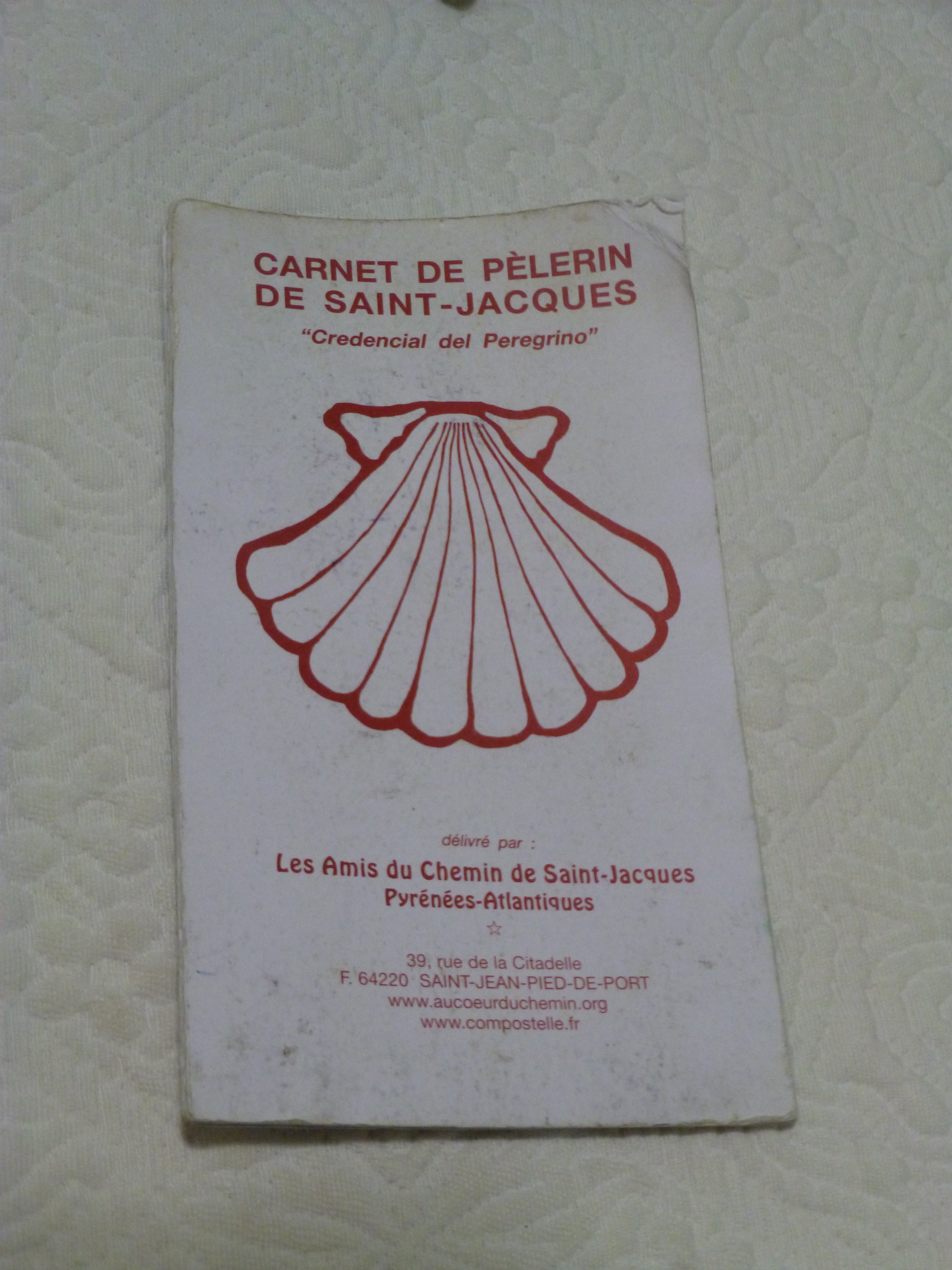
But I do find the cathedral, find the Pilgrim’s Office, show my credencial, full of stamps for the last nearly 800 km, and answer the questions about the reason for my Camino.  Religious?  Religious or Spiritual?  Cultural or Sport?  Hmmmmm.  I look at the man and say, “Well, I’m not religious at all, not even a believer, but it wasn’t for sport, either.”

He tries to help sort it out.  “Well, did you walk because you wanted reflective time, solitude time?”  “Yes, I did.  Definitely.”

“Well, then,” he says, “you can mark Religious or Spiritual.”  “Fine,” I say.  And he marks the spot, writes the Latin version of my name on the Compostela, also written in Latin and hands it to me.  It has been stamped, as has the credencial I have presented him.  Actually, it’s now two credencials, since I ran out of space about three towns ago and bought an extra one in Barbadelo for that reason.

Sleeping in Santiago the first two nights.

Sleeping in Santiago the first two nights.

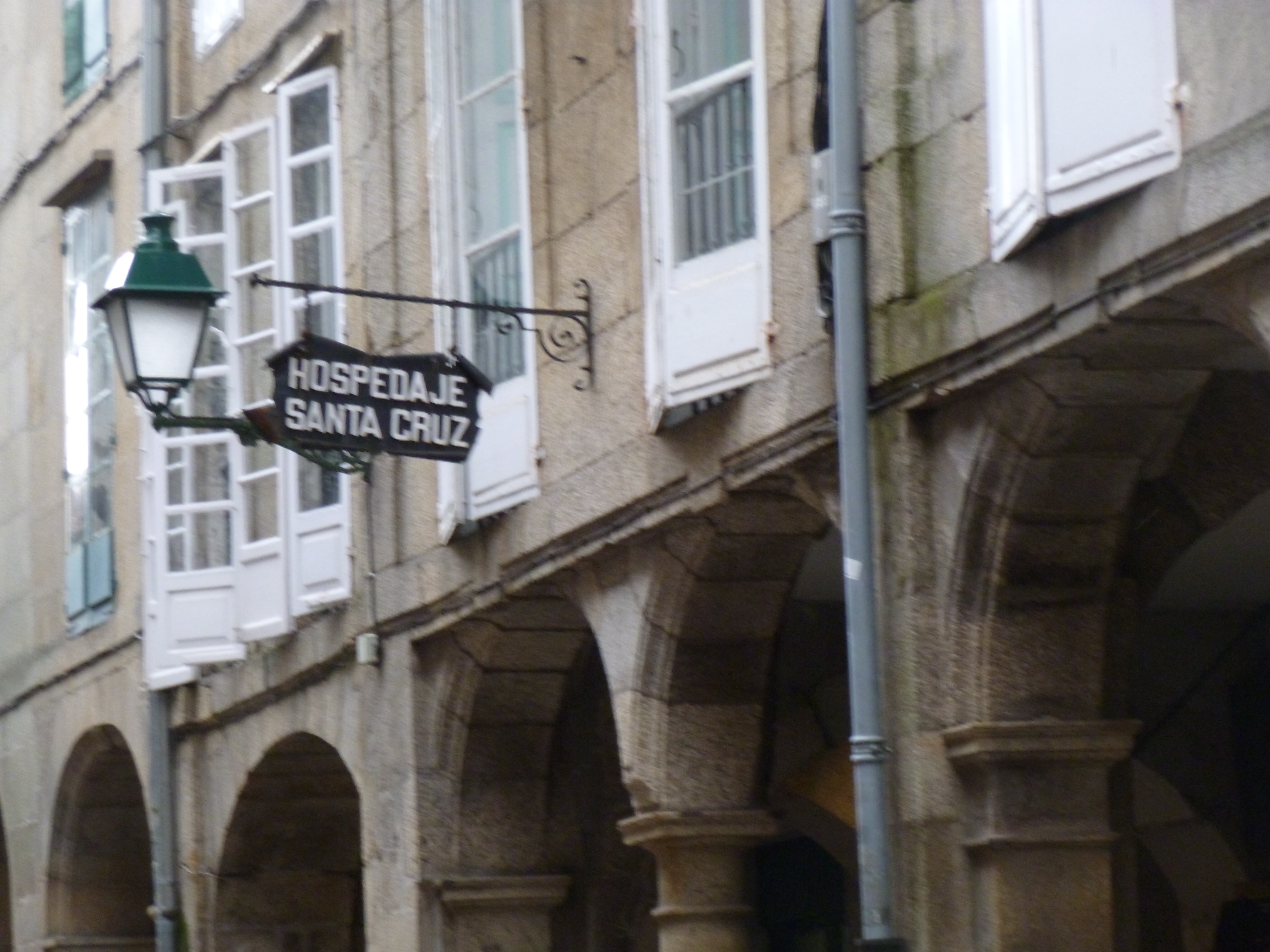
I buy a cardboard tube for my Compostela and walk out into the Rue de Vilar, where I again hear that familiar voice.  “Joannah!”  It is Ria, who has found my hotel, named Santa Cruz, right down the row from where I now stand.  She’s checked herself into a room, and is ready to lead my disheartened self to claim my reservation.  I tell her about the attempt at stealing my sticks.  No, the successful theft of the sticks, and my recovery of them.  She agrees that this incident, coupled with the yellow barriers on the torn-up road, are anticlimactic to what we have each experienced during the past six weeks.

We go to the hotel, I find the old man who runs the place, pay him, he settles me into a dumpy but private room next to Ria’s, and Ria leads me out, across the street to a nice bar and restaurant where we can get a drink.  I gather my bubble around me again.  We’ll text Christel, tell her where we are, and go to dinner.  Tomorrow at noon is another Pilgrim’s Mass, and perhaps they will swing the Botofumeiro, an enormous incense burner (again, see the movie, The Way, or my Facebook page) in honor of all of us.  Historically, the priests swung the Botofumeiro because the pilgrims smelled so bad, all congregated in the church together, but now, God invented showers, so the incense burner only swings on certain days, or if someone pays 300 Euro to see it, or on the whim of who knows who.  It is the one thing I anticipated eagerly as I planned my trip this past eighteen months.  I hope it swings.

When Christel joins us, we all discuss what turns out to be our common feeling . . . that the journey was what gave us joy, peace, discomfort and comfort, a sense of our own strength, not reaching our destination.  None of us is religious, not even spiritual, come to find out.  Maybe instead of what I used to call myself, a spiritual atheist, I’m more appropriately named an ethereal atheist.  Hence the fascination with mist!  And I remember a line from something long ago:

Perhaps it is better to travel hopefully than to arrive.

Posted in Miscellany | 5 Comments

Nights in Castañeda + Santa Irena = “Nearly There”

A fellow peregrina from Denver wrote in a post nearly a year ago (alacartespirit.com):

“In a pedestrian tunnel someone had written in green paint on the grey cement (my translation):  The Camino is NOW.  It´s not better in Compostela. 
 
“And, in an arrow pointing to the ground : Here.

“She mused, ‘I wonder how many speedy pilgrims saw it.’ ”

Well, I’m happy to say that I was paying attention to my surrounds, and I did see it.  The closer I get to Santiago de Compostela, the clearer I am that the Camino has always been NOW.  That was how I unconsciously greeted every walking day, and as I’ve said in these past posts, it’s surely how I’m feeling at this point.

So . . . October 11, 2013  It’s Friday, and we are on our way to Castañeda.  Ria and I begin  together, first having breakfast at our albergue, which doesn’t have eggs, but does have delicious, fresh croissants and marmalata.  Then the walk out of town.  We meet Karin and the three of us wind our way through the streets, looking for a farmacia so I can renew my supply of ibuprofen.  It’s too early, of course, and I doubt there will be big enough towns along the way to house a farmacia, though the locals must go somewhere.

But the towns greet us one by one, and we find ourselves each walking alone, adjusting to individual strides and thoughts.  I like traveling this way, with opportunities for company if I wish, and no insults thrown at anyone if I just want to be alone.  That will be something to get used to again on “re-entry”.  Not being able to just duck out of a conversation to function at my own pace.  So at one bar or another I see Ria or Ken or other familiar faces with no names, and more quickly than I can imagine, I’m in Boente, one town before my sleeping destination.  And there is Ken, still trying to figure out what he will do when he gets to Santiago.  He tries to tell me his possibilities, and I gently explain that I need to get to Castañeda for my room.  So he walks with me awhile, still agonizing over his choices.  Finally, he turns back, since he is sleeping in Boente, and I walk the next 2 km alone and in peace.

The albergue in Castañeda isn’t hard to find, since the town is barely there, and there are two places to stay, but only one albergue, private, sleeps six.  The Brierley book calls it Albergue Santiago, but I don’t really pay attention to what the sign says.  However, when I arrive, I see Ria and an Australian woman I’ve met before, but her name escapes me at the moment.  The owners, Mercedes and her husband are wonderful, and like their guests to feel as though they are staying with family.  They cook the dinner, and since I don’t want the usual Menu del Dia, Mercedes offers to make me a cheese omelet.  I have a bit of the heaping salad Ria and our friend share, and of course I do not miss the opportunity to have tarta de Santiago.

P1010896

Our little corner of the world in Castañeda

Ria and I are the only two people in our four-person bunk room, with the bathroom just outside in the hall, and our night is restful, uneventful.  In the morning we will go through the big town (population 7000) of Arzua, walk another 23 km and again settle into smaller village, Santa Irene,  just about 4 km. from the “on the page” destination of Arco o Pino (or Pedrouzo).  Face it.  We will be one day from Santiago.  No ignoring it now.

P1010898

Walking out of Castañeda

Saturday, October 12, 2013. This morning, Mercedes’ husband makes eggs for me, with a bit of toast and the requisite cafe con leche.  He is as kind as she is, and when she arrives, they are beaming, waving us off as though we were their children, though I’m older than either of them.  I thank them in my smiling Spanglitalian and we’re off again.

Ria says, “See you at the next bar,” as usual, and indeed, as I get to Arzua, into the middle of nothing like a pretty place, there she is at a table on the sidewalk outside a large bar and cafe.  She is just leaving, as usual, and I get my juice, croissant, and water, so I can take a break.  A small child’s giggles breaks me out of my thought cloud.  I look across a fairly busy main street to see a father pushing his baby in a stroller.  From the sound of the giggles, the baby is perhaps almost a year old.  Who can tell, really, but no toddler, no infant.

The father fakes a loud and drawn-out sneeze.  “Ah . . . Ah . . . AH . . . AHHH . . . CHOOOO!”  And peals of laughter come from the stroller.  Over and over the father plays this game with the child as they move across my line of vision.  Then the father stops for a moment, and the baby waits.  Hearing nothing, the baby tries . . . “ah . . . ah . . . ah . . .  . . .” and stops.  The father finishes with, “CHOOOO!!!”  Giggles and giggles.  It isn’t the camino for this dad and his child.  It’s real life, day to day.  I have loved watching fathers and their children on the occasions in which the size of the town allows me that opportunity.  Children on Daddy’s shoulders, or walking hand in hand, or in strollers like this one.  All over the world, there are children who are loved and cared for, no matter how messed up the world in general might be.

I must move on, and I see a Farmacia sign across the road, down a block.  The time is 10:49 a.m.  The sign on the Farmacia’s door says that Saturday hours begin at 10:00.  But the door is locked.  I sigh.  Of course.  Glad I’m not bleeding.  A helpful woman comes out and in her Spanish lets me know that if I just go around this plaza and down the street, there is another Farmacia and it is open.  This one is closed for a holiday, though I have no idea what that means and why the other one won’t be closed as well.  She kindly insists it will be open.

So I go.  I see it down the street, past the Plaza, but as I approach it I can see that it too is closed.  The woman waves to me from across the street, and I shake my head and say, “Cerado.”   She gestures in an animated fashion, but she can’t change the fact that the Farmacia is just not open.  So I turn, retrace my steps enough to find my yellow arrows, and walk out of town.  My leg pain and any headache I might have later on in the day will surely be gone before I find an open Farmacia.

Again, the walk is easy and uneventful, with an uphill just before I get to Santa Irene.  Other than a glimpse of Ria now and then, and also of Karin and her young German fellow, I am alone, or passed by relative strangers.  Sleepy villages with names like Raido, Cortobe, Boavista, Ras, Oxen are on my path, but most of them are a few stone houses, the requisite chickens, dogs and cats, and the farms.

John Deere must be expensive here, too!

John Deere must be expensive here, too!

I turned a corner to see this:  a typical ancient stone building, with a new (and very expensive) piece of farm equipment parked next to it.  I wonder how these people do it?  This is one of the smaller pieces of big equipment I’ve seen, and it hasn’t occurred to me that the money has to come from somewhere I’m not seeing, but this vision brought it home, somehow.

Not an isolated sight, as we pilgrims move out of the way for huge hay stackers coming along the road, or backhoes or tractors.  A sort of visual oxymoron.

I reach Santa Irene, where I have my reservation for a room, and wherevRia will most likely show up.  I’m glad I have Brierley’s book with a little photo of where I am to stay, because there really isn’t a good sign outside.  However, when I ring the bell and the young woman of the house lets me in, I am taken aback.  An actual living room, with fireplace, classical music, walnut furniture, family photos, like a real home.  I ask whether a German woman named Ria is here, and the young woman says no.  She shows me to my bed, the only single bed, in an alcove of the bunk room, no less, and I drop my pack.  I follow her back out to the living room and there is Ria, coming in from the garden in the back of the house.  She was relaxing, waiting for me, before she registered.  I sign in, give the young woman my Credencial to stamp, pay for the room and 13 Euro for the dinner.  It seems like a lot for dinner, but when the soup, the salad, the roast and gravy with delicious potatoes, and a homemade dessert show up, I’m grateful.

However, in the two hours before dinner, Ria and I sit in front of the glass-fronted wood stove, listening to the music, feeling as though we’ve been transported to some other civilized world.  Other trekkers drift in and sit down, talking quietly as the mood of the room encourages.  I do some writing, in my journal and on the computer, call Ashley on GoogleVoice, since I have both a good connection and a fairly quiet room, and generally relax.

Dinner for thirteen of us, Ken included, three Italians I’ve never met before, several other Germans, Ria and myself.  The young woman explains to us that tomorrow, Sunday, this Albergue will be closed, so we must let ourselves out the garden door and gate in the morning, and walk another 2 km. to the next village for breakfast.

I split a bottle of wine with Ken, the German couple to my right, and one of the Italian men.  Then it’s a late shower for me and I join the rest of the residents for a good sleep.  Tomorrow I will walk into Santiago de Compostela.

Posted in Miscellany | 3 Comments

Gettin’ Some Respect! And Getting Too Close . . .

P1010854

Walking out of Portomarin

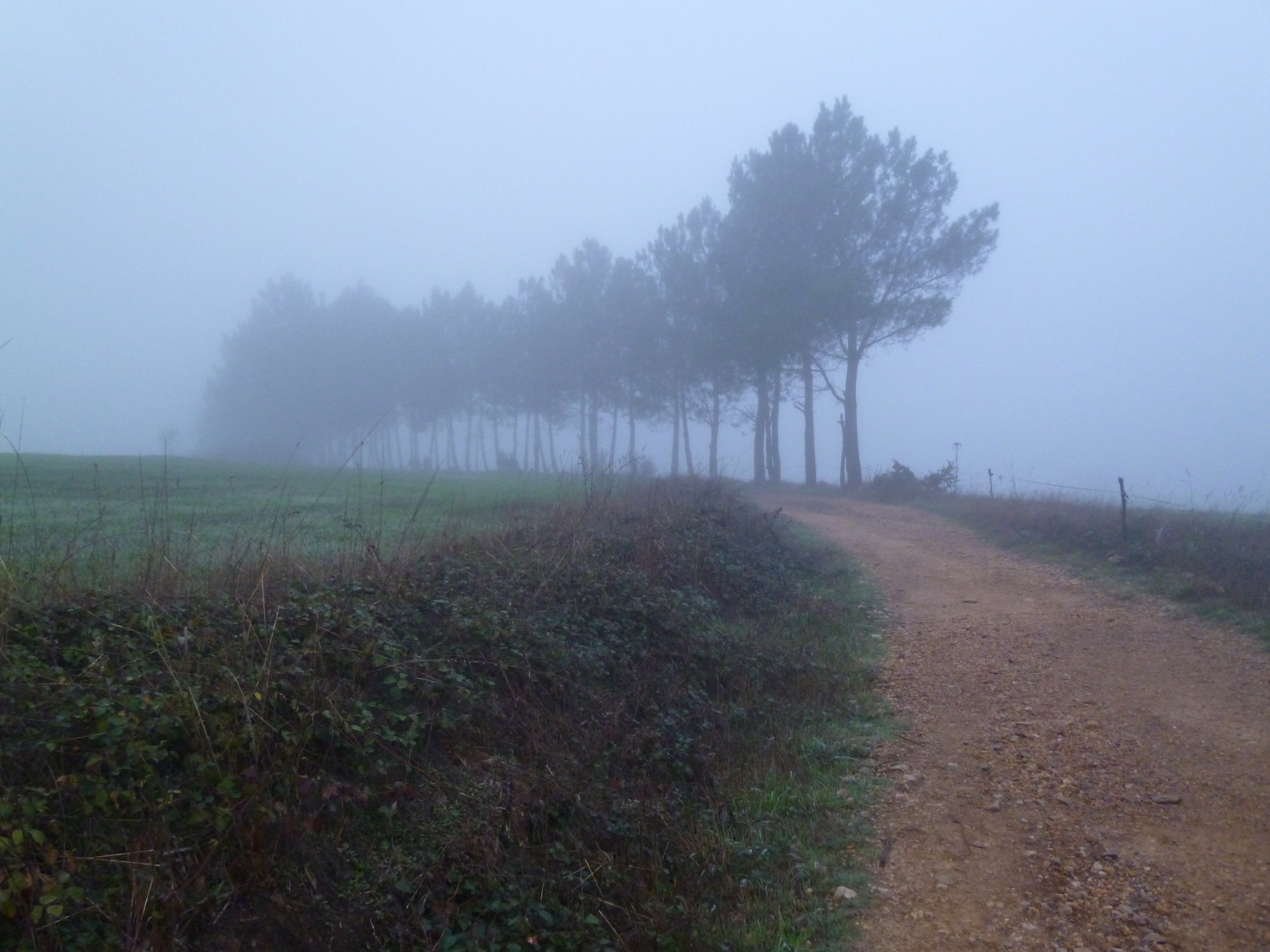
October 10, 2013.  Out of Portomarin into the misty woods again, though there is a bit of “town outskirts” before we get to the countryside.  After about an hour, I can feel the wet from my hat and my hair running down my neck.  Gives “Play Misty Again” a whole new (and much more comforting) meaning.  And though I experience this misty environment anew every day, to someone reading, it must sound like Bill Murray and Groundhog Day have been transported to Galicia.  “All right, already . . . stop with the mist stories!  I need a towel just reading . . . .“  Okay, I’ll stop.  But just because you already know what it’s like, doesn’t mean the magic goes away for the person who is living it.

The birds are especially vocal today for some reason, or maybe I’m just noticing more.  I try to see where they are, especially two sets that seem to be conversing, but all I hear is “CAW.  CAW.  CAW.” answered by “W O E!  Yup yup yup yup yup . . . “  Kent and Judy, I need your birding ears.  Even when I stop to listen and look toward the sound of each, I cannot see the birds, so I have no description to offer.

Late morning, I stop at a little roadside building, not even in the approaching village yet, and see Ria and Karin sitting at a table.  Karin is a doctor from Germany, and has been quite excited to discover that I am from Colorado.  Her father was apparently interred in a Colorado POW camp during or after World War II, and she has memories of her father’s stories about the beauty of the Rocky Mountains and the fair treatment he and his fellow prisoners received at the hands of the US soldiers.

Last night while we were all sitting in the Placa in Portomarin, she began to tell me her story about her father.  She asked me whether I know where the prison camps were during that time, and I have no idea.  I’ve read about Japanese-Americans being contained (a nice word for it, isn’t it?) in southern Colorado, but can’t help her regarding her father’s experience.  But I had offered to make some inquiries among the history professors I know from CSU and you would have thought I’d presented her with a winning lottery ticket.

Karin and Ria on the road, eating nuts and fruits!

Karin and Ria on the road, eating nuts and fruits!

Today when I come upon Ria and Karin, Ria gives me her warm smile and wave, but Karin jumps up from her seat and comes to give me a big hug.  She begins talking about her father again, and says that since he is dead, she can’t ask him these questions herself.  But she is still clearly nearly obsessed with getting any link his history, and I again reassure her that I will make some calls when I get back home.  We exchange our names and e-mail information, and they offer me the special fare that is sold in this little store.  Freshly roasted nuts of all sorts and small bags of trail mix with only dried fruit and shaved coconut, hand mixed.  I purchase a bag of almonds and a bag of the fruit mix, though I very much dislike coconut.  But these snacks will be a diversion from bocadillos for my meals today.

P1010872

Today, the sunflowers bow down to me . . .

The three of us set off together like the Musketeers, but soon I adopt my slow saunter and they march heartily ahead of me.  They will also part company at some point and I might meet Ria in Palas de Rei, where I have my reservation next to the church on the near edge of town.  We have had our socializing but each of us has come alone, and that’s our preference.  I am back on “quiet” mode.  And today, the sunflowers take their turn bowing to me!  They are the first to do so, and I am honored.

In Eirexe I stop at a casa/restaurant, and order a plate of half ham and half cheese, and pack it up to go.  I’m learning how to avoid the bread.  Just ask them not to bring it.  The horses I’ve seen on the trail are now in a meadow on the Casa property, and a young woman at the table next to me gets up to go for a short ride.  Her mother is encouraging her, saying, “Oh, wait until we tell DADDY!” and other sweet-ums like that, though the daughter is in her early twenties, I would guess. The young woman looks familiar, but I don’t remember exchanging names or information along the way.  I overhear a bit of conversation about being gluten-intolerant, and then I tune it out.

I still have 8 km to go to get to Palas de Rei.  Just a short distance after leaving the Casa/restaurant, I pass a very nice albergue and bar with a large, comfortable looking patio.  Sitting outside at one of the tables, drinking a glass of wine in the sun, is a very good looking, very robust older Spanish man.  I pass him, he points in the direction I am going and lifts his eyebrows.  I nod.  He returns the nod approvingly and pumps his fist repeatedly in the air, beaming admirably at me.  I beam inside, proud of myself and his acknowledgment.

I had another triumphant moment such as this one, back in the Meseta days.  Finally walking into Mansilla after more than a week and about 160 km of sand, dust, and wheat, I entered the old city under an imposing stone arch.  Sweaty, relieved, peaceful, having listened to John Mayer’s “Say (What You Need To Say)” over and over for the past hour, I begin to look for the municipal albergue.  A local man comes toward me, looking at me closely.  He has on work shirt and jeans, work boots.  Perhaps about fifty years old, if I had to guess.  Dark hair with streaks of grey in it.  He stops, points to me, my backpack, my hiking sticks, carefully, but not in any sort of threatening way.  He then thumps his chest with his fist and says, “Cour-AGE!”  That’s a deep, booming voice pronouncing it “Cour-AHGH!”  Giving me a beaming look of admiration, he bows slightly and continues past me.  Makes me want to cheer!  But I just smile all the way down the street to the muni albergue.

I’m not sure which was a higher compliment.  The one from this man in Mansilla, who is not walking, or the one from the man who decided to call it a day, while obviously I have more steam in me (or am more stupid . . . ).  Either way, it’s nothing I ever imagined for myself.

Basking in this last interaction, I hear someone come up behind me and say hello.  She appears to recognize me, and reminds me that we spoke briefly two days ago, out of Sarria/Barbadelos when she and her daughter were just beginning.  I recognize the daughter as the one who was just on the horse in Eirexe, gluten-intolerant.  But I can’t place where else I’ve seen them.

The woman – Cathy, she says – reminds me about a tiny altar to the Virgin Mary of something or other, created in a stone wall, with miniature flower pots filled with dried lavender.  I do remember that.  And I remember the short conversation, too.  She was clearly Catholic, for which she will forever be filed among my Camino personnel as Catholic Cathy, of course.  At that first encounter, she referenced a story about a miracle having to do with that shrine.  I said, “Well, I don’t believe in any of that stuff  Gave it up with Santa Claus and the Tooth Fairy.“

“Well, you’re here, so you must believe in something,” she said presumptuously.  I hate this kind of comment.  So I quipped, “Yes, I believe in myself.  Buen Camino.” And went on my way.  Now here she is again, two days later, with her lovely, faith-filled daughter Bridget.  Needless to say I was not anxious to continue in that line, but this wasn’t my day.

She begins by asking me what I gave up, and when.  I say I had had a good Catholic education, complete with all the indoctrinations, thirteen years of it, but became a complete non-believer slowly and then quickly, by my mid-twenties.  She asks for specifics, and as I give her some of what I consider to be the ridiculous contradictions I was taught, heavy on the mortal sins, which then changed to NOT mortal sins, or perhaps not so bad – eating meat on Friday, going to my father’s church after I attended Catholic mass, etc., she counters everything I say with, “Well, THAT wasn’t right . . . those priests told you the wrong things . . . “   She cites something called Cathegesis, a word I had never heard, which she tries to explain, but it is a quietly dreadful way for me to finish my walk, actually.  Friendly, but full of dread for me.  Her daughter attempts to say a few things, and Cathy sweetly interrupts, while I turn my attention to Bridget and encourage her to finish her sentences.

I won’t go much further here, but to say that Cathy interjected at least half a dozen times:  “Well, I’m not selling anything, and I know you’re not buying, but . . . “  Somehow, it seemed she didn’t know how NOT to sell.  But I’m not buying, she is right about that.

Just as the specific subject matter has become divorce vs. the Church’s “dissolution of marriage/annulment”, another of what I consider to be the Church’s hypocrisy,  I look up to see a stone church, nearly in our path.  Cathy says, “Oh, I want to get a stamp for my credencial at this church. “  I think I’ll just take this opportunity to slip away, and begin to walk past the church when I hear my name called again, with the now recognizable exuberance that is Ria.  I turn around and there she is.

“Aren’t you staying at Albergue San Marcos?” she asks.  I nod.  “Right next to the church, yes?”  I nod again.  She points, and I realize that I’ve spent the last nearly two hours with Catholic Cathy and her Cathegesis, as well as her daughter, who has been trying to explain that once you know your best friend is a real PERSON (Jesus Christ, she means . . . )  . . . I give a wave in the direction of the church and turn right, up the steps to my night’s bed.  Ria follows as I roll my eyes.  Saved by the German!

As a postscript, when Ria and I meet Karin for dinner, I summarize my late afternoon experience, and immediately see Cathy and Bridget coming into the restaurant.  Bridget walks up and gives me a very warm hug.  Guess she appreciated my interest in hearing her entire comments, despite her mother’s not-unkind interruptions.  Cathy gives a little laughing apology for taking up my afternoon, and promises that if we meet again, we will discuss something else.  This is the last time I see her.

Tonight I have to acknowledge that there is no more delusion about our distance from Santiago de Compostela.  We’re a bit less than 70 km away, and soon we will begin to hit the Santiago ‘burbs.  I don’t look forward to it.  In three days we will be there, together or separately, unless I begin to do a slow crawl on my stomach to make it last longer.  And my shin splints seem to have healed themselves, so I won’t have that as an excuse to go      s-l-o-w-l-y.  I have given a bit of thought to the fact that I want to walk “in” alone, though surely will connect with my Camino buddies once I arrive.  Christel is half a day ahead of us, Ria will be faster-paced than I.  I haven’t seen Yves and Janice, Larry or the other Neal (notice it’s even spelled differently than “my” Neil) for awhile, and I think Matthé and Elma from the Netherlands are far ahead and probably gone by now, but there will be mobs of people, including all those who started at Sarria.

P1010882

Someone with an angei-wing pen decorates our signs as we move toward Santiago de Compostela

So we discuss where we’ll stay tomorrow, putting thoughts of our final day aside for now.  I think I can make it to Arzua, a much bigger town, but Ria would like to stop a bit sooner, in barely-a-village called Castañeda, 23 km from here, She’s too young to have read Carlos Castañeda and his magic peyote books, but she’s heard about them from her brother and they always intrigued her.  Though the books were set in the American Southwest, she has wanted to stay in this same-name-town just to say she did.  We agree, I call the private facility, imaginatively called Albergue Castañeda, and reserve two lower beds for tomorrow.  Then we bid one another goodnight, from our doorways at each end of a long hallway in the Albergue San Marcos, and call it a night.

Posted in Miscellany | 2 Comments

Mist, Rabbit Holes, and Leprechauns

P1010832

Do the spiders have to towel off after they spin these webs?

Wednesday, October 9, 2013.  I am on a Wizard’s Walk, full of indescribably simple, mystical, physical beauty.  Is it the season, with autumn coming on or is it Galicia?  I think it is the latter.

Mist collects on the trees above me, and green, emerald green, surrounds the rocky path at my feet.   I reach up to feel the same mist dripping from the ends of my hair.  Even the spider webs suspended from branches and leaves have misty dew clinging to them, dripping from them.

Looking for Leprechauns

Looking for Leprechauns

Leaving the Casa/Albergue Barbadelo after a full breakfast with eggs for a change was a real treat.  My fellow inhabitants and I stream out of the property, just as the pilgrims who stayed in Sarria are coming by.  I encourage them to stop for breakfast, because if they are here now, they began very early and nothing would have been open an hour ago where they were.  Many of them pay attention to how inviting the place looks, and head up to “our” restaurant. As they turn in, we enter the Leprechaun’s territory.  At least that is how it seems.  Single trees catch my attention, wiggly and eerie against the low-lying clouds.

In Galicia . . . (as over the Pyrenees) cows are interspersed along the way, though over the Pyrenees the fields were vast, and now, as I’ve written previously, they are small, comfortable, contained mom and pop meadows.  I can hear the clang of the cow-bells before I round a corner, and as I approach, the volume increases . . . their clappers clanging in the old-fashioned iron bells around their necks, like the ones that were in the children’s books I used to read to the kids.  What must clanging do to their serenity?  Maybe cows don’t know the meaning of the words “clanging” and “serenity”.  Maybe phones and internet are our clappers.  The cows (and the sheep, some of whom have bells as well) seem serene enough anyway.  A clapper lullaby for them?

My leg is throbbing but I’m walking, and I think it will get better as I go.  I seem to get a bit more relief each day.  Good sign. Today, I spend most of my 20 km walk marveling at the numerous shades of green and the rising mist.  When the sky can show her bluest color by mid-morning, all the colors intensify.  I walk in and out of literally eighteen little villages, most of which are just a sparse clump of stone houses, dogs, chickens, cats, and diligent farmers ignoring the parade of pilgrims that goes through their hamlets each day.  It is hypnotizing, joyous.  I think only about where I am at the moment.  Ram Dass’ instruction to BE HERE NOW.  It’s easy to do just that when I am in this environment, though I’m not sure I’d want to live here.  What do people do in a village of half a dozen stone structures, a few chickens, and most of the residents over eighty years old, if the ones I’ve seen are any indication?

P1010880

Ria, my new German friend

Occasionally I see a town with a bar, and often  I hear my name.  When I look up, I see Ria calling, “JOANNAH!” and she gives me a hearty wave.  She is usually just finishing her coffee or bocadilla, but she stays to talk a bit.  I like this woman very much. She has a  no- nonsense style, but with a solid sense of humor, and a deep heart.  Though she’s nearly twenty years younger than I, we agree that age differences at this stage of our lives don’t matter much at all.  We get to know one another little bit by little bit, since that first meeting in Foncebadon at dinner, and I sense that she, like Christel and Charlotte, will be someone I won’t forget after this Camino is finished.  We end our little visit and she gathers her things, saying, “See you at the next bar!”

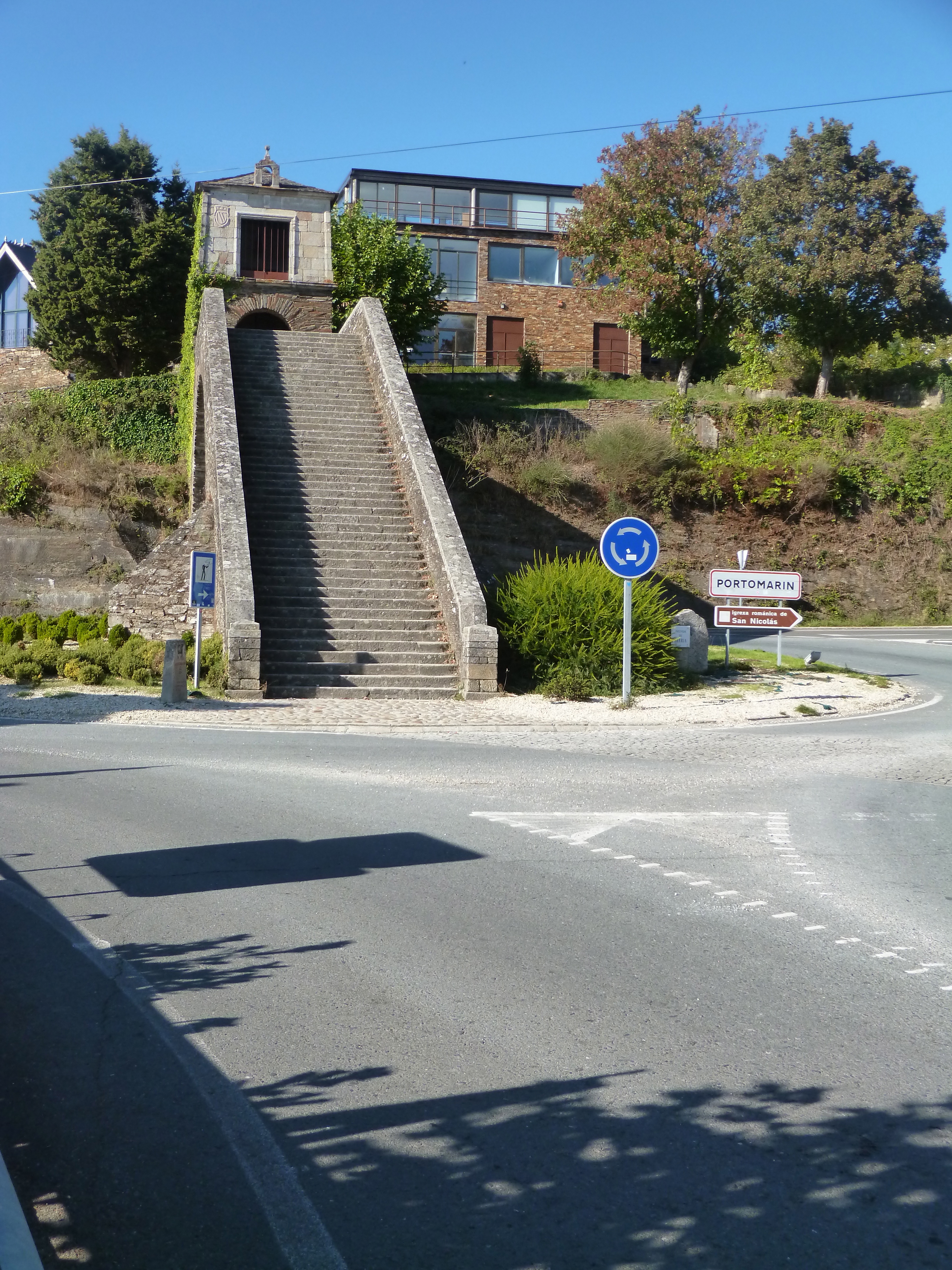
The approach to Portomarin

The approach to Portomarin

As I move across the day and across the path toward Portomarin, my destination for tonight, I see the town come into sight.  A lovely bridge over a river that has seen more water than is in it now, and then another dose of a Sarria welcome, with a full set of stairs in order to get to the town.  The stairs aren’t QUITE as long, but still . . . is this going to be a daily test?

Once up the steps, I can see the town unfolding, with walkers turning this way and that as they approach their albergue.  Mine is somewhere past the main square so I’m still looking.  I hear my name again, and there, at a bar with three other women and four glasses of wine is Ria.  She beams when she says, “Tonight I got my own room!  Splurge in a pension!”

I congratulate her and say I’ll return to join all of them as soon as I check in.  My albergue tonight is run by a very sweet middle-aged woman.  I was going to say “young” woman, but I suspect she’s in her 40’s at least, and to me that is young.  Her English is almost non-existent, but we make do with our Spanglish-talian.  There is a kitchen here, so I make a note to stop by a supermercato after my glass of wine with Ria and her friends.  I’m longing for a plate of good tomatoes with salt, and perhaps another nectarine.

Sitting at the table outside the bar with Ria, I meet Barbara and Karin, both from Germany, people Ria has met along the path as well.  Poor Ken from Northern England pulls up a chair, searching again for someone who will start tomorrow’s walk at the same time he wants to start.  He likes to get an early beginning, but doesn’t like to do it alone, he says, because he doesn’t want to get lost in the dark, and doesn’t have a headlamp.

I will hear this same explanation from him every time I see him from now until we reach Santiago.  For this moment, I’m ignoring that city, and focus on where I will walk tomorrow.  Palas de Rei?  25 kilometers from Portomarin.  A respectable distance for a day’s journey.  And as it turns out, my albergue manager has an excellent recommendation in Palas de Rei, and she calls to make sure I have a reservation in a bottom bunk.  All of this after I finish my wine.  And get my tomatoes from the store.  I see Ken again in the supermercato, coming around a corner toward me and he says, “I’m not stalking ya, really.”  He looks sheepish, and I see that he is still a bit lonely.  Waving I take my purchases back to the albergue and into the kitchen.   I see some young people cooking up a storm in the kitchen.  Some sort of spicy pasta, with fresh garlic and peppers, and roasted chestnuts (though not in the pasta.)

I meet them briefly, but will see them again.  Tomer, from Israel, who has been living in New York and Vermont for the past six years, but now is having a visa extension problem so he’s walking.  Laura and Luis, just friends, she says, whom I’ve seen here and there along the trail today.  She has worked in Bologna, I think, and he is an infectious disease physician.  They all look so young . . . I cut up the tomatoes, a full plate of them, sprinkle them generously with salt, and gobble them up, cleaning up quickly and leaving the young people to their more complicated dinner preparation and exuberant discussion.

My lodging for tomorrow night is secure, and tonight’s is quite comfortable, though I’m about six feet from the raucous conversation in the kitchen.  Nevertheless,  I slather my leg with Arnica cream, and slip into my bunk.  I feel so contented, and it’s time for the long sleep.

Posted in Miscellany | 4 Comments

It’s More Than Just The Last Few Days . . .

P1010747

Ancient chestnut tree trunk in Galicia

Tuesday, October 8, 2013.   I’ve been in Triacastela for two nights, one night in a bunk bed in the albergue and the second night in a private single room, to help my shin splints heal.  I thought the good rest would surely work, but apparently my left leg has other plans.  It wants to punish itself or me.  But there is nothing for it but to walk.  Before I head out the door of the Albergue, I look around to see if Bern, the man with the skin infection in his leg and foot, is out of his private room, but I don’t see him, and his door is closed.  I will trust that he is being well-taken care of, and that his wife will make sure he gets safely home very soon.

After today’s walk through Sarria from Triacastela, I will be 62 miles (100 kilometers) from Santiago and I don’t expect anything to get in the way of getting my journey.  But that brings me to a new issue.

For the past five and a half weeks, I have walked daily, with my pack or with half a pack, experimenting with the various shoes and sandals I have, sending back (or sending on) what doesn’t work, meeting people along the way, eating more bread so far than I’ve eaten in a year.  I have gotten over any false or true modesty about bush bathrooms.  I have said “Buen Camino” more times than I care to think about, wishing that I had a dollar for every time I heard or said that phrase, and I could have paid for this entire trip already.  I have slept in rooms with over 100 people and in rooms with four or six.  Occasionally I take a rest day in a private room with my own bath, no matter how monastic the furnishings.  Shower adaptation has become a skill for which I expect a certificate in my next life.  I actually don’t mind sleeping in a slot, even if it’s on the top bunk, though generally I prefer the “baja” arrangement, because I am so tired at the end of the day.

Throughout the weeks, that “tired” has gone from bone-numbing exhaustion to a rather energizing exhaustion, though that makes no sense generally.  The “accomplished exhaustion” might be a better phrase.  At the end of a good day of hard work and long walking, I expect to be tired, in order to sleep well so I can wake up the next day and do it all again.

I look at menus and think, “If I have to see “jamon” or “lomo” one more time, I think I’ll throw up or slit my wrists.”  I don’t of course, because at least on the Menu del Dia, there are only so many choices, and one has to eat..  I have learned to choose among the options without “ham” overload.  A salad or soup at least every couple of days breaks the hamonotony.  Occasionally, I find eggs for breakfast, not dinner.  More often now that I’ve learned to ask for them.

In addition, I have learned to fairly effectively reserve a room in my destination town each day, in Spanish, and make myself understood.  Granted, my “Spanish” is some combination of pidgen Span-talian, but I seem to get the job done.  We have all learned that with a few exceptions (and there are always those) the owners and staff at the endless bars along the Camino de Santiago respect us, want to help us, and know that without them, we would not be nourished on our journey.  The thing is that not once have I thought, “I only have X number of days before I get to Santiago.  Before I reach my goal.”  Before I get to “the end”.  But now I am getting close, and find myself trying to shake free of the “goal” thought that is creeping in.

On Day 38, it is nearly unavoidable to look at the map pages for the next five or six days and not see SANTIAGO DE COMPOSTELA at the end of the last one.  It is impossible to plan reasonable mileage days and not know that at some point very soon I will have “reached the goal”.  But “the goal” was to walk the Camino.  Yes, that also means getting to Santiago.  However, the old “life is a journey, not a destination”, at least for me, has become very literal in this case.  Hard to explain, since people at home (and I would be one of them, I suppose, if someone else were doing this) will wait for the news that I “got there”.

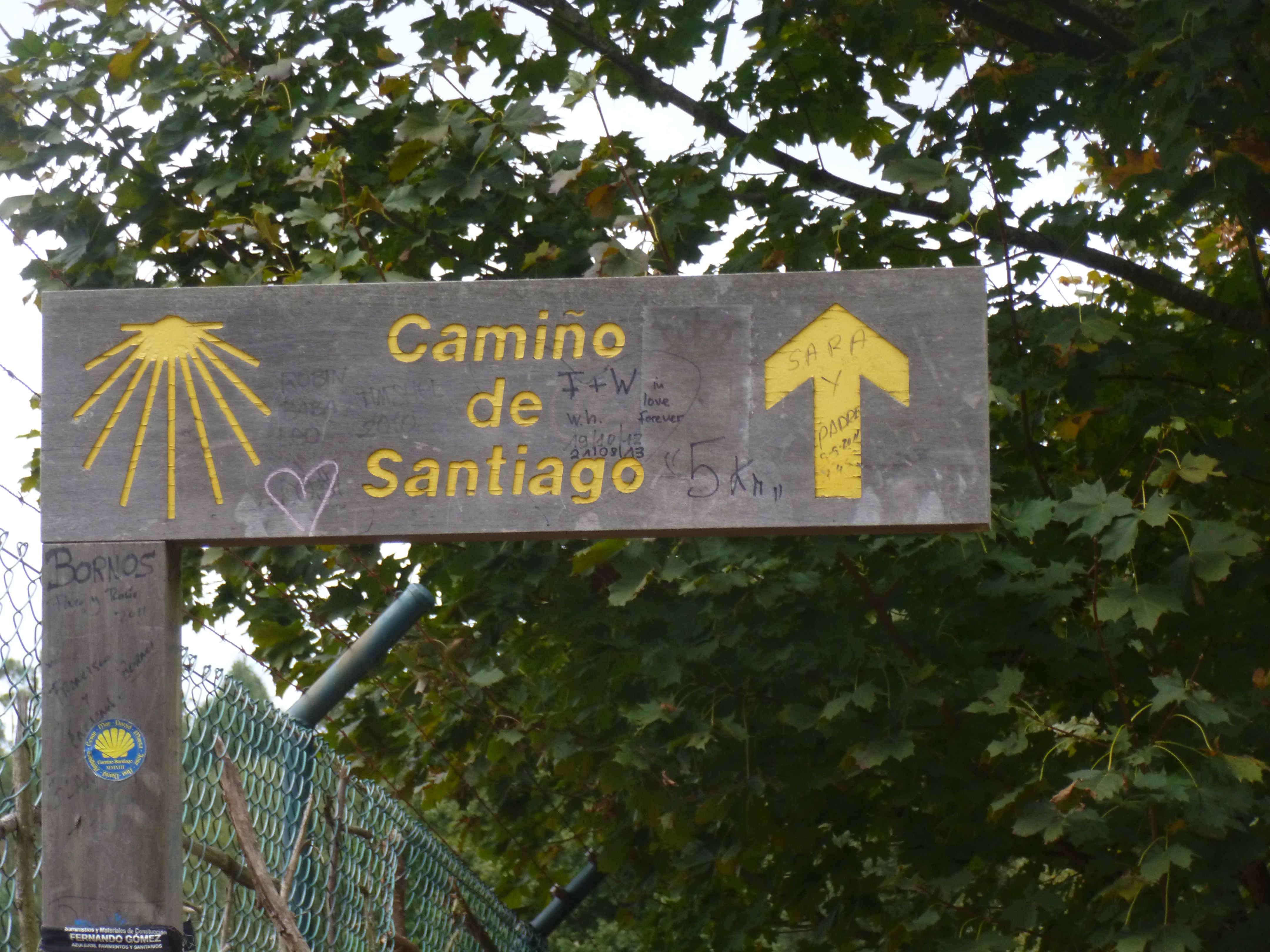
The more I write this, the less I am making myself understood, I fear.  Even to me.  But I feel like I don’t want to know that I’m close to getting “there”.  I want the comfort of thinking I can get up every morning, don my boots, shorts, shirt, little Sherpani pocket-purse (again, thank you, Santa Neil!) and backpack, grab my sticks and go, with only the next day’s map in my consciousness.  And I know that won’t last much longer.  I am still trying to avoid the daily acknowledgment, but it will get harder and harder to ignore those kilometer signs every 1/2 km, ticking off the distance to Santiago, Point Zero.

With that in mind, and in my effort to keep it off my mind, I begin today’s section of the journey.  Again today there are two ways out of the beginning town.  One goes to Samos, an extra 7 km out of the way and into more mountains than the other, to San Xil.  I choose the latter.  Under other circumstances, especially because of my thoughts written above, I might choose Samos.  But I have a bad leg.  7 km. of mountain up and down with shin splints seems like a bad idea.  I suppose if I really consciously wanted to drag things out, I would do this 5 km at a time, and let it take until Halloween.  Stroll into Santiago in some sort of costume.  But I will walk through San Xil and on through Sarria to Barbadelo.  See what it’s like there.

Sarria is the town at which short-term walkers MUST begin in order to fulfull the minimum requirement for a compostela, the certificate one gets in Santiago for completing the Camino.  So there will be a large influx of new (and fresh) peregrinos as I walk through Sarria.  I decided to walk past Sarria, because I’m trying to stay away from the “end of this page” schedule Brierley and others set as a reasonable goal.  The smaller towns before or after those “set-page” cities tend to have fewer (or perhaps just different) people than the bigger places.  They often have very nice surprises in the form of smaller private albergues, and I’ve come upon some favorites in these mid-page towns and villages.  So today my destination is Barbadelo and I’m going to take it slowly.  Having a reservation makes it easier to take my time, with no fear that I’ll get to the only place in a village and there will be “no room at the inn.”

I think this is the right way.

I think this is the right way.

It is dark again as I leave Triacastela and I join other walkers who are trying to be sure they are walking the option they’ve chosen, rather than the one they mistakenly follow.  “The woods are lovely dark and deep . . . ”  and once I see a sign for direction San Xil, I relax into my walking pace.  More than half a dozen  little spots along the way will afford me the opportunity to refuel my water bottles and my cafe con leche fix, with other no-service tiny hamlets scattered among the ones with any evidence of commerce.

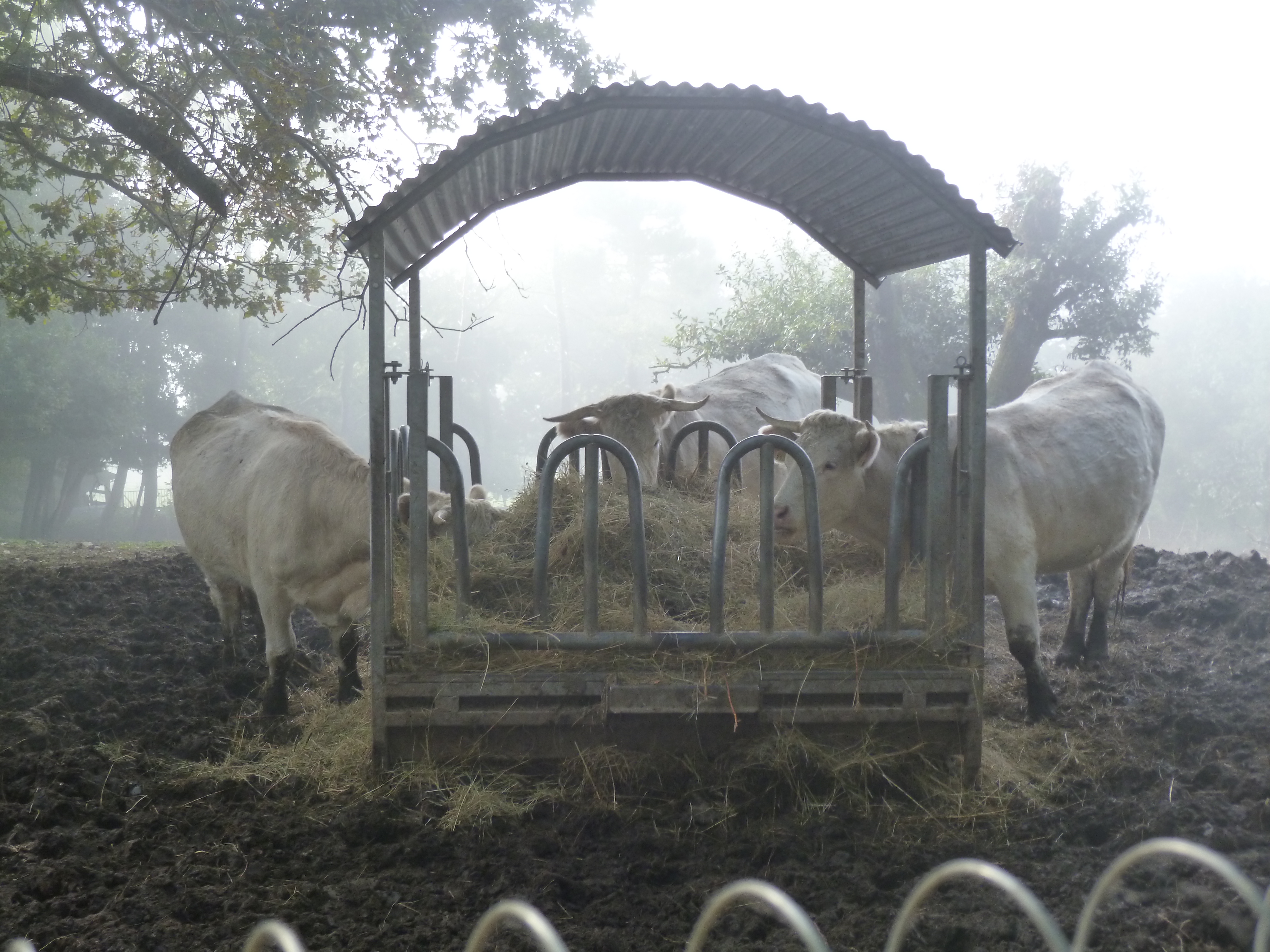
The cows know where their breakfast bars is!

The cows know where their breakfast bar is!

The mist is rising slowly through the mountains, through sheep meadows, through hay-cribs.   These cows have their own breakfast bar, a type I have not seen before.  Very fancy and efficient, I’d say.  The walk is an easy one, though the elevation map indicates a breast-like bump from Triacastela to Furela, a 300 meter climb.  Nice and gradual, up and down.  And I amble through it, along with the small streams of other walkers.  Today the faces are less familiar, perhaps because when I choose to spend an extra day somewhere, the familiar walkers are mostly past me by the time I begin again.

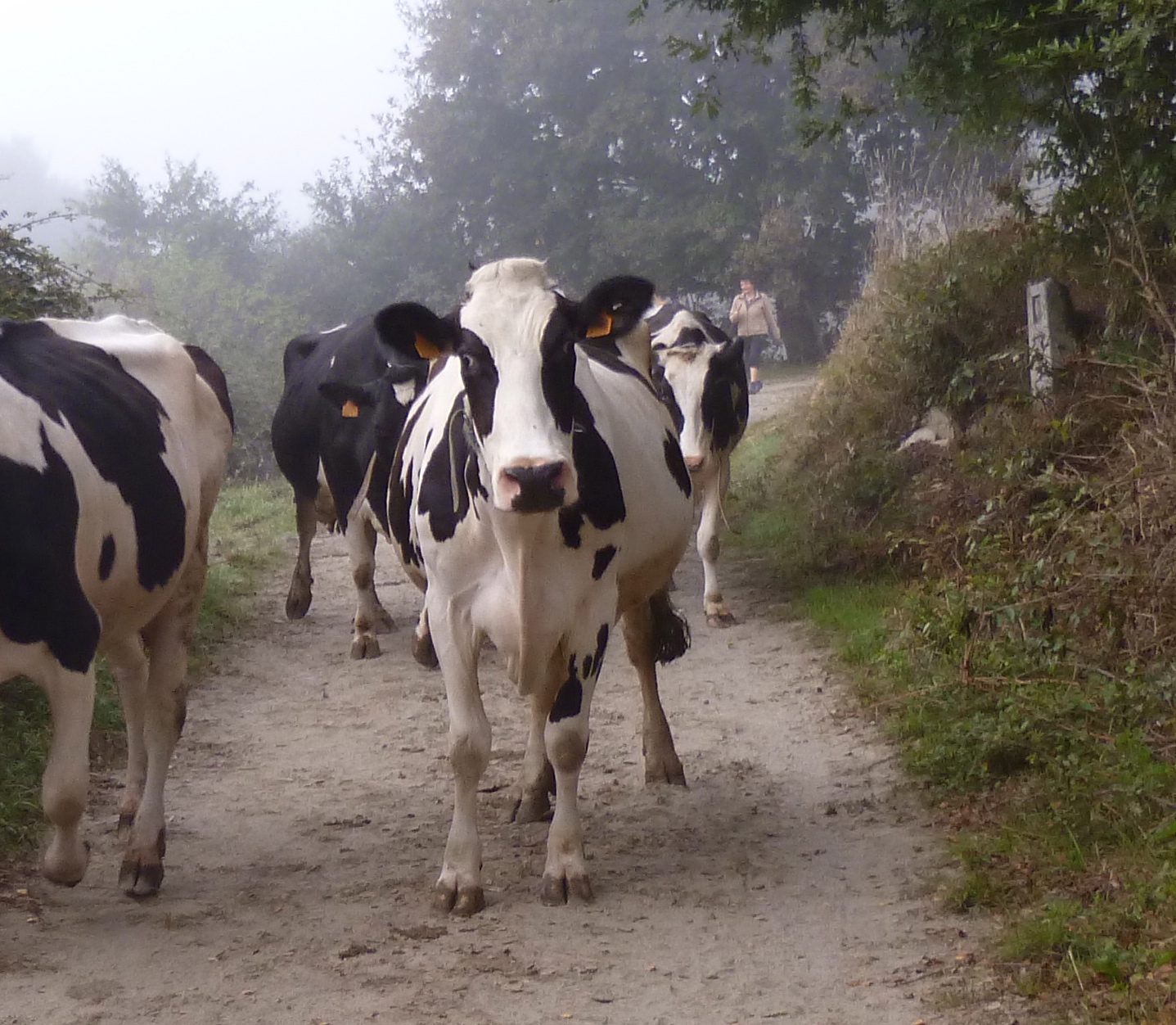
MOO!  And what are YOOOOU doing on my road??

MOO! And what are YOOOOU doing on my road??

I turn a corner and there is traffic coming toward me.  Black and white traffic, and one of the “vehicles” stops and stares right at me. I stop and so does she.  We stare at one another for a minute or two.  Then she decides I’m nothin’ much, and ambles around me and past, with her black and white buddies.  These are the surprises I like most.  How many photos do I have of a cow or a bull or a horse or a sheep looking directly at me, asking what in the world I am doing messing up their serenity on any given day.

Is this the same day I see an old woman in a farm yard, sleeping against her shepherding hook, with four lambs lying down in a semi-circle at her feet ?  Certainly these scenes are intermittent in this land of Galician farms.

The air is thick with the smell of vinegar, wet hay, cow manure and a tinge of some flower aroma I almost recognize.  Even when the mist from the morning has lifted, a wetness  permeates even the brightest sunlight.  I am constantly sticky, though the temperature might anywhere from the mid-50’s early in the morning to the mid-70’s by the middle of the afternoon.  It is the wetness that heats things up and cools them down, creating a chill near sunset.  It is that wetness, hot and cold, that makes a good shower and a long-sleeved shirt feel so good before dinner.  It will have to wait, that sensation, but it always comes at the end of the day, no matter what or where.

Subtle scallop shells on the sidewalks in Sarria

Subtle scallop shells on the sidewalks in Sarria

Most everyone I see passing me is planning to stay overnight in  Sarria.  I’m so glad that’s not my target.  The “arrows” in Sarria are very subtle scallop shell tiles on the sidewalk, and heading out of town, I miss some of them and then don’t see them anymore at all. Walking into the center of the contemporary part of town, I look in a direction that just doesn’t seem right,  and ask a teenaged girl how to get to the bridge.

She appears confused, as though her whole life is lived in only three or four blocks, and after a great deal of thought and consultation with my map, she points me in the opposite direction from where I was headed.  At least she has some sense of how wrong-footed I had become.  After a half mile or so, I begin to see pilgrims heading where she pointed, and I think I am back on the right track.  Then I begin to see the sidewalk tiles again, but I lost them for longer than I want to think about.  Again, something like life.  How long does it take before you sense you are not on the right track?

Steps and steps and steps in Sarria.

Steps and steps and steps in Sarria.

Now that I am over the bridge, this is what greets me.  Complete with yellow arrows every dozen steps, as though you might be looking for an escape hole in the wall before you reach the top.  Seems cruel after a day’s walk, and the photo doesn’t even show how many SETS of steps there are here.  I think I counted somewhere over seventy steps.  You can see the end, w-a-a-a-a-y up there past the yellow building near the upper center.

I see “the other Neal” just as I reach the top, and ask, “Hey, there, how are you doing?”  A friendly, rhetorical question, and he grimaces and says, “Oh, maybe half . . . ” and disappears into a bar to get something to eat or drink.  That will be the last time I’ll see him for about 10 days, and he won’t be too happy even then.  But there’s a very friendly crowd of new faces at a table just at the top of the last flight, and they applaud my effort at this late hour.

I’m tempted to sit with them for awhile, because their food looks really good, but I know I have about 4-5 km to walk before I arrive at my Albergue/Casa Barbadelo, so I push on.  The path is easy, gorgeous, winding here and there, but not up and down.  I see by the map’s diagram that it is climbing, but it doesn’t feel so bad to me.  Up is better for my leg anyway, and it seems to be working itself out, at least a bit.

Casa Barbadelo . . . a sweet welcoming image

Casa Barbadelo . . . a sweet welcoming image

My home for the night!

My home for the night!

The Galician landscape just mesmerizes me, and late afternoon light does wonders for an already luscious emerald countryside.  I begin to see signs for a variety of albergues in Barbadelo and wonder when mine will show up.  Just at the soonest-edge of town, I am welcomed by this sight, and know that sheer luck made me choose this one.  Since it is a “casa” as well as an albergue, it has bunk rooms and hotel rooms, in addition to a full restaurant ad lovely setting.  I check in, find my bunk room, in which I am (so far) the sole inhabitant, and clean up quickly before walking back out to this beautiful patio and ordering a glass of vino tinto, red wine.  I even have two glasses and some cheese and bread.  I’ve drunk so little wine on this journey, but tonight I will relax and then have a good, a real, dinner.  Delicious soup, a small salad, baked chicken, and home-made dessert.

When I go back to my room, there is a young couple across the room, getting ready to go for a walk (yes, I know . . . ).  By 8:30 p.m., I’m in bed, and I don’t hear them return.  A good day, all in all.

Posted in Miscellany | 7 Comments

It Could Be Worse, After All

Monday, October 7, 2013.  In the early morning, I hear my roommates rustling around, getting ready in the dark.  But the man next to me is still sleeping soundly.  A woman across the room brings him a second blanket and I notice he is shivering.  She asks if I will watch him while she goes down the street to the restaurant owned by our albergue complex.  When she returns, she says the doctor won’t be in his office for another hour, so the restaurant people are calling an ambulance.

I ask the man if I can get him anything, and he asks for tea.  I bring it, he sees that it is too hot, and puts it on the floor, but when it cools a bit, he gulps it down.  The ambulance people arrive, a man and a woman.  The man, Mr. Macho Medico, is yelling his questions as though the patient is deaf, not sick.  “WE ARE FROM THE HOSPITAL.  WHERE ARE YOU HURT???”  Geez!  If the guy weren’t already in trouble, he would be now.  He is still shivering and has a fever.  When the medics examine him, they (and we) notice that his left foot and ankle are very, very swollen.  They help get him dressed, lift him to his feet and into the waiting ambulance.  The albergue people gather the man’s things and put them in the office for safekeeping.  I hope I will be able to know whether he will be all right.

Convinced now more than ever that staying an extra night is a very good thing for me to do, I make the arrangements, move my things to the private room with my own bath, and go down the street to have breakfast.  Eggs and juice, toast and marmalade.  Sigh.  Heaven.

Today will be a rest and writing day.  Christel will be here mid-morning and I will meet her for coffee during my writing break.  And of course to make the morning complete, we see Yves and Janice strolling by the restaurant window and they stop to talk for a bit,  I surely hope I see them in Santiago.

When I get back to the Albergue, I see the medical people delivering the man . . . his name is Bern, from Germany . . . back here, with a sandal on his right foot, his left foot completely bandaged, ink drawings around his lower left leg.  And crutches.  He looks slightly better, but I think that’s only because he’s gotten some treatment and a diagnosis.  An infection of the skin on his left leg and foot.  The ink drawings were for the area from which the doctors took skin samples.  Uck.

He has arranged for a private double room on the main floor, and his wife will arrange for his flight home in a few days, after he continues to be monitored by the doctors here.  It’s such a shame, with only a few days to go.  But it’s a shame no matter how many days or weeks he has left on the walk,  He won’t be walking.  I talk with him for a few minutes, help get his belongings into the room, and fetch his shoes and sandals from the community space.  He would love some tea.  I get half a dozen tea bags and hang them on his door.

I take a short walk through town to find an ATM for more cash, and see a sign for a town beyond this one that, but for one additional letter, is the new last name of one of my son Morgan’s friends.  I snap the shot and send it to him so he can pass it on to her.  The rest of the day is very quiet, writing in my room on my little single bed, and I eat my food, along with an added baguette and a small jar of pate, throughout lunch, dinner, and the rest will be for breakfast tomorrow morning.  This was a good idea, this rest day.  Shin splints.  It could be worse.

P1010750

Posted in Miscellany | 2 Comments

Shin Splints, Anyone?

P1010709

Misty mountain “islands” – the sunrise view from O’Cebreiro

Sunday, October 6, 2013.  Everyone is up really early this morning, probably because with 75-100 people in a bunk room, crammed together, no one can sleep late anyway.  I get ready in the dark, wander to one of the two or three pubs at the top of this hobbit-village, have the requisite cafe con leche and bread, and yes, drop off part of my pack.  Leaving O’Cebreiro is magnificent in the early morning.  As the sun rises, the mist settles into the dips in the mountains, making the tops of the hills look like islands in a steamy sea.  The island misty scene is one that follows me on my right for quite a while this morning.  I allow it to distract me from the discomfort that is rising to my consciousness.

That left leg problem I noticed a couple of days ago has gotten worse overnight, and I know that since we went UP to O’Cebreiro, we will all have to go DOWN now.  I want to take care of this in a hurry, though I’m not sure what “this” actually is.  My guess is that it is shin splints, my first real problem (unless you could all the bush visits . . . ) on the entire Camino.  I remember that the twinges began the day after the awful nearly-vertical ledge going to Molinaseca, and wonder whether that might have been the cause.  Runners usually get shin splints.  I don’t run.  Ever. But the pounding down the ledge might have done a real job on me.   That said, my shin is beginning to scream a bit and I’m brainstorming alternately with my appreciation for the scenery up in these clouds.

I know that nearly every day has some up and down on the path.  Again, kind of like life.  However,today’s trail looks like it will go for nearly 15 km on a gentle walk.  It’s the last 3-4 km section that has the now very recognizable (!) in red on the Brierley map.  I will have to be very careful because I don’t think I have any options today for a farmacia.  It is Sunday, when almost everything is closed, and there are only little spits of villages on the road during this stage.  But I am so close to the end of my walking days here and don’t want to shoot myself in the foot (or shin, in this case) after all this time.

However, for once I am in luck.  After 3 km. I come to Liñares with an open Farmacia along the two blocks that make up this village.  The pharmacist nods when I point to the place on my leg, “Shin?” I say inanely.  She says, “Crema or wrap?”  I’ll try the crema first.  Should have gotten some ibuprofen as well, but I do have a few in my pack, so I don’t think of that.  I open the creme (Arnica) and rub it into my lower left leg.  We’ll see.

P1010722

Monumento do Peregrino – 4 km. west of O’Cebreiro

Soon after the farmacia stop, the mist is clearing and I see up ahead clusters of walkers taking their turns, posing with some sort of statue.  Turns out it is the Monumento do Peregrino, head bowed against the wind, stick in hand, facing Santiago and mounted on a pedestal of neatly cut and stacked rock cubes.  As you can see, the sky is magnificent, as it will be for many Galician days.

The countryside is full of little farms with their contented cows, usually a dozen or two.  Vegetable gardens, fields full of corn still on the stalk, for feed, I assume, because I wouldn’t want to eat any of what’s still standing.  Occasionally there are a few sheep, always the village dogs lying about, and the cats scurrying under fences, through doorways, over stone walls.  I’ll bet there are no mice anywhere in Galicia!

A contented Galician cow

A contented Galician cow

I’m headed to Triacastela, a bit more than 22 km from here, and I’ve gotten used to that distance.  The village stops along the road (sometimes with only an albergue and a bar) seem full of familiar faces sitting at the tables here and there.  I see my red-headed pod-mate, Larraine, from Cacabelos and she again apologizes for the whole young crew that night.  “We were so rude . . . we should have known better and just gone to bed.”  I remind her of the stars.  She nods.  “Rude,” she repeats firmly.

Yves and Janice show up again, and Ken from Northern England, near Manchester, I think.  I thought he was from Ireland, because his accent is so thick almost no one can understand him, and that makes his forlorn demeanor even worse, poor man.  But it’s not Ireland.  Just country northern Brit.  He seems to like to hang out with a South African young woman named Nompi, whom I met on the worst meseta day and I’m happy to see her again.  Christel is texting me, letting me know where she’s stopping.  She’s about a half day behind me, and will catch up soon.

When toward the end of my day I hit the big downhill into Triacastela, I am really limping, and  have my zip-off-shorts pant legs wrapped around my left ankle, trying to prevent the boot tongue from hitting the sore spot with every step.  And some of you know that when one part makes you limp, you begin to feel the effects on other parts . . . knees, the other leg, etc.  Sigh.  Larraine warns about wrapping shin splints too tight, and I tell her this is just for padding, not containment.  By the time I see Triacastela, I’m really ready to sit down, but this is another of those towns that just seem to jump away from you as you approach it.  One sign said:  “Triacastela – 2 km.” and then twenty minutes later another said:  “Triacastela, 2.5 km” and on and on.  I tell myself that the damned town will show up when it wants to and I already have reserved my room, so just walk, already.

Finally I swing onto a street that looks promisingly as though I’ve finally arrived, and I check into the Complexo Xoajacobeo.  Lower bunk, lots of space between the bed sets, and a man in the next set who is sleeping soundly, red-faced.  It’s 4:00 p.m.  Must have had a long day.  He looks terribly sunburned.  I get organized and then go looking for a supermercato.  I had planned to walk two more days and then rest in Portomarin, but I think that rest day needs to be tomorrow.  And a private room for tomorrow day and night.  This place has a big eating area with a kitchen so I’m going to buy some food to eat here.  I text Christel so she can join me tomorrow for breakfast when she gets here.  She’ll catch up her half-day and go on, leaving me a half-day behind her all the way to Santiago.  But we don’t mind leap-frogging. We’ve each had our injury reasons for keeping things slow when necessary.

When I return to put my few groceries away . . . fresh tomatoes, little packets of salt, a box of mint tea bags, Ruffles potato chips (only on the Camino can I eat these), two bananas, a box of orange juice, and a nectarine.  Oh, and a bar of dark chocolate.  My first  . . . anyway, I see that the red-faced man is still sleeping.  And hasn’t moved when I return from dinner 90 minutes later.  Maybe he’s just really tired.  It’s now 8:00 p.m.  I will arrange my private room for tomorrow but there is no one at the desk now, so it will wait. After one more dose of crema on my leg, it’s time for me to crash.  I’ll leave you with a most favorite photo from today’s walk, near the Monumento do Peregrino.

How can one beat this scene?

How can one beat this scene?

Posted in Miscellany | 4 Comments

The Last Long Hill – Into Galicia

NOTE:  For some reason, some of you might have gotten this section attached to the Cacabelos post, and I’m not sure why . . . but here it is in its final form, with photos.

Saturday, October 5, 2013.  After a great evening with Matthew and Livia, I was awake half the night, trying to think about whether I brought my hiking poles into the cab yesterday, and finally decided I had not.  An early morning search around my bed and the reception area of the albergue confirmed this.  GEEZ!  I carry them across a country and can’t get them ten steps into a cab in the dripping rain.

So this morning, Matthew calls the hotel and they quite kindly say they have the sticks at their office.  Matthew drives me back to pick them up and we return to the albergue so I can load myself up for the walk to O’Cebreiro.

Galician Rabbit Holes Begin

Galician Rabbit Holes Begin

The day is very overcast, but apparently it is just the mist, which should disappear slowly over the next few hours, leaving me with a clear blue sky, emerald green surroundings, and an “up and down the rabbit hole” walk that will take me through tiny villages and on up to the top of this particular clump of mountains.  The weather does clear up beautifully, though the humidity is like a sticky blanket that envelops everything.  This is why it’s so green here.

For all the time I worried about this climb before I got here, it is only half the elevation gain as that of the Pyrenees from St. Jean Pied-de-Port to Roncesvalles, though the fact that I’ve had a bit more than a month of walking myself into much better shape might have a wee bit to do with how much easier it seems.  I pass familiar fellow travelers who have opted to stay overnight in Ruitelan or Herrerias or La Faba, pass  dogs and cows and signs that say I can rent a horse to make this section of the trip, but I am fascinated by the fairy-tale quality of the woods.  We’ve come to Galicia.

I continue until the path pops out of the woods and becomes a groomed walk.  To my right is a neatly constructed stone wall, about hip-high, and to my left is a drop-away view of the hillside deep below.

The view off to the left of my path to O'Cebreiro . . . the valley I've come from

The view off to the left of my path to O’Cebreiro . . . the valley I’ve come from

Coming to O'Cebreiro, now used for both peregrinos and weekend strollers alike

Coming to O’Cebreiro, now used for both peregrinos and weekend strollers alike

Elderly local people are taking a morning stroll up this walkway, and before I know it, I have reached,

You can do this on a horse!!

You can do this on a horse!!

of all things, a parking area for those who have come up here for their Saturday afternoon outing.  Thatched roofs on rounded stone buildings give way to a tiny mountain-top village with souvenir shops, bars, small hotels and two tiendas.  It is a hobbit-land.

P1010706

The thatched-roofed buidings in O’Cebreiro

I try for the first hotel I see, and have to go through the bar to get information.  There sit Shirley and Len from Toronto, from Cacabelos two nights ago and Molinaseca before that.  They have searched to no avail for a room, and finally settled on beds in the only albergue, so I head off to secure one for myself.  Another large building with two or three large sleeping spaces housing 100 beds.  At least I get a bottom bunk.  I’ve learned to be grateful for many tiny things.

The settling-in routine is always the same.  Find your bed, then a spot for your pack, gather the cleaning necessities for becoming half a civilized human being again:  quick-drying towel, mesh bag with soap, shampoo, toothbrush and toothpaste.  Open the now much-appreciated Eagle Creek Pack-It system zippered cubes, light as a feather, and pull out clean underwear, clean shirt, black capri pants and black pull-over hoodie.  Take off socks and slip feet into the Crocs sandals and head for the shower.  This one happens to be in the basement with another large room full of bunk beds and inhabitants (including Shirley and Len).

I always long for my own shower and bathroom at this time of day, but again, am grateful if the water is relatively warm, the cubicle is large enough to segment for the dry clothes separate from the spraying water, and the whoosh of the cleansing wet as it rinses salt-sweat from my face, hair, body.  I am coming back to being a reasonable respectable- feeling human being.

Returning to my bunk space, clean, dressed, and nearly dry, I edge sideways past my bunk-neighbors, all of us apologizing in our various languages for practically stepping over one another.  Hang up my travel towel, put dirty clothes into a bag for hand-washing tomorrow, and slip on my Teva sandals.   It is windy on the top of this hobbit hill, so I gather the long-and-wide multicolored scarf Sharon H gave me last spring, wrap it around me and head for the outside.

Back to the original bar where they have wi-fi and wine.  Lovely combination for what energy I have left at the end of this, another day on the Camino.  Shirley, Len and I will have dinner together in a couple of hours.  More hot and delicious Caldo Gallego (the cabbage soup, with actual cabbage this time, rather than kale).  We have a grown-up conversation, just the three of us, and then shiver back to the albergue in a very brisk wind at the top of this mountain.  Maybe I’m grateful the bunks are so close together in my part of the municipal facility.  I’ll be warm just from the mass of bodies shivering together.

I look forward to a good sleep and another spectacular day in Galicia . . . all the way to the Atlantic Ocean.

My favorite section, in many ways.  Celtic, green, lush, mystical.

My favorite walking section, in many ways. Celtic, green, lush, mystical

Posted in Miscellany | Comments Off on The Last Long Hill – Into Galicia

Caldo Gallego and the Pod People of Cacabelos

Every town remembers us

Every town remembers us in some way . . . 

Thursday, October 3, 2013– Cacabelos – I’m in the Hotel Gallego restaurant with delicious soup  Caldo Gallego – the menu says it’s cabbage soup, but really, this one is kale and potatoes and beans in a clear broth.  Then I order something else . . . I have no idea but that it is meat.  I ask the man behind the bar what the item is, and he pounds his left shoulder with his right fist.  I ask, “Carne?” and he nods.  So do I.   Soon he brings me a huge plate of fairly thick sliced ham (what else?) with lovely roasted red peppers on top.  Red peppers grow everywhere here . . . in the fields as we pass by, and everything is decorated with roasted red peppers.  Fine with me.

I take my time eating, plug my computer in to recharge it and try to call Neil.  The noise in the restaurant distorts his ability to hear me on the GoogleVoice so I postpone our conversation until I can get outside and actually use my phone to talk with him.  For now, the wi-fi in the restaurant allows me to capture a bit of the last day or two.  The owner’s daughter and two little grandchildren come into the establishment, and the kids run around squealing delightedly as only little ones can.  Grandpa turns from a solemn restauranteur-hotelier to beaming and big-armed hugger and kisser.  More squeals.

I finally put away my things, pay the bill for my dinner, and head outside.  After a town-center courtyard conversation with Neil, I walk back to the Albergue in the church courtyard.  This place has an very unique design.  Old stone church, surrounded by old stone wall, with very large, nearly circular old stone courtyard between.  That in itself is fairly unusual – the huge courtyard.  But then, nestled inside the stone wall have been constructed thirty-five joined together pods, creating an orange metal and wood inner circle.

Each pod has two numbered doors and two single beds, with a little square table between and a low-voltage light above the table.  The inside roof is wooden construction and pitched.  But the inner walls are regular eight-foot walls, so there is an open space at the ceiling, above the walls, throughout the thirty-five double pods.  In the courtyard, I see Kevin from Foncebadon, with his smiling face, baseball cap still backward on his head.  His beard is growing out, and he looks pretty mellow.  He tells me much later (when I see him in Muxia) that he slept on a mattress under the stars that night.  In the courtyard.  But I digress.

I am assigned #64, which means that I am in Pod #63-64.  When you shut the door inside the room, it is dark.  No windows.  A sliding lock on the outside of each set of doors.  Like the Pod People of Cacabelos.  5 Euro a pop.  I’m sorry I didn’t think to take photos.  But you have your imaginations.

Down the pod row, perhaps half-way, are the showers and bathrooms.  The laundry sinks are in the courtyards, as are the drying racks.  Picnic tables are there, next to a stack of mattresses.  I see Shirley and Len from last night’s Albergue Santa Marina in Molinaseca, and they tell me they are in Pod #55-56.  When I return from my dinner in town, we say goodnight and settle in for the good sleep.  At “curfew”, 10:00, the courtyard gates are locked, but no one is around to make everyone get into their pods.  So the young people decided to party hardy into the middle of the night.  The rest of us tried to settle in.

In the pod #65-66 to my bed’s right side, I hear a young man and young woman giggling, going in and out of the pod, back to the courtyard, giggling again, back in the pod, getting a bit louder, a lot more coy, very flirtatious, clearly getting drunker and drunker.  At some point, though, they return to their pod (I’m not even sure they were both assigned to this bed space, or perhaps they had just met in the courtyard party.)  And all of a sudden, they are quiet.  Rustling around.  Getting undressed.  Then the little moans and groans . . . oh, voyeur evening for Pod #64.  But they’re too quiet to be having any real fun, in my humble opinion.  Occasional rustling . . . I try not to engage my imagination.

I haven’t seen a human pod-mate, but there is evidence that someone will be around.  A sleeping bag, backpack and hiking sticks are scattered on the bed #63.  Soon a darling young woman with wild long red hair comes in and apologizes to me.  She turns off the little light and apologizes again.  I tell her she hasn’t done anything to disturb me, as she goes out the door .  Much later I learn that her name is Larraine.  But now she’s just the apologetic red-head.  “The stars are amazing!” she breaths.  I wish I were outside to see them, but I’m not in the mood to move at all.  She leaves, closing the door quietly.

The mmm-ing and ohohoh-ing continue next door for a while and then subsides.  Maybe too much alcohol for any real passion.  Or maybe they just hardly know one another.  Either way, I’m glad I’m not either one of them.  I fall asleep.  Two days from now when I run into Shirley and Len, they tell me they too had a bit of a sex fest going on next door to them, but it wasn’t quiet at all.  I’m surprised I didn’t hear it through the air-space that is shared by the pod-circulating rafters above all of our heads.

Then in the early, still dark morning, a loud Woody Woodpecker phone alarm . . . Ha ha ha HA ha, ha ha ha HA ha . . .  and then a few snickers from sleepy pod-creatures who can’t contain themselves.  It is funny.  Then a real rooster crows, and the life begins again.

Friday, October 4, 2013  Beginning in Cacabelos, my plan is to take a long, leisurely walk to Vega de Valcarce today so I can get set for a fairly short hike (12km) up to O’Cebreiro tomorrow.  We (collectively – I walk alone again today) have missed most of the rain, and today’s camino will be about a 26 km. day, but it looks easy, winding up and down a bit through the Bierzo wine area and some little villages.  The vineyard workers are in the fields, little trucks going by me on tiny, rutted dirt roads.

There are three paths from Cacabelos to the mid-area of today’s walk at Trabadelo, one of them up a highest mountain, a second on the road most of the time, and a third up a smaller mountain.  Today, I choose the second way.  On the road for part of the day.  This is not what I chose on any section of the meseta, though there were days when the emptiness of the dirt paths and fields could be substituted for the emptiness of walking a path along the main road.
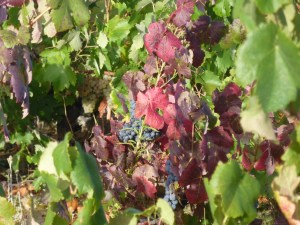
Bierzo grapevines, their leaves turning in the autumn sun

Bierzo grapevines, their leaves turning in the autumn sun

But today it looks like I’ll get a mix of main road, smaller road and vineyards, and I can save my climbing energy for tomorrow and the last big uphill walk before Santiago.  The vineyards are again a mix of old vines and newer ones, and the huge clusters of purple grapes lie nestled in deep contrast to the autumn color of the leaves on the vines.  Again, I can’t resist picking just one grape from a cluster.  I wonder what kind of wine they will make.

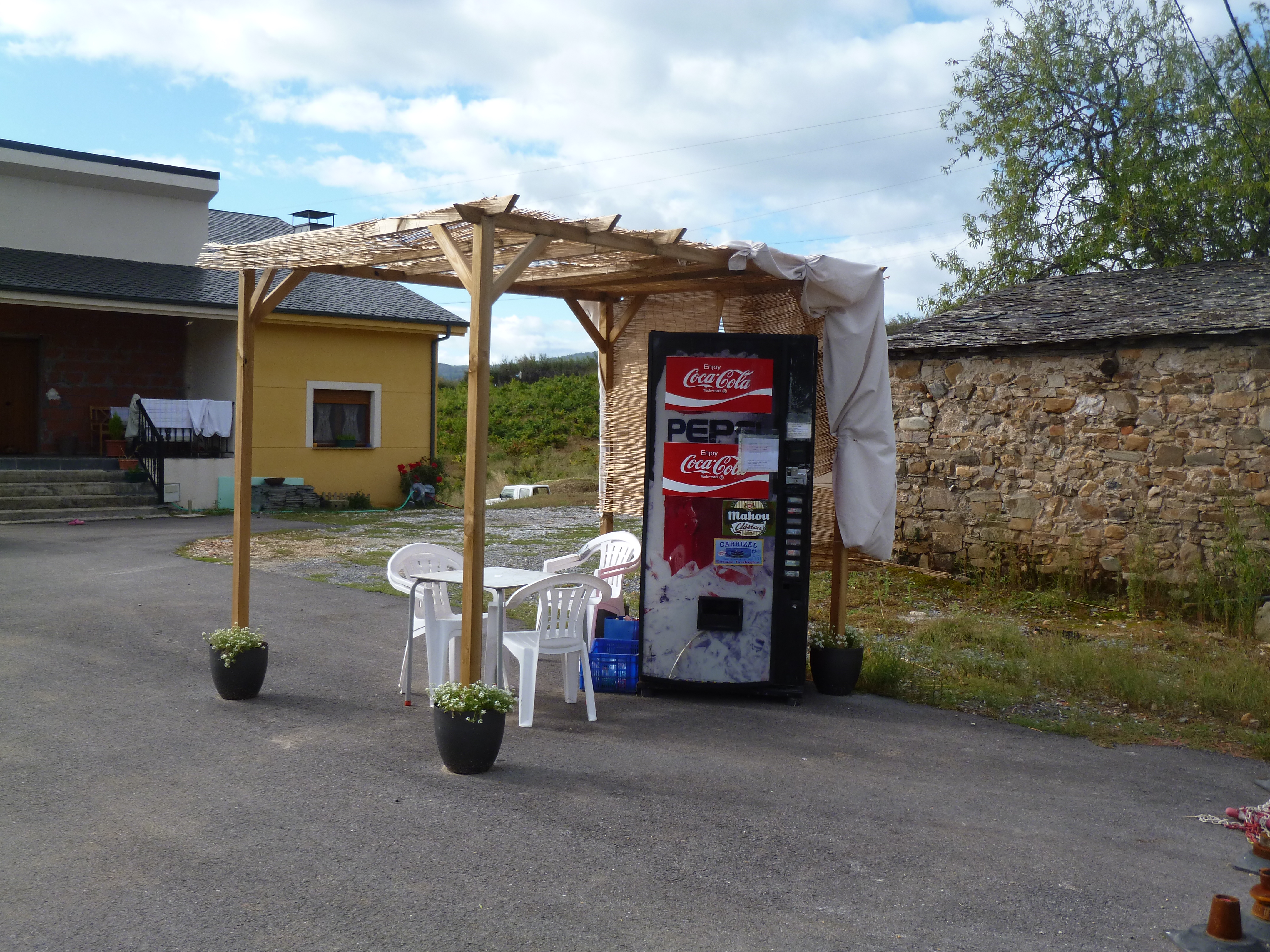
Pepsi, anyone?

Pepsi, anyone?

I stop occasionally at the villages for water or juice or some snack I am carrying.  I did  pass up one humorous and most likely non-functional refreshment stand.  There are a few of these, but none tempted me at all.   At most stops, I see at least one or two people I recognize from yesterday or last week or the last village.

Christel is a day behind me, Ria might be one day ahead of me.  Yves and Janice vowed to go a bit more slowly after Janice developed a bad case of blisters a few days ago.  Matthe and Elma from the Netherlands are surely long gone, since I last talked with them in Burgos.  I will be sorry not to see them again.

As I enter a larger town,  Villafranca de Bierzo, the woman behind me is a Brazilian, Vera, living in England with her husband.   I met her briefly about ten days ago near Sahagun, when she told me her anniversary is the same day as one of the two I celebrate for my relationship with Neil.  Her husband was coming for five days to walk with her for their anniversary, so I asked how that went.  Unfortunately, he hates to walk.  As she emphatically said, “He hates to walk.”   But walk he did, for five days, 12-15 miles (not kilometers) per day.  Hating every minute of it.  I’m not sure whether that’s a loving sacrifice or a torturous gift to receive.  Vera and I sit at an outside table in a large city square and have something to drink, shed some warmer clothing, talk just a bit before going our separate paces, eventually down one of the same paths that will lead both of us to the mountain-top and O’Cebreiro tomorrow.

The trees and houses make lovely paintings, yes?

The trees and houses make lovely paintings, yes?

The day is cool, sunny, but with storm clouds always somewhere else not-too-close by.  I am grateful for the promise that I will reach my town, Vega de Valcarce while the weather holds.  After each village, Pereje, Trabadelo, and am nearing La Portela de Valcarce, I leave behind several peregrinos who decide to stay where they’ve landed, but I still have about 4 km. to go, and my backpack is waiting for me.  Again.

Then it begins to sprinkle, then rain, and I pull out my trusty plaid umbrella, the 6-Euro purchase at that corner stand in Leon.  It works well for a while until the sky really opens up.  There is nothing but to walk, and my lower shin is beginning to ache.  I wonder what that’s about??  And I muse about the irony of walking all this way without any disasters, only to be struck by lightening while holding my silly umbrella.  I notice at least it doesn’t have a metal pointy-thing on the top of it like some fully-grown umbrellas do.  No actual lightening rod, but still . . .

Just as I think I might have to cross the road and stick out my thumb for a ride, for a different reason than heat exhaustion this time, I see up ahead a very large complex with a several-story hotel, a restaurant and bar, a gas station, and a truck stop combination, and I head straight for it, sheets of water coming down around and on me, only a part of it now deflected by the little umbrella.

Inside the restaurant, I ask about a taxi, and a man behind the counter makes a quick phone call and nods to me, holding up all the fingers on both hands.  Ten minutes.  Quickly I call the Jacotransport people to see where they have delivered my bag.  I remember having put Albergue Brasil on the tag, but the phone number I have for them is not a correct one, and I don’t see their name on my computer list.  Bad sign.  Happily, the Jacotransport driver says the albergue is still open, but has a new name, or rather has returned to its previous name:  Albergue El Roble.  Relieved, I see the taxi pull up outside and dash out to greet him.  He knows exactly where El Roble is located, and drives the 3.5 km to Vega de Valcarce . . . actually not even really into the town yet. This would have been such a easy finish to an already easy walking day.  But here I am in the taxi.

When we arrive at El Roble, I ask that the driver wait while I see whether my bag is indeed here (it is), and whether they have a bed (they do).  He, Carlos, tells me he can transport my backpack for 5 Euro, rather than 7 Euro, as I’ve been paying for the past few days.  Tomorrow will be the last day for that, up over the mountain, and then my back will carry the thing.

Matthew and Livia - Albergue El Roble - Vega de Valcarce

Matthew and Livia – Albergue El Roble – Vega de Valcarce

The hospitalier who greets me at Albergue El Roble is a young, blond and blue-eyed Englishman named Matthew.  Matthew Sanchez, apparently, though you could have fooled me.  Looks very much like a young Ewan McGregor with a bit fuller face.  Darling and delightful, as well as delighted that he has a customer.  He and his girlfriend, Livia from Switzerland, have only two weeks ago put their funds together to buy the lease on the albergue, and happily for me (though probably not for them), there are only two pilgrims staying at their spacious place tonight.  The pilgrim’s meal is not the usual fare, but rather chicken curry with rice, a salad, and the Tarte de Santiago (a very moist almond cake, fresh-bakery made, not in a plastic container!).

One other woman, Ingrid from Germany, and I have the place to ourselves, and when Ingrid goes to bed, I invite Matthew and Livia to sit at the table with me.  We talk about their meeting two years ago in Finisterre “on the beach”, Livia tells me.  For two years, they have been working, saving money, finally just purchasing this business after being in Finisterre for the past six months.  Their dream come true.  We talk about the many risks of buying a business, and the energy created when you take opportunities where you find them, about relationships that require nearly 24/7 time together, the up and down of seasonal establishments, and generally share a delightful evening.  They are just about the ages of my two younger children.  Matthew is 32, Livia is 29.

Tomorrow morning, Matthew has enthusiastically agreed that he and I can go over my Brierley book about Finisterre and Muxia, and he will give me some suggestions for the best places to stay.  That will be extremely helpful, since only about 10% of pilgrims continue to the sea, and the paths are less well-defined, albergues few and far between.  I’ll have my own tour-guide, at least tomorrow, and I’ll take good notes.

It seems impossible that there are only 150.5 km. to Santiago!

Posted in Miscellany | 1 Comment