Caves and Cóbreces and on to San Vicente de la Barquera

Friday, September 11, 2015.  Raise a glass today . . . the 14th anniversary of the attack on the World Trade Center.  And I spend the morning walking to, and exploring, a replica of the Caves of Altamira, near Santillana del Mar.  Ria and I walk there and back, laughing that it feels like a long walk, but if it were part of the actual Camino, it would just be a short spit.  Perspective is interesting.

We can’t actually see the real caves and the original cave drawings, because the hoards of people who visited during the 20th century nearly destroyed the site, just by their very presence.  Now the Caves, a UNESCO World Heritage Site, are protected, and what a visitor sees is a reproduction of parts of the caves and the drawings, as well as a nearly overwhelming amount of information about primitive peoples and their ways of living.

Very intriguing, but as with any museum, more than two hours is enough for me, I’m embarrassed to say.  We walk back to Santillana del Mar, grab lunch and our backpacks, which we’ve stored in the dining room of the Casa Octavio owner, and find our way to the yellow arrows and out of town.  A very late start, already nearly 3:00, but we don’t have so far to go.  We pass the local Albergue de Peregrinos, which is closed to get rid of a bed bug problem.  Good for the hospitaleros there.  I’ve encountered no bed bugs, and if albergues would be as responsible as this one (for the most part they are), no one would ever see one little bug.  No bugs, and no blisters at all, I might add.  My Keens and my 1000 Mile Fusion Socks are serving me very well.

We also pass the inviting food shops, including a chocolate shop displaying this poster on its stone face:

Tempting to buy, but I'm walking across a country . . .

Tempting, but I’m walking across a country . . . and only have energy for one or the other . . .

The day is again bright and sunny, and though the temperature isn’t too high, walking under all that uncloudy sky makes it seem like it’s the desert.  But it surely doesn’t look like the desert.  Lots of cows and open fields, as well as the forested walkways I’ve come to love.
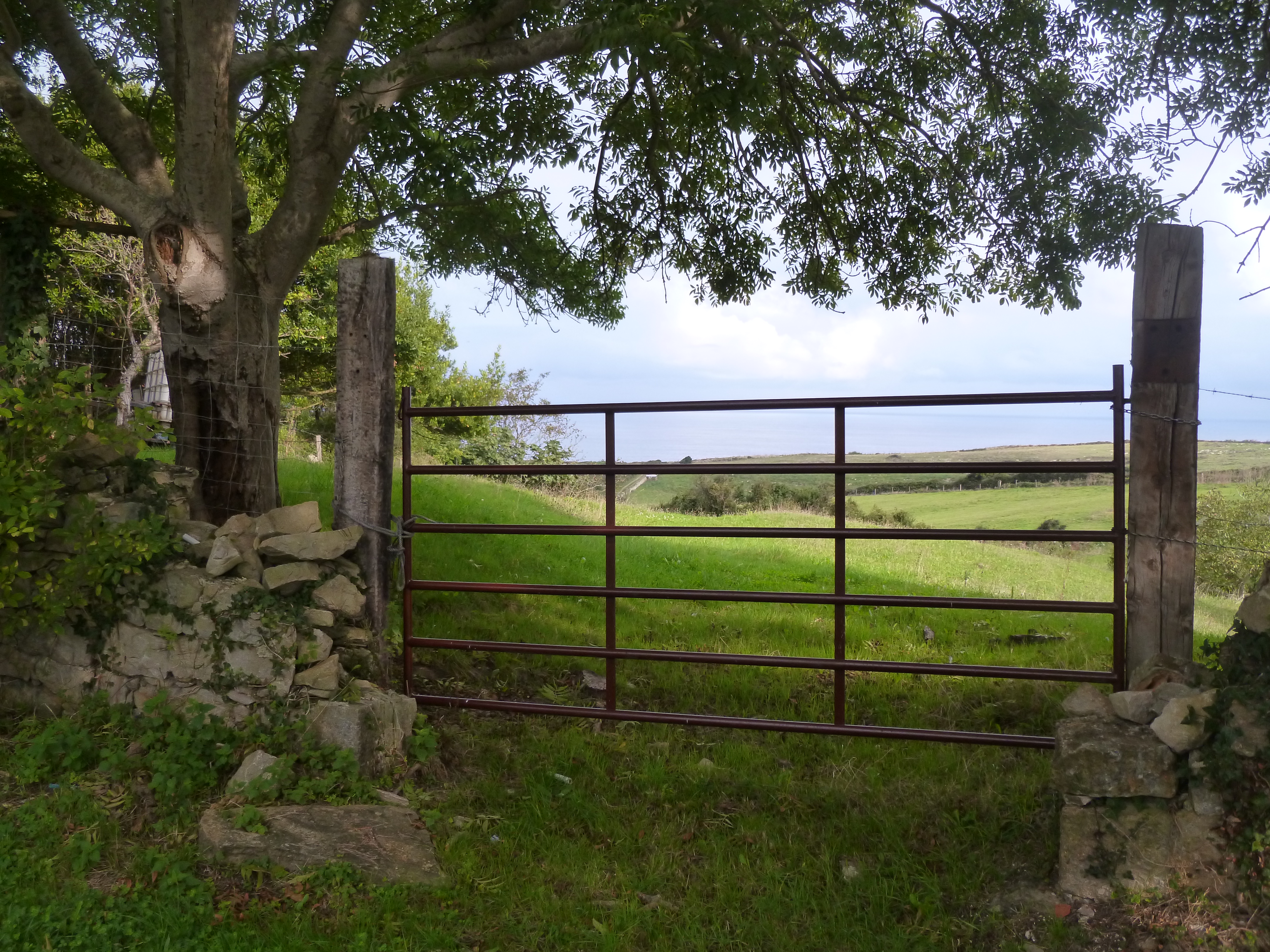
What might be beyond this gate?

What might be beyond this gate?

Not sure what this is, but gorgeous, surrounded by farmland and lots of cows.

Not sure what this is, but gorgeous, surrounded only by farmland and lots of cows.

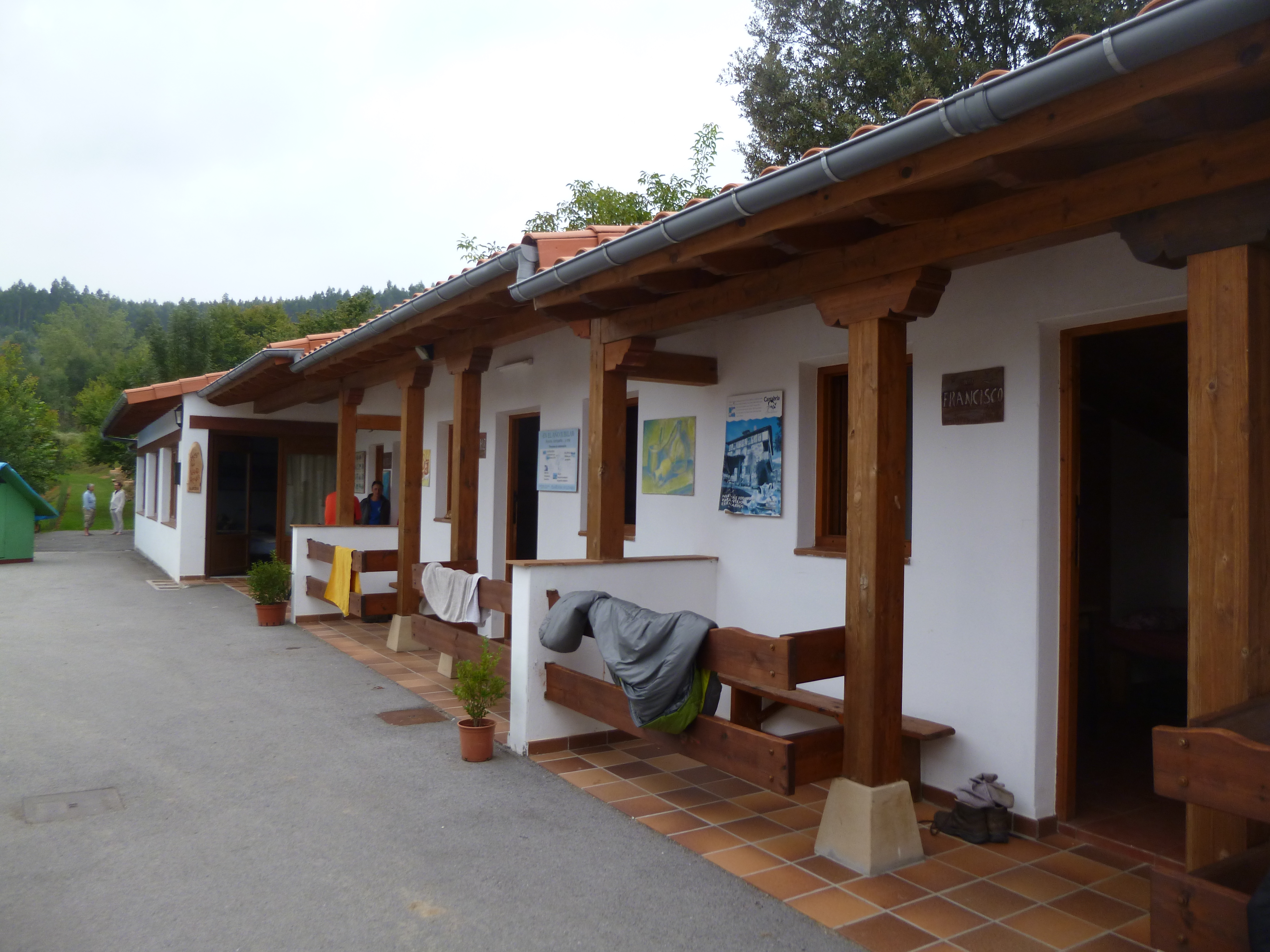
When I get to El Pino,  just on the early edge of Cóbreces, I am delighted to see a very nice, apparently very new, small albergue.  The owner lives in the house on the main level, and there is a kitchen and big eating table just as I walk into the place.  Rooms are upstairs, two of the, with three sets of bunks in one room and two flat beds with a bunk in the other.  Ria and I have requested “flat beds”, if possible, so the owner shows us to that room.  We are the only ones here at the moment, but later two more couples come, all Spanish speakers, and they are given the other room.  Something to be said for being the “old ones”, though Ria is nearly 20 years younger than I am.

We walk into town to the grocery store and put together the fixings for a dinner.  Tomatoes, roasted red peppers, good cheese, bread of course, and pasta, onions, garlic, etc.  We will eat “in” tonight, and Ria wants to cook.  I’ll prepare the appetizers and open the bottle of wine.
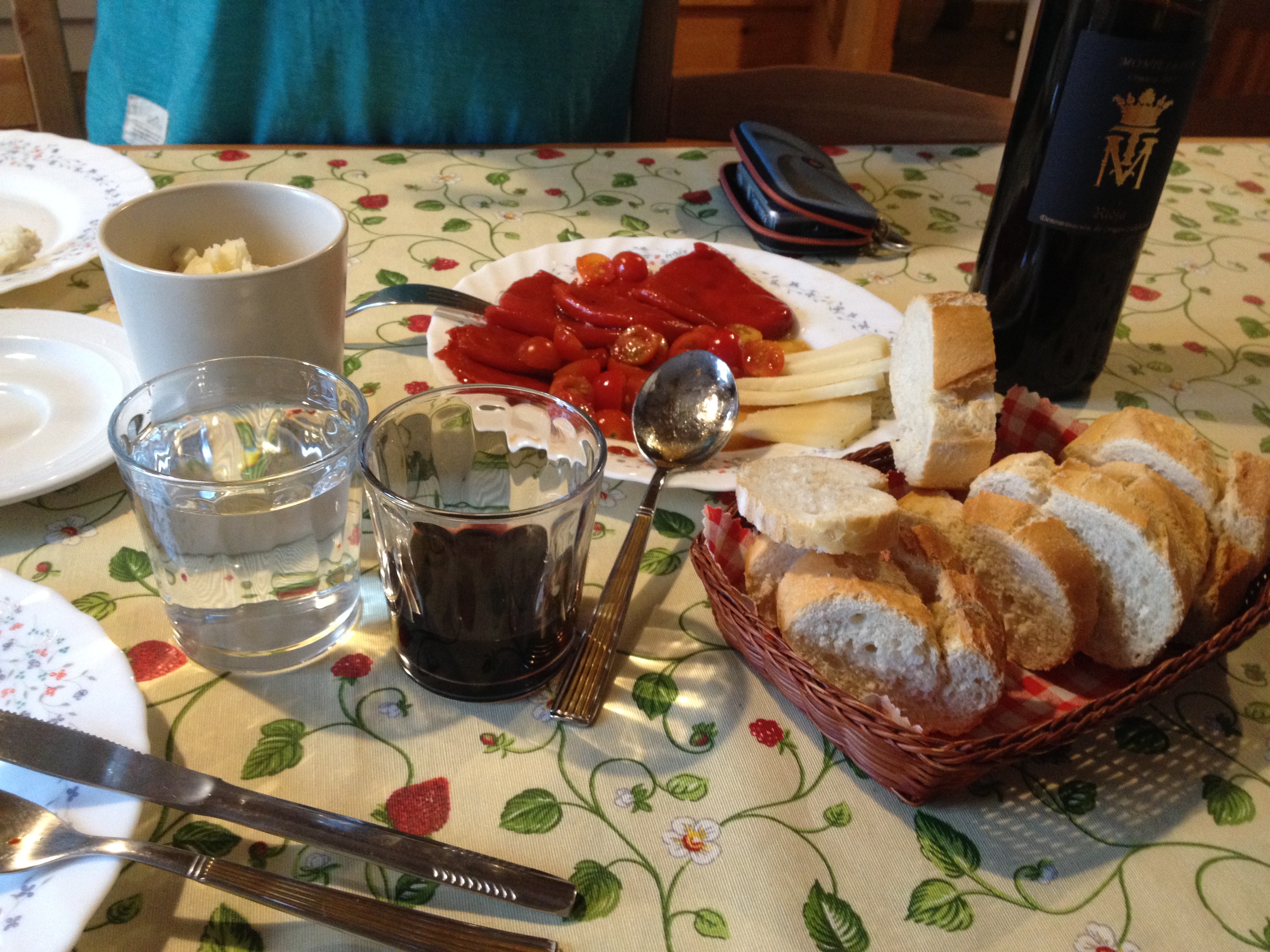
Our dinner

Our dinner “at home” for the first time on the Camino del Norte

IMG_2557

Saturday, September 12, 2015.  I am up entirely too late trying to get caught up with my writing (and am still a week behind as I type this), but in the morning, our hostess has breakfast for us at 7:30 so it’s out of bed, get packed up again, and be ready to head out after eating.  Yogurt, bread, cafe con leche.  No eggs 😦       But this has been a wonderful place to stay, and I would give it very high ratings in the scheme of albergues.

And we are off.  We walk together for awhile, only because Ria stops to make boot adjustments, to check the route, etc., but finally we go our fast and slower ways, knowing we will meet at the Albergue in San Vicente de la Barquera, about 22 km away.  My longest day so far on this much more challenging camino.

Red church and blue church (no photo of this one) are standing tall on my left as I walk through the town and out toward the countryside for awhile.

Red Church looming above most of Cóbreces

Red Church looming above most of Cóbreces

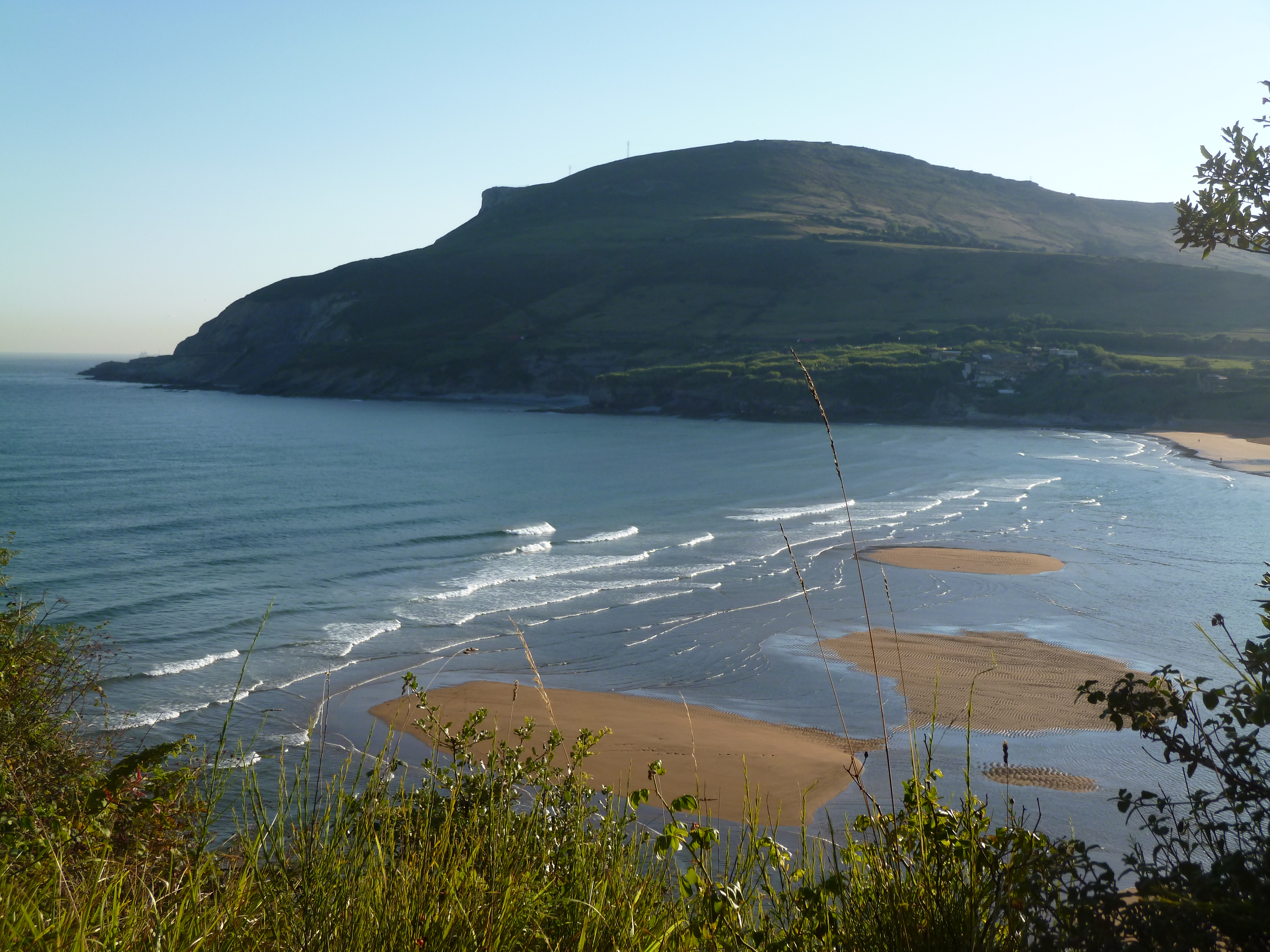
Another day of part coastal walks with beautiful views and an enormous gathering of shore birds and seagulls down below me about 3 km out of Cóbreces, but also of way too much road walking.
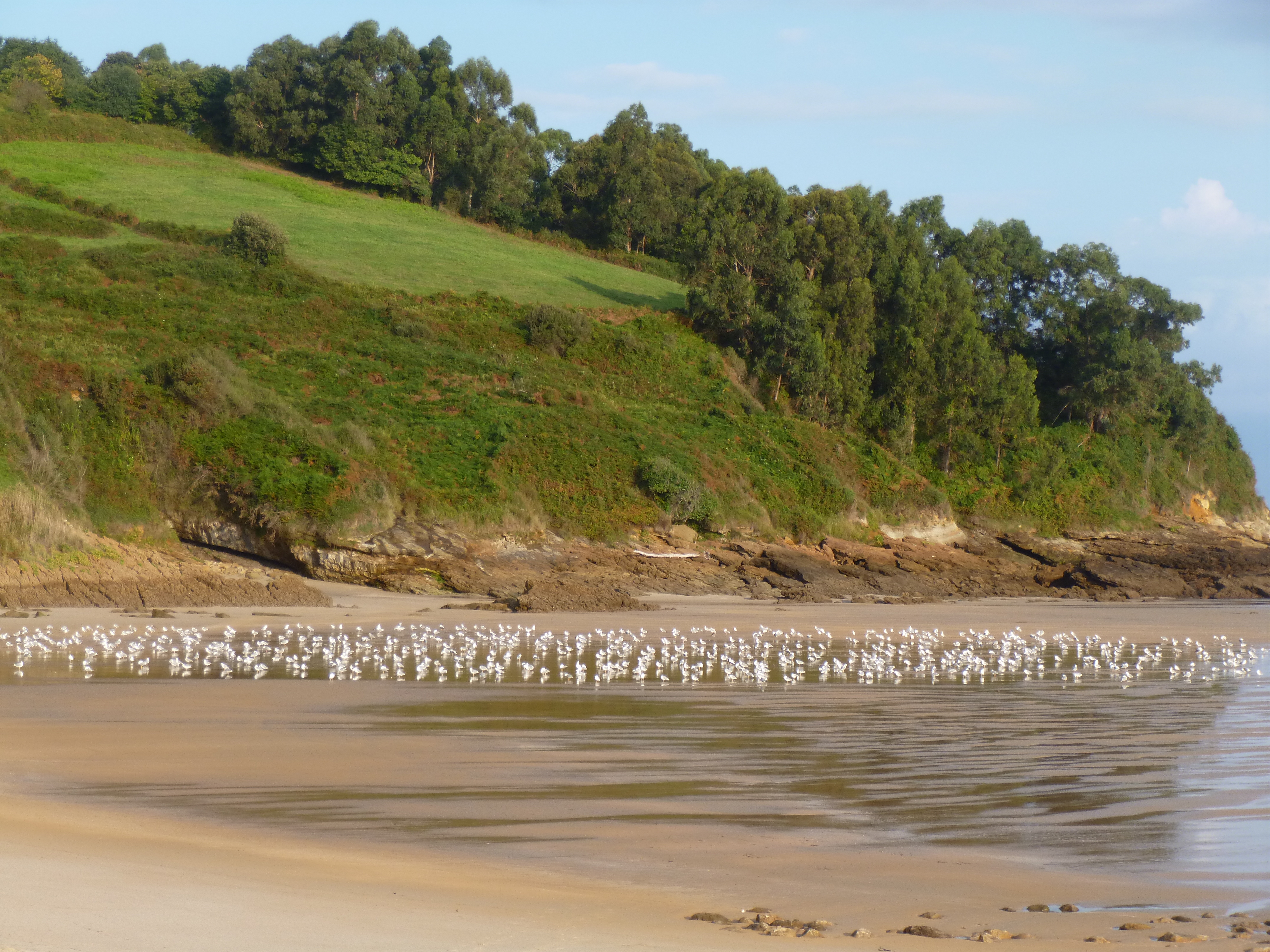
I'd rather be down there with the birds!

I’d rather be down there with the birds!

The asphalt is not fun on feet, and walking against the traffic rather than on a path is pretty grueling after a few hours.  Fortunately, the cloud cover gives a big chunk of heat/sun rellief.  I stop for lunch in Comillas, another beach/medieval little city, and continue toward my goal for the day.

My friend Larry, whom I met last year, has been e-mailing me his whereabouts here and there, but I haven’t heard from him lately.  Last I knew, he was in Castro Urdiales long before I was, with another friend we both met two years ago.  I wonder whether I’ll run into him at some point.  When I get a couple days down the road, I’ll write to him again to see where he is.  He visited us in Fort Collins in July, and Neil enjoyed meeting him, as did my son-in-law, Justin, who happened to be in the Fort that day.  Larry is enjoying his “drifter” status, having been widowed three years ago, and is taking his time on this Camino.  I have no such luxury at this point, and still haven’t gotten my head around just what “my Camino” will look like this time, though I’m more relaxed about the walking and occasional bussing, especially when I’m joined by others who need to or want to cut down some of the kilometers they will walk.  Ria is probably two hours ahead of me by now.

More injuries on this one, as I listen to people talk about their blisters, their knee problems, strained or sprained ankles, etc.  Some have decided to pack it in and go home.  At least I’m still on the trail!  And at the edge of the road, down in the valley below me, is an interesting sight.  Something like Clematis, with blue flowers, is growing wild, covering the growth below me.  Not only that, but it reaches up to grasp the low branches of the trees above me, creating a long, dense carpet and wallpaper.  Just gorgeous.
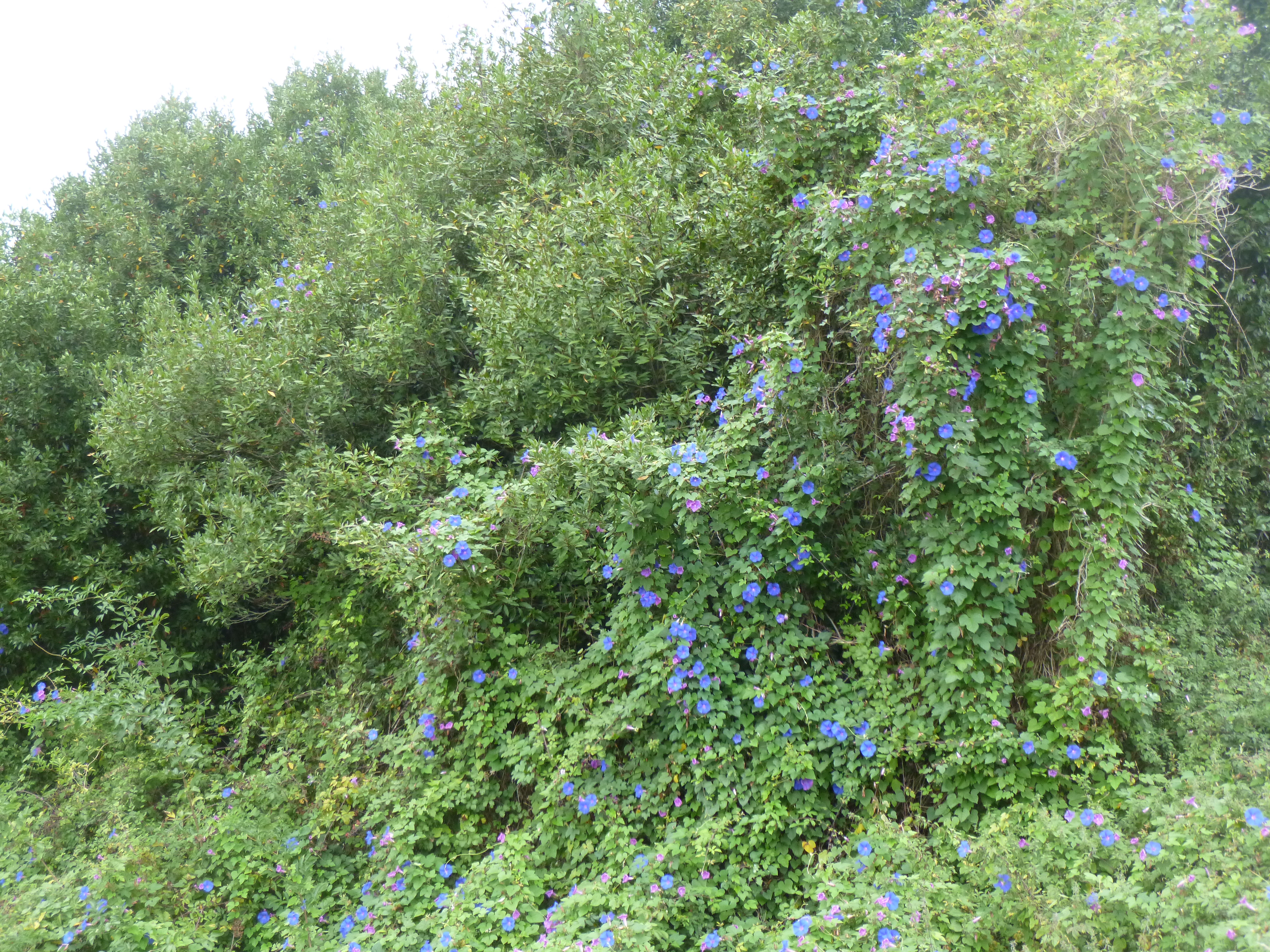
P1030440I arrive at the bridge to San Vicente de la Barquera, and am grateful the threat of rain has only been that . . . a threat.  My directions for the Albergue read “up the hill”, but the whole town is built on a hill and it’s already been over nine hours since I left the nice El Pino albergue this morning.  The walk across the bridge IS lovely, so I breathe it in.
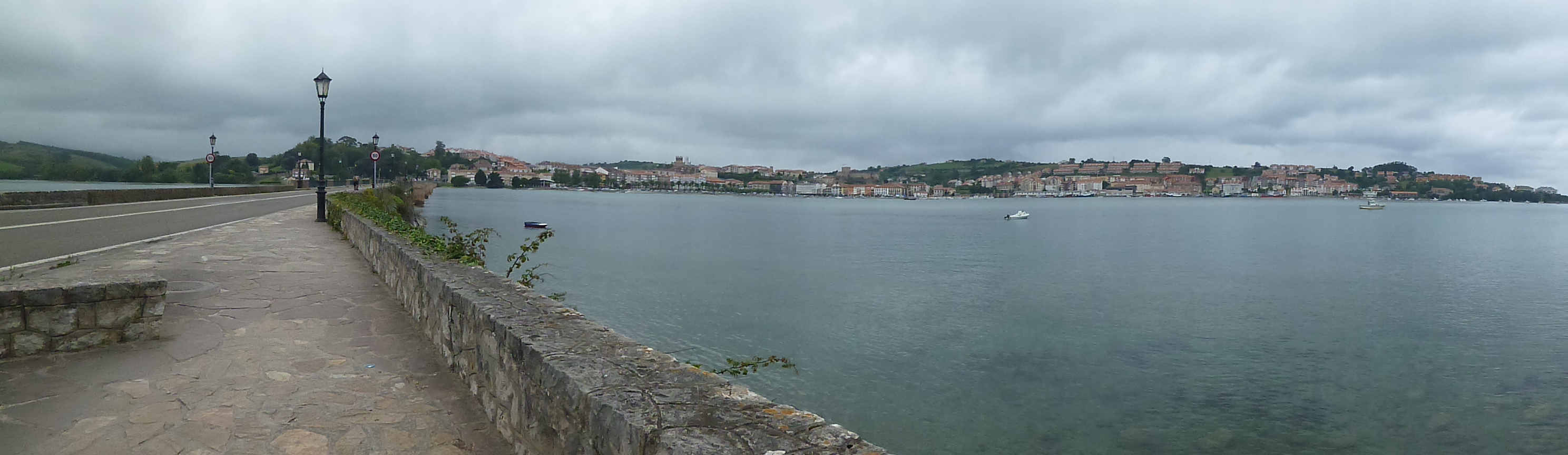
The bridge to San Vicente de la Barquera

The bridge to San Vicente de la Barquera

Once I’m on the city-side, I begin to walk up the first hill, and the yellow arrows half-way up seem to point me to a left-hill.  Some men nod and point confirmation, and I ask, “Albergue o Camino?”  They say “Albergue” so I climb to the top of the hill and there is no albergue in sight.  A hotel reception person sadly smiles and points me back down THIS hill and up the next.  I shake my head and begin my descent.

Going up the next hill, I ask two people and get two different responsees, but both say “next to the church”.  Climb climb and it begins to drizzle.  No point in digging out my poncho now.  I’m already soaking wet from exertion.  I call the Albergue to ask for clearer directions, and the hospitalero says, “Just next to the church.”  I see people dressed up, coming out of Saturday evening mass at . . . the church . . . at the VERY top of this hill.

Finally I arrive, and I’m pretty crabby, but I know I cannot be crabby to these volunteers who work so hard for us.  Julien introduces himself, pulls up a chair for me, and shows me the form I need to fill out.  Then to my bunk in a VERY tight bunk room, and then to the spacious kitchen and eating area.  But of course the stores are closed and I have no groceries in my pack.  Maybe I’ll just go to bed.

But then Ria, who has greeted me with congratulations for walking so far today, coughing all the way, has met a German man, Johann, and a German young woman, Adriana, and she wants me to go to dinner with them.  She says there might be another woman with them, and who knows?  Julien has given them a recommendation for a restaurant only a few streets down (down, get it . . . this is so high that EVERYTHING is down), so I sigh and grumble to myself and follow them.

As it happens, this will be a sort of turning point in some ways, though I don’t know it yet.  The restaurant has SOUP!  I’ve been craving soup for my cough, and here it is.  Johann and Adriana sit with us and soon we are joined by a man who is solo, Matthé, a Belgiun walker.  And then we hear a laugh I will never forget, and Adriana says, “Oh, that’s the other woman, Erika!”  She calls down to Erika and another burst of laughter wafts up to our second floor table.

So now we have six.  Three Germans, two Belgians and an American (me).  The conversation starts in German, until Adriana asks if I understand much German.  I say, “Not a word.”  I want to add “and I’m tired so I don’t care whether I can understand” but she switches to English, as do the others.  Of course the Belgians can speak Flemish, French, Dutch, German AND English, putting almost all Americans to shame.

Erika is the most exuberant person I’ve met yet on this trail, or almost every, when I think about it.  If her laugh weren’t so charming, I’d want to put a bag over her head, because she bursts out laughing with nearly every response she makes.

She tells us she has a pretty bad knee problem, and had been pushing herself to go 30 km per day, at the additional urging of some man who happened to be walking with her.  But she ended up earlier today on the beach in Comillas in tears because she was in so much pain, and some “senior walkers” invited her to go more slowly with them.  She says she also met a very nice man on that beach who comforted her for a few minutes.  We all encourage her to listen to her body, and not some guy who doesn’t have her best interests at heart.

Then I can barely keep my eyes open so I excuse myself, pay my part of the bill, and walk back to the albergue.  Get into my sleep sack, wrap my jacket across my eyes and go to sleep.  8:30.  Crash.
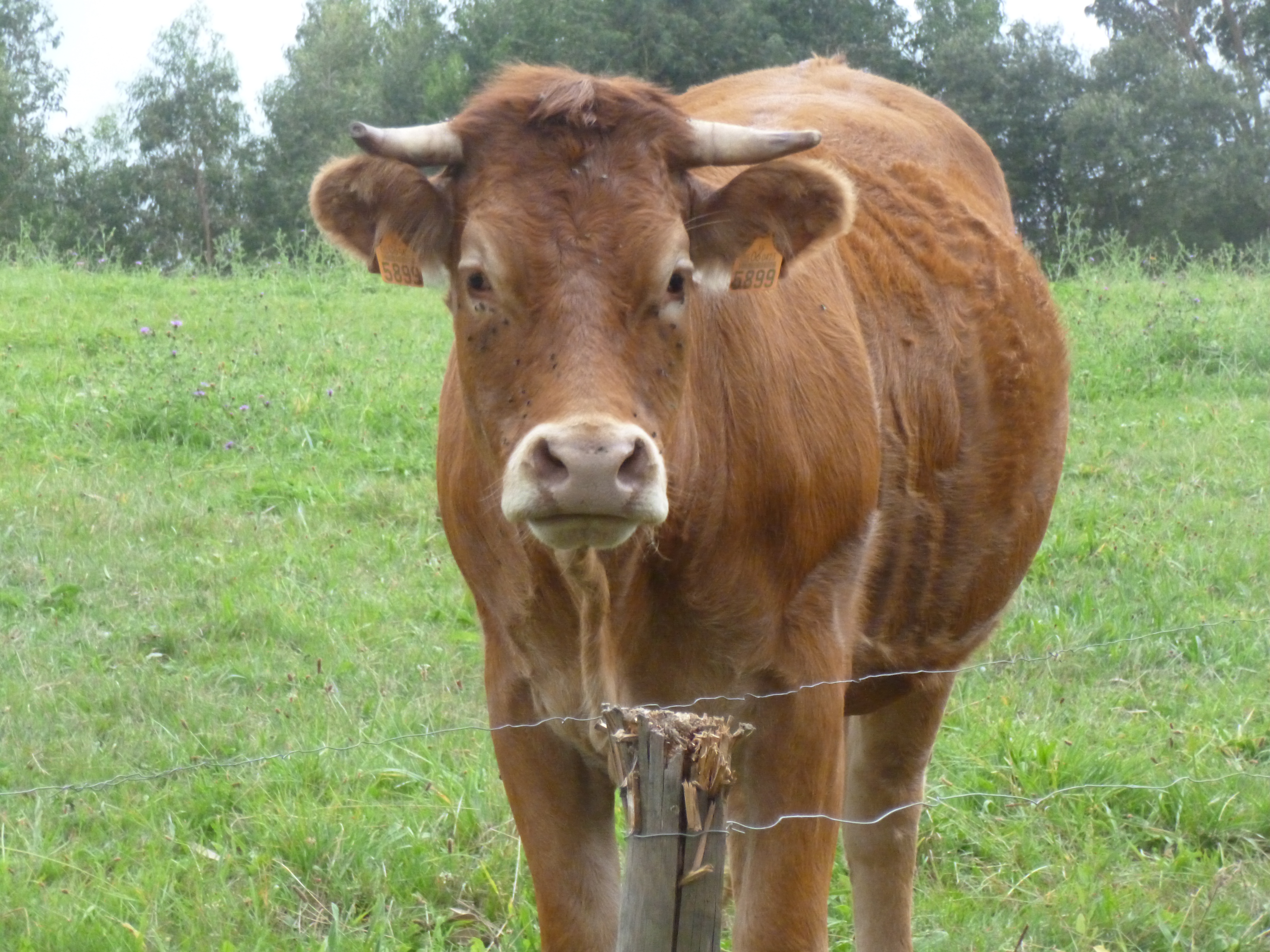
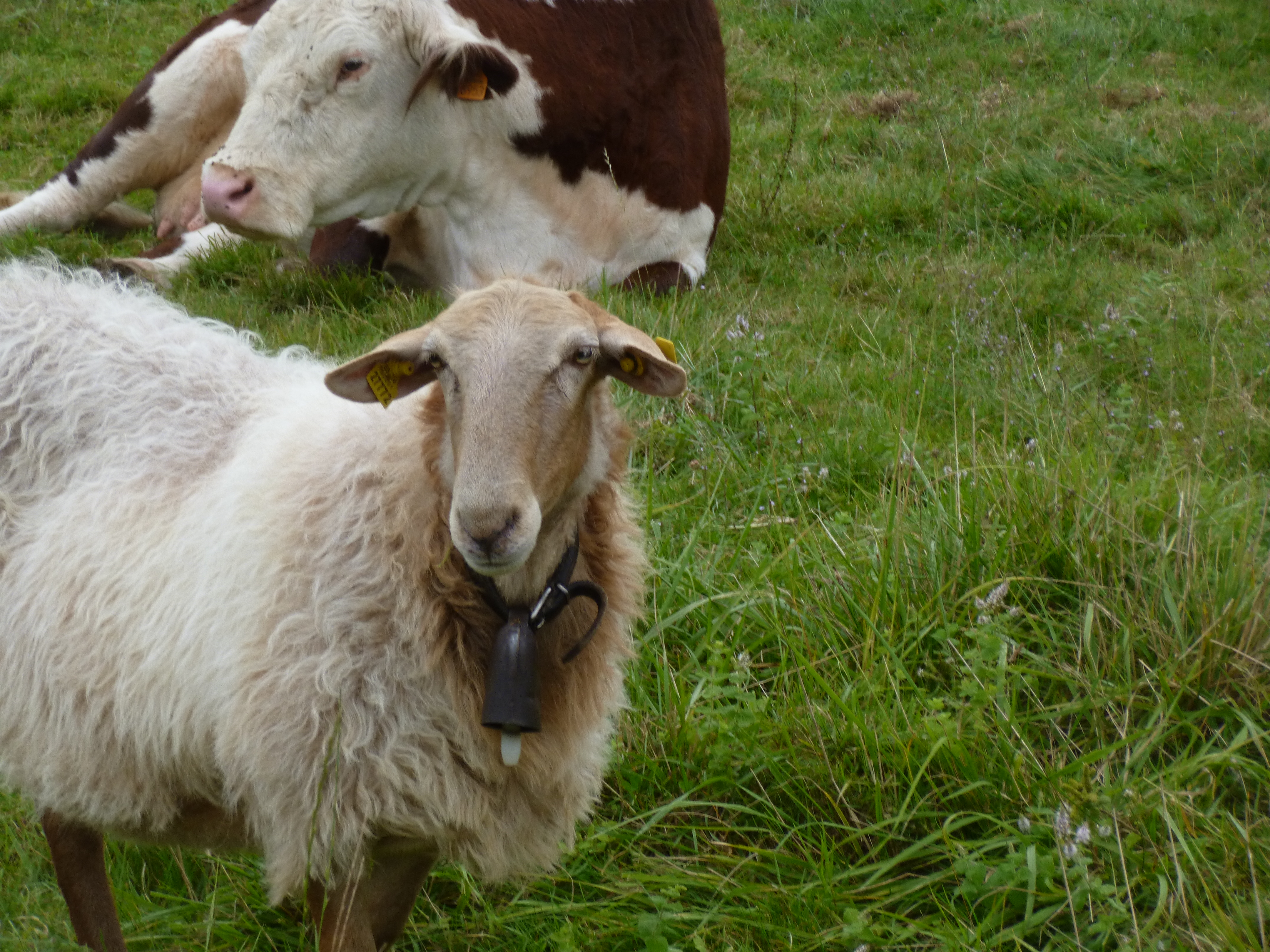
Another beloved cow . . . had to include her in this post!

Another beloved cow . . . I thought only male cows had horns, but this one was with a whole dozen females with horns and she was interested in me, so I had to include her in this post!

Posted in Miscellany | 2 Comments

The Long Way To Somo, Skipping Santander, On to Santillana del Mar

Thursday, September 10, 2015. 

Last night, Ernesto, through his translator peregrin0, told us about the longer but more beautiful coastal walk today to Somo, rather than taking the road. Feeling motivated and ready to be off the asphalt, I jump at the chance to walk the alternate route, 5 extra km be damned. Good choice!

The trail does indeed go along the coast and there are warnings in my book that the waymarkers (yellow arrows and scallop shells) will be minimal. That is true, although when there is absolutely no other trail anywhere in sight but the one we are walking on, there is a bright yellow arrow, on a rock or on the rock wall or somewhere the walkers can clearly see it.   Completely unnecessary when it does appear, as if we had any alternate route to take.

P1030404 P1030407Rain is beginning to show its sprinkles and then the drizzle lasts for at least an hour or more. The distinctive characteristics of familiar pilgrims disappear along with the trail, as everyone throws on their ponchos and other rain gear.

Pilgrims wandering among the rocks

Pilgrims wandering among the rocks

And when the obvious trail disappears and the only place to walk is DOWN to the beach and across the sand, there are no arrows anywhere in sight. Follow the coastline, and you’ll get there eventually, no matter where “there” is, for we are all heading west.

I see, far below me, a group of pilgrims slogging through the sand, so when I get down to that level, I try to determine where they went, but they have disappeared. Looking backward and forward on a very wide stretch of wet beach, I hear a shout and see a little person holding two walking sticks up in the air triumphantly. It is Ria! She had stayed in Merueles last night when I was in Guemes,  but I figured she’d catch up at some point. And here she is . . . wish I could have gotten under my bulky poncho to dig out my camera, snapping a photo of her.  But use your imagination.  She is like an Indian scout, checking all the footprints on the beach, trying to sort out which ones are for the myriad of surfer students and which are the hikers, and then pointing in a direction.

Footprints everywhere, but where are the yellow arrows now??

Footprints everywhere, but where are the yellow arrows now??

I am dubious, but again, the only way to go is west, and eventually, after about an hour, we see a place to climb up to the level with the town, Somo. A bar is waiting for us, and we get café con leche, of course, and bottles of water. I’m sure food is involved as well, but just can’t remember what sort of little bread thing we order.

Eventually we find our way to the pier, where the barque (a sort of ferry boat) will take everyone to Santander, a huge city, I think. As it looms in front of us at the water’s opposite shore, I know I do not want to stay here. My book (and the German one Ria is carrying) says the walk out of Santander is pretty grim. We disembark, head for a tourist information center and then walk down to the bus depot. A bus for Santander leaves in two hours, so we find somewhere to eat and kill time.

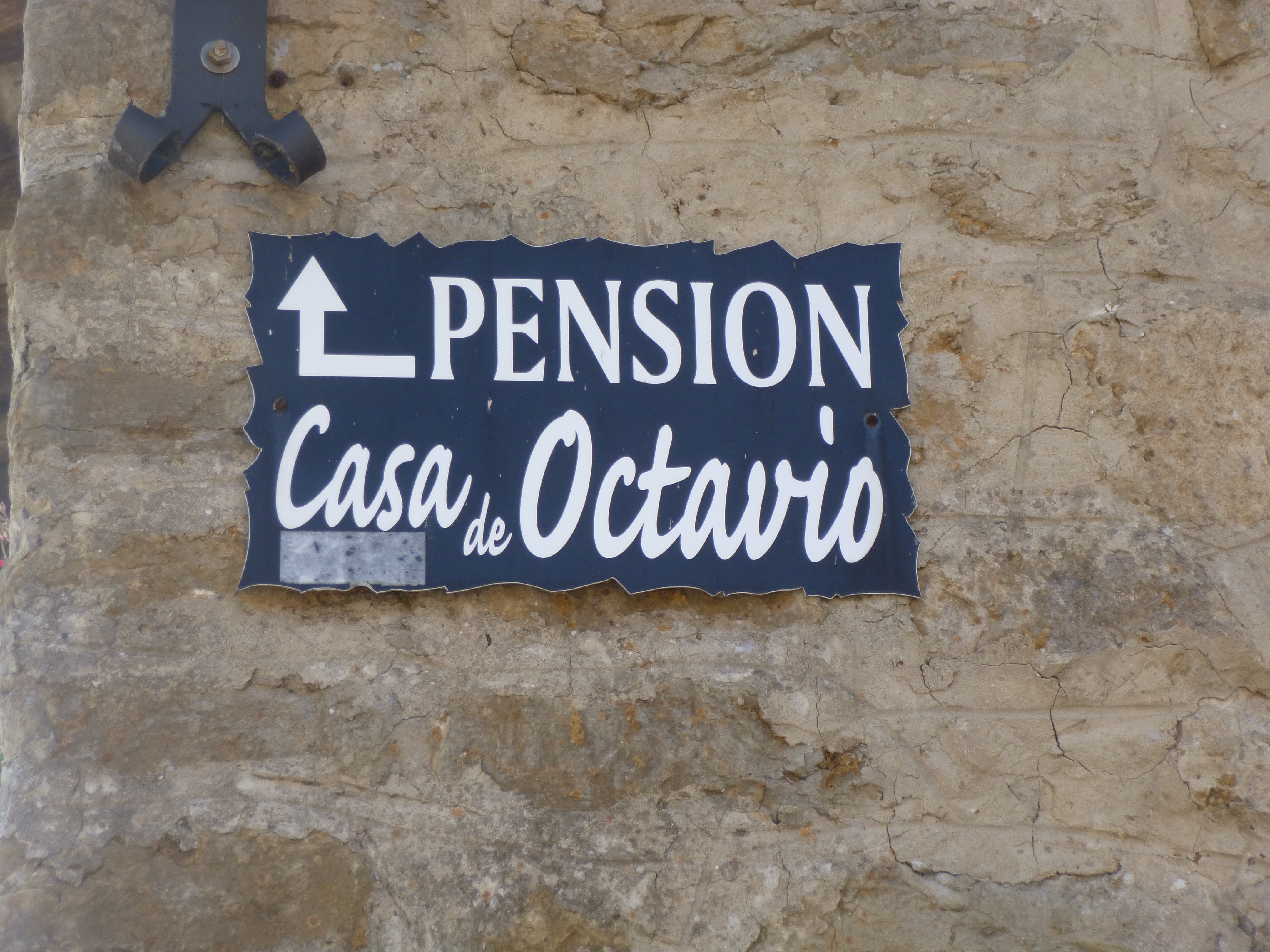
Our destination will be Santillana del Mar, though it is one place that is NOT on the”Mar”. I call the Pension Casa Octavia to see if we can secure a room for the night. We can. 38 Euro for the two of us.

P1030431

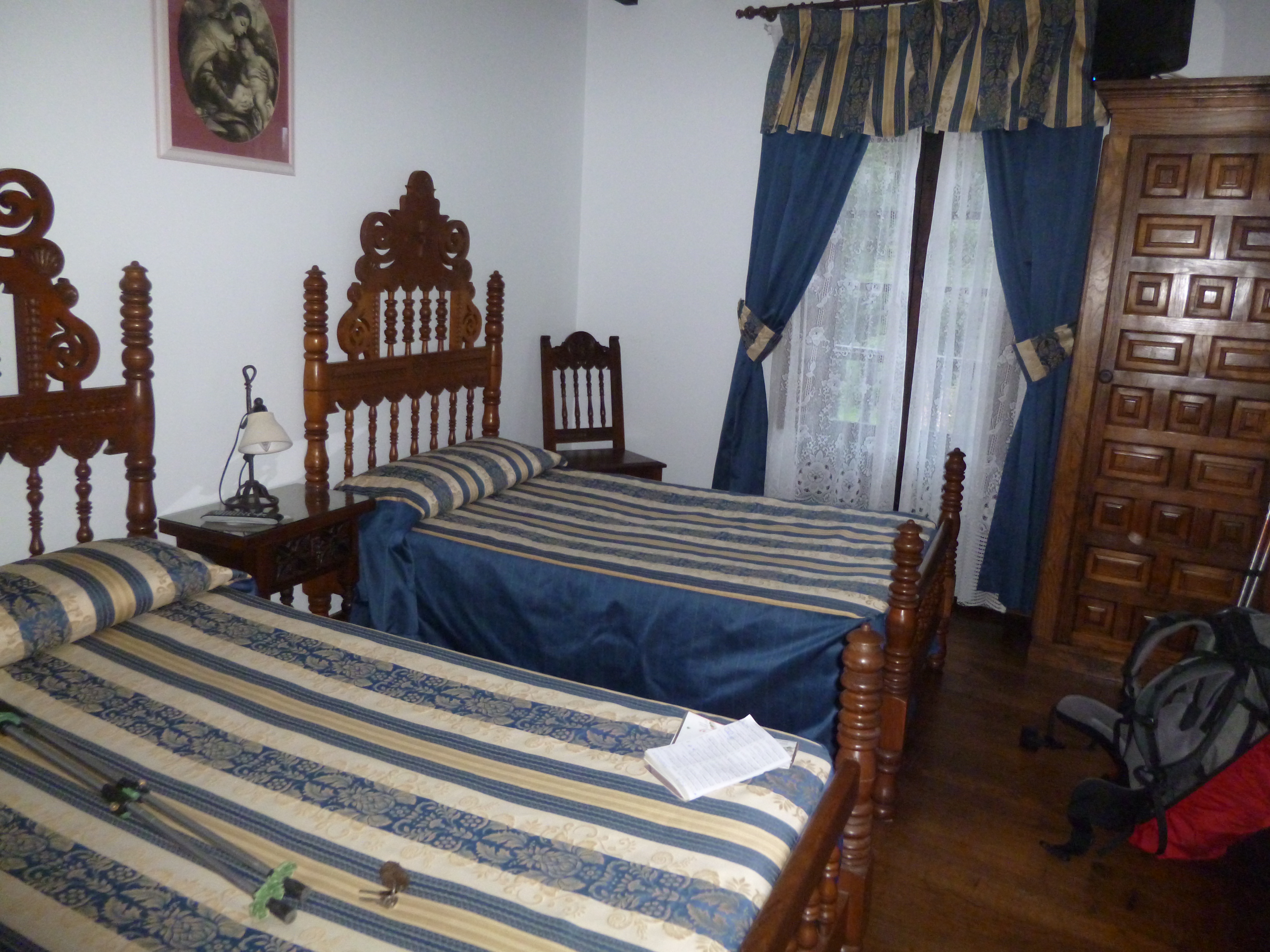
Our little room at Casa Octavia

Our little room at Casa Octavia

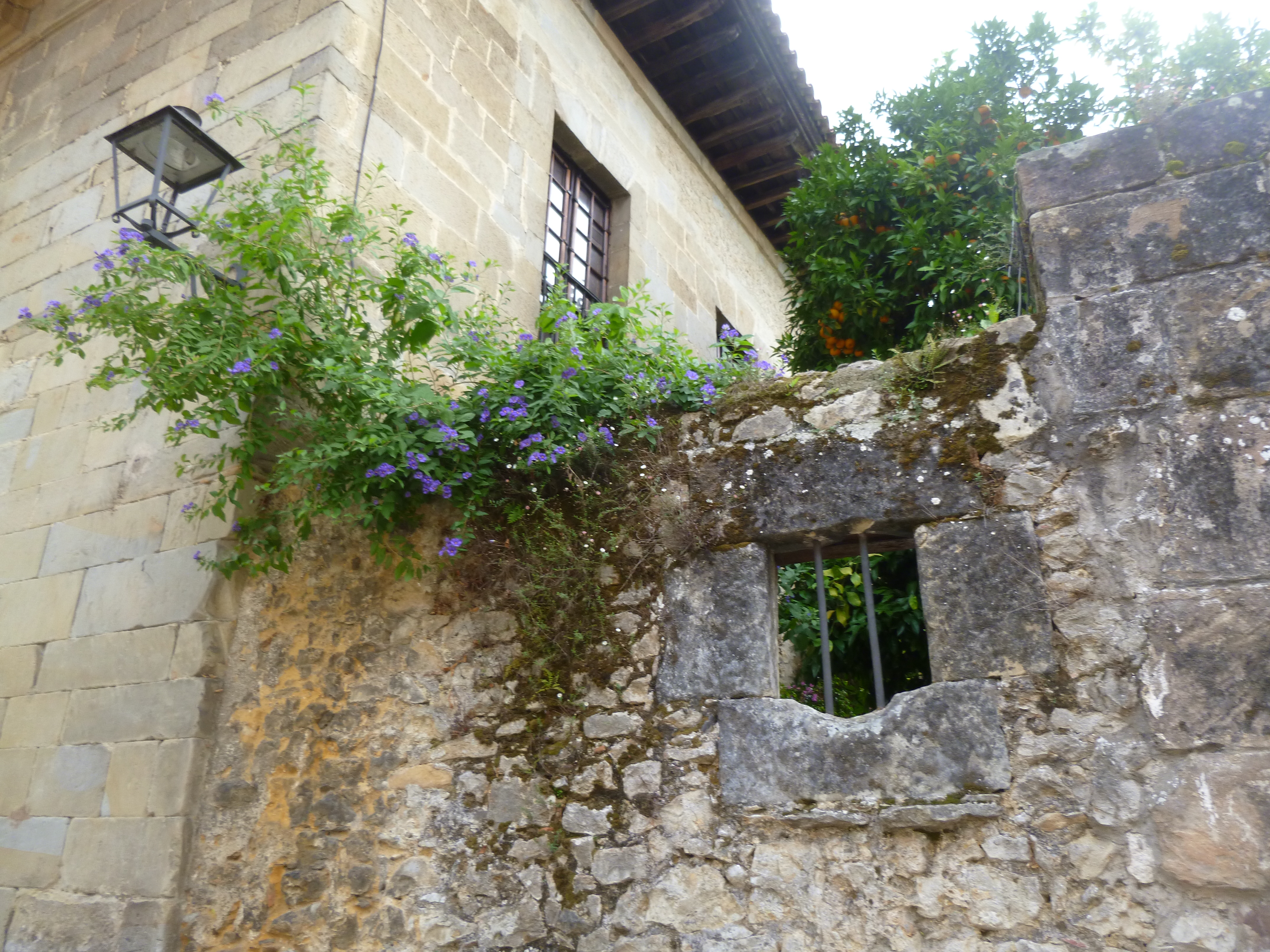
Walking into Santiillana del Mar is sort of walking into a tiny version of San Gimignano.  Very old stone buildings, lots of restaurants and tourist shops, a torture museum (every medieval town outta have one!) and a beautiful stone church, just before our little pension.

P1030416

P1030423

I take a photo of Ria taking a photo of . . .

P1030429

Advertisement for the Museo de Tortura

Entrada for the Museo de Tortura

After settling in just a bit, we wander to see if we can find something to eat that is neither exorbitantly expensive nor enough food for five people.   The light at sundown, reflecting on the stone facades, makes the entire village glow.  This is the kind of salad you get if you are lucky (and you often ARE lucky!)

Yum! Ensalada Mixta

Yum! Ensalada Mixta

Tomorrow our plan is to go to the Museum of the Altamira Caves about 2 km. southwest of the town itself.  No photos allowed, so have a quick look on the link here.  Then we will resume our walk in the afternoon. We have reservations at a private albergue in Cóbreces called El Pino tomorrow night, though it will be a long afternoon’s walk to get there by the time we are done with the caves.

Posted in Camino de Santiago, Camino del Norte, Hiking oceanfront, Women Walking | Tagged , , , , , | 3 Comments

To Noja and Guemes

Wednesday, Sepember 9, 2015. From Argoños – Noja to Guemas and the “famous” Albergue de Peregrinos de Bustio

Up this morning early and out; the “carrot” is the first café con leche of the day in Noja, 4 km from the Blue Albergue.  A fairly large market is being set up in the square next to where we eat our breakfast.

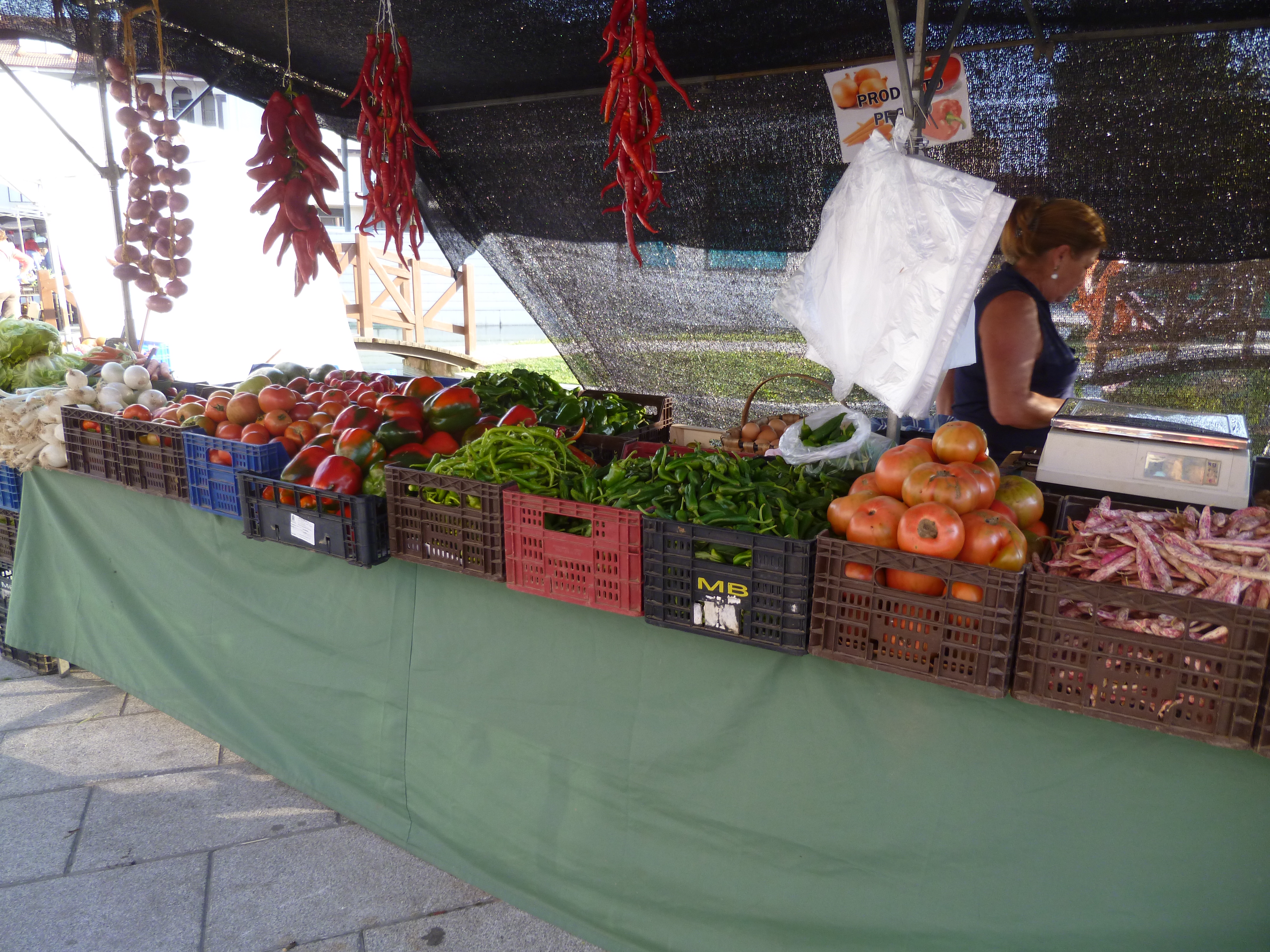
Market Day in Noja

Market Day in Noja

Noja Market Day

Noja Market Day

Henrietta has survived her first (and perhaps last) night in an albergue, and is determined to get a pensione or casa in Guemas. I plan to stay in the much-touted Albergue in Guemas . . . apparently it has quite a following.

The day’s walk is either not so difficult or I’m getting used to it. Every once in awhile there are surprise chairs or benches, set out for us, I think.  Green vistas of farmland, cows and sheep and horses grazing near and far down the meadow. I say this often, but seeing the animals as I come around a curve always makes me smile. Somehow it is a healing thing. Dogs, cats, birds, chickens, no matter, but the cows and sheep munching on green grass is fascinating. Do they ever stop?

BAAAAHHH!!

BAAAAHHH!!

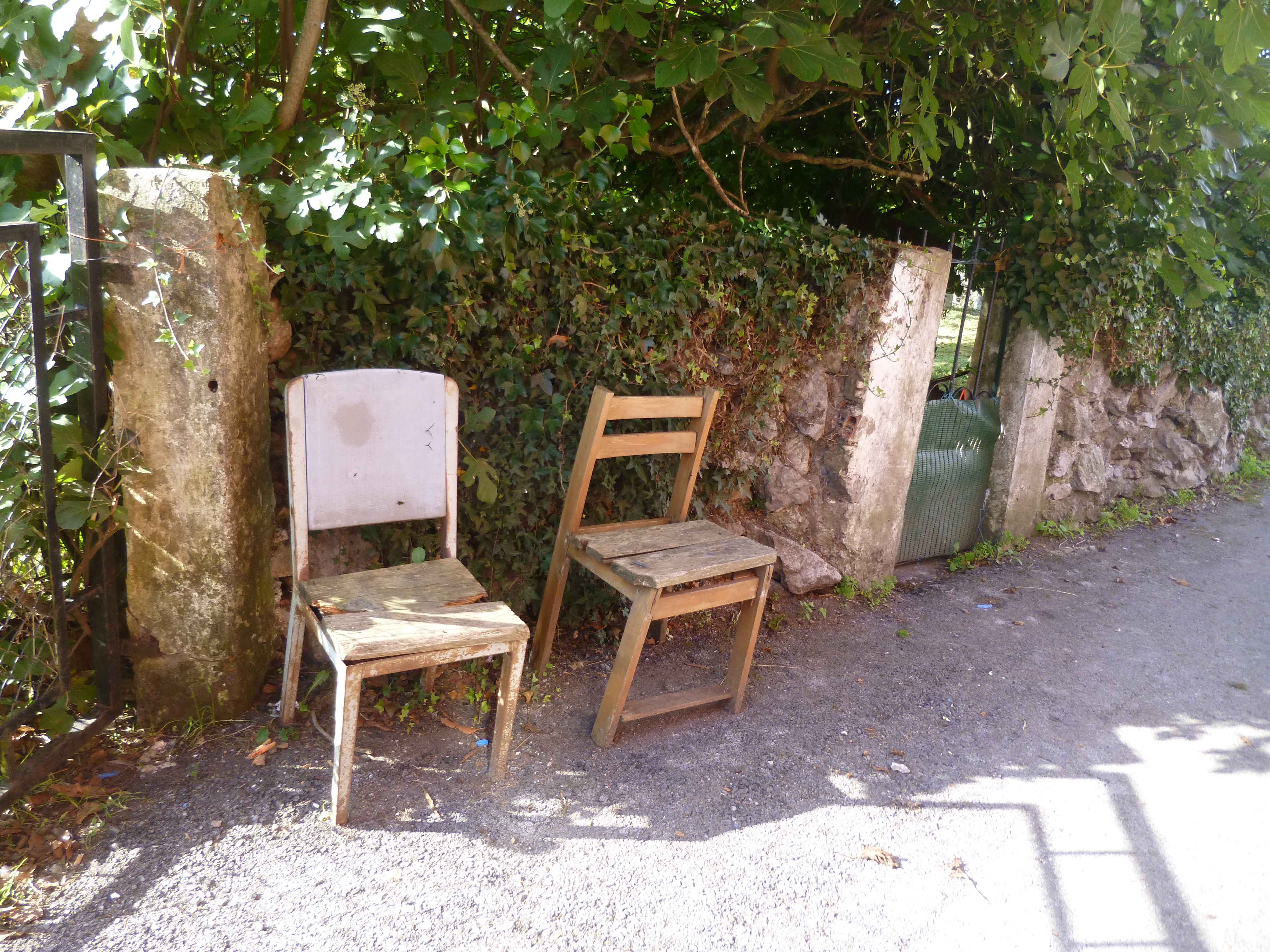
A strange selection of chairs, encouraging us to rest

A strange selection of chairs, encouraging us to rest

More coffee at San Miguel de Meruelos, and past the town is a brand new albergue . . . we poke our heads in, but this woman is walking on to Guemas. That’s my goal and I’m sticking to it. It was only a little bit tempting, because the meal of the day at the Meruelos Albergue included both soup (something I’ve been looking for during the past many days) and paella (also not found yet), but it’s only 1:00 and too early to stop.

Finally we get to what should be Guemes, but there is no real town. We ask a woman, “Donde esta Guemes” in my horrible Spanish. Henrietta has none, and makes no attempt. The woman gestures that we ARE in Guemas, but we are in the middle of a field with one house . . . hers. Asking about the Albergue, she gestures off into the distance, so we walk. Soon we get to a couple more houses and a man outside with his dog. We ask again, where is the Albergue. He gestures and says it is a half kilometer down the road. Henrietta tries to find the name of her pensione, and final sees it on her phone. She points to the name and asks the man. In rapid Spanish (I don’t think the Spanish know how to speak slowly), he gestures in a different direction, makes circles with his hands about a church, etc. So we head up the road again. .5 km.

At that point, I’m pretty finished with the day, and I see no albergue. But then there is a sign . . . Albergue de Peregrinos, .8 km. So I’ve walked half a kilometer, supposedly the distance, and now I have nearly another km. Henrietta and I part company, and she plans to take a bus tomorrow to wherever her next leap will be.

I move toward the Albergue sign. Ah, well, and of course it’s uphill. But it supposed to be “magnificent” as the books describe it . . . nearly a sacred little cult following for the owner, Ernesto Bustio, a 78-year old man whose grandparents built the main building 105 years ago for themselves and their 15 children. Ernesto is the only son of the 15th of his grandparents’ children, and is very proud of this place.

As promised in my book, I’m greeted with a cold glass of water and some cookies. The volunteers are SO happy to be here, so I smile and try to be “tranquilo.” The man who shows me to my room is kind, and I am in the main level, with two sets of bunks and my (our) own half bath! Excellent! Later I am joined by a young German couple, Andreas and Anna, and another young woman whose name and country I do not know.
I'm in this row, the one with the open door, at the Albergue de Peregrinos in Guemes

I’m in this row, the one with the open door, at the Albergue de Peregrinos in Guemes

Before we eat dinner, all 50+ of us, we are called to gather in the “library” and sit in a big circle while Ernesto proudly explains his heritage, the history of the Albergue building, and the four philosophies of this place (that is, the four philosopies of Ernesto). Environmental, spiritual, historical, and the negative effects of technology on our minds. There is a man sitting next to him, one of the peregrinos staying here, who translates into English and French every few paragraphs. Thus this little introduction takes more than an hour, and we’ve all walked miles and miles, and are very hungry.

Ernesto talks about his grandparents, the family dedication to offering lodging and food to the pilgrims, and says we should donate responsibly to the “Donativo” box in the dining room. I’m happy he stresses this, because apparently some pilgrims think “Donativo” means “free” for them, and the albergues can’t even sustain themselves.

Ernesto describes the greedy developers, and the ones who bring the eucalyptus forests to Spain, so they can make more paper from the trunks.   The eucalyptus trees, though I love to look at them and smell their scented leaves, are a blight on the native growth of the Spanish hillsides, and it is sobering to realize that between the Eucalyptus and the pampas grasses, Nature is having a struggle, though I can’t explain any of the details. In the midst of speaking on the woes of the mind caused by technology, his cell phone rings. No one laughs out loud, out of respect for this lovely man, but I can hear all of us bursting out in our minds . . . such a disruption right in the middle of his passionate discourse about the demise of . . . etc. etc.

After his speech is finished, we all head to the dining room where there is . . . SOUP. Delicious soup, and some sort of okay penne pasta in tomato sauce with bits of chorizo. Andreas and Anna sit next to me, and when Andreas hears that I am writing, he asks whether I write like T.C. Boyle. I laugh and say, “Don’t I wish . . . “ and he tells me T.C. was in Germany last year, and Andreas went to see him. I tell him about Fort Collins Reads and write down Chris Bohjalian’s name and the title of our book for this year. A nice conversation, for sure. Andreas asks for my website information and I give him a card, asking him to please e-mail me when he gets home so I can have his information as well.

After dinner, I check on my clothes in the (oh, yeah) DRYER, fold them happily, and go to bed. Tomorrow I can either take the short way to Somo or the longer coast way. More beautiful, and 5 or 6 km longer. I think I will choose the coast.

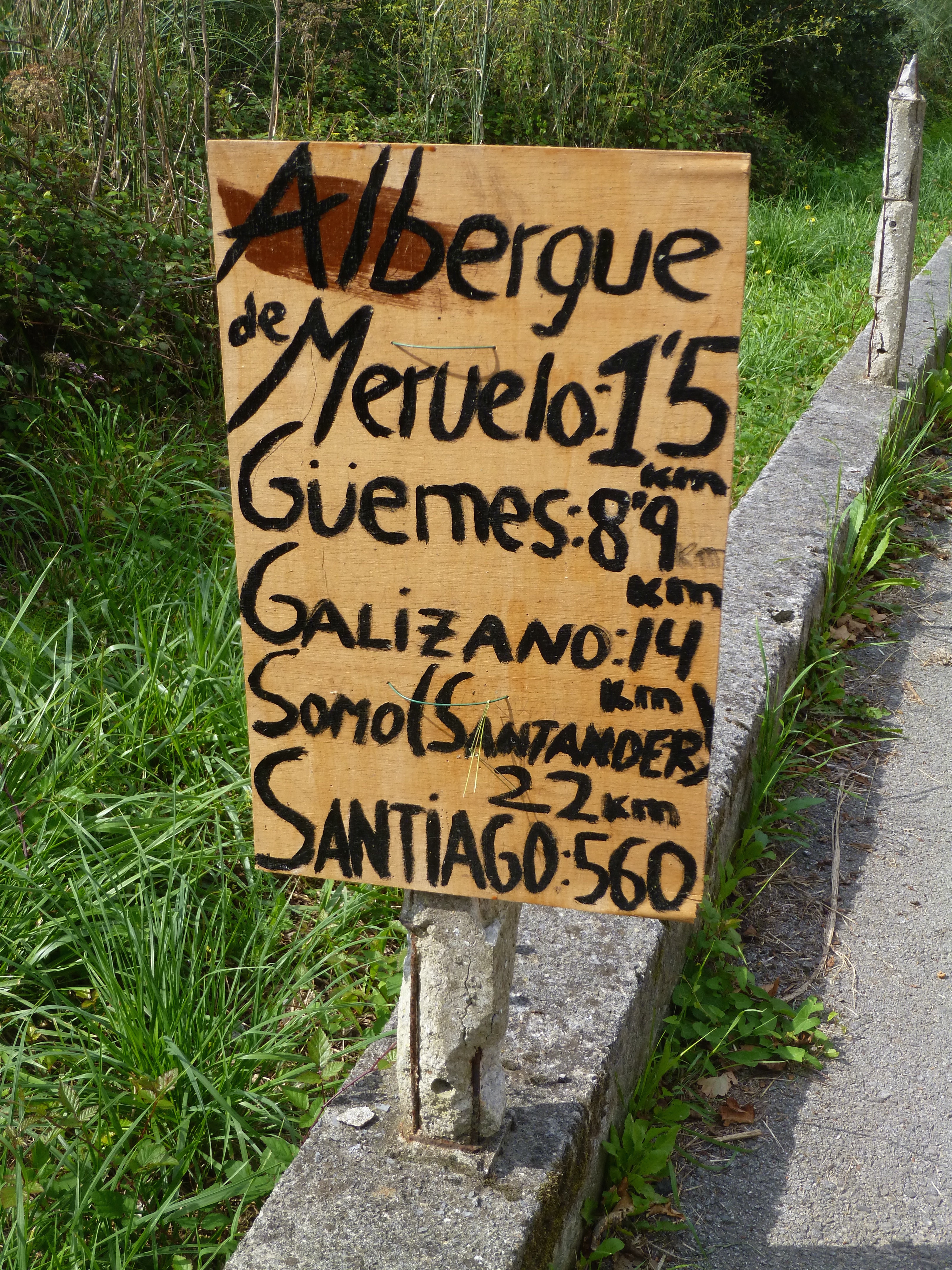
A sign along the way

A sign along the way

Fill up our water bottles here

Fill up our water bottles here

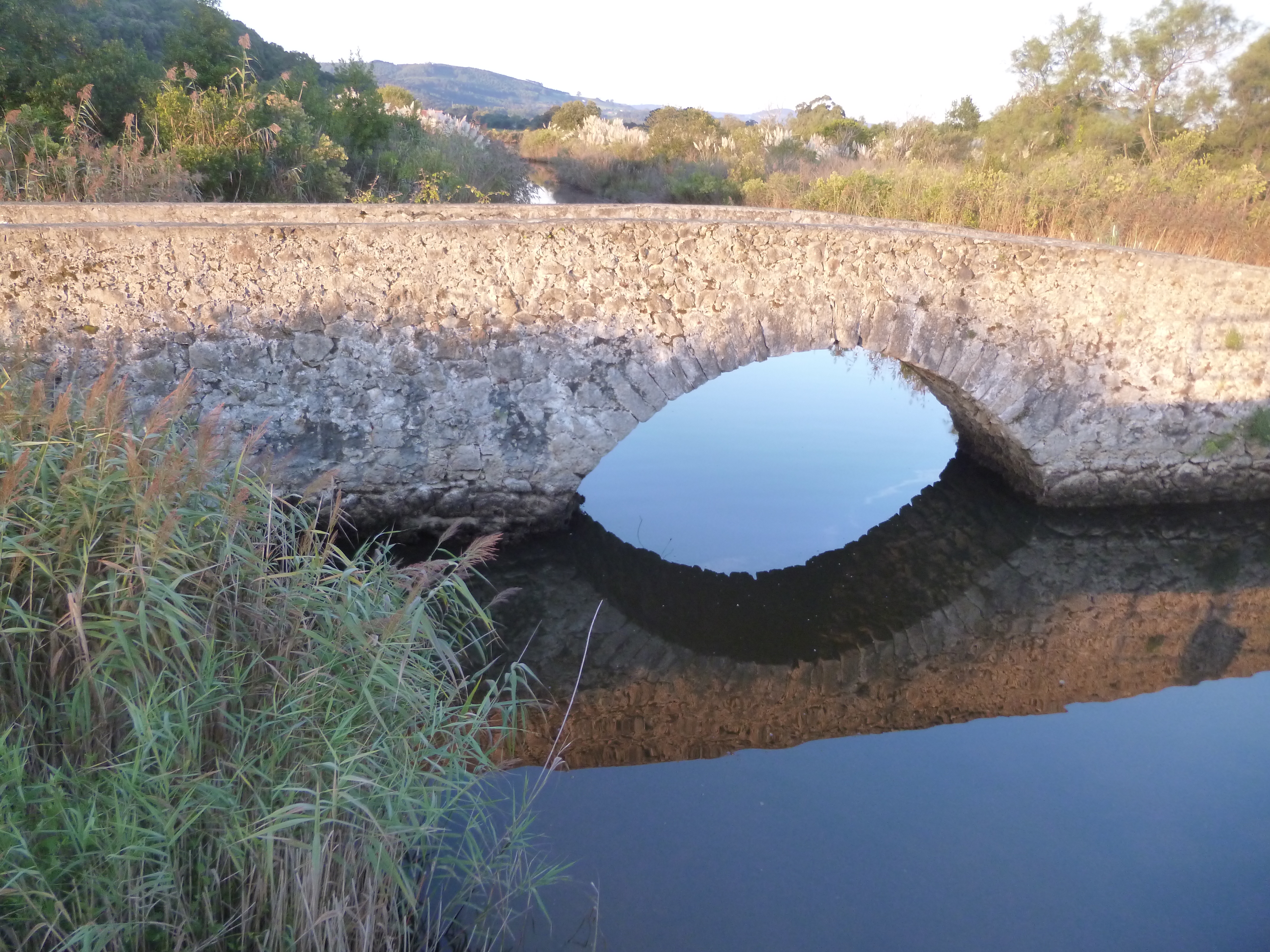
An unexpected bridge surprise . . .

An unexpected bridge surprise . . .

Eucalyptus groves along the pathways

Eucalyptus groves along the pathways

Ernesto Bustio, the proud owner of the Guemes Albergue . . . built 105 years ago

Ernesto Bustio, the proud owner of the Guemes Albergue . . . built 105 years ago

Posted in Albergues on the Camino, Animals, Camino de Santiago, Ernesto Bustio, Eucalyptus trees, Guemes, Spain | Tagged , , , , , | 8 Comments

Castro Urdiales – Laredo – Santoñes – Argoños

Tuesday, September 8, 2015.  After ten hours of sleep and a couple more to wake up and make some decisions, I walked to the bus stop for Laredo, the next stage.  Continue to figure out how and where I’m going to cut what I now think are 225+ km from this walk, in order to get to Santiago by October 10.

At the bus stop, I’m greeted by three other peregrinos, and as we board the bus to Laredo, two more join us.  This will become my experience . . . hesitating at the bus stops every few days, only to be joined by at least two or three or six more people loaded down with backpacks and sticks.

In this case, I begin to talk with a South African woman, Henrietta, who says she is headed to Laredo.  My plan is to get the bus to somewhere, in this case Laredo, and then continue to walk.  From Laredo the walkers must take a strange little boat to get over the canal or whatever it’s called, and reach the shores of Santoña before walk toward Noja and then Guemes.  I think I’ll get to Noja today, despite the fact that I don’t begin in Santoña until after noon.  The path is through town, where there is some sort of festival going on, and on to a path at the beach, then up and over a “little mountain” after which I am supposed to find an albergue in Noja.

Great.  Henrietta says she’s on board, I think only because she doesn’t want to walk at all today, but would rather walk with someone than stay in Laredo herself.  So we have a coffee (of course) as we poke our way through the Santoña festival, and head toward the path on the beach.  Beautiful days continue, though rain is threatening for the early part of the weekend.

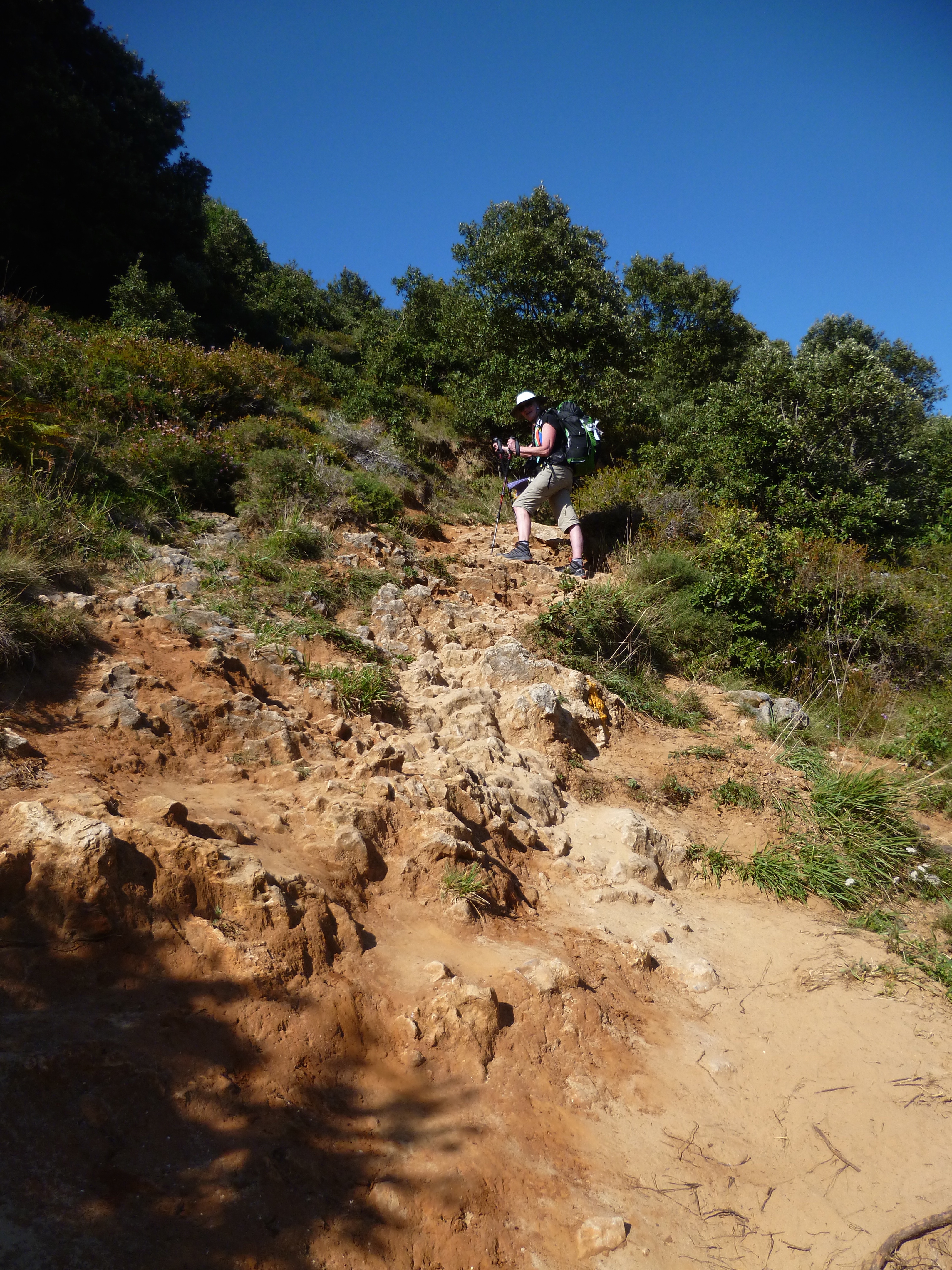
We cross the beach and go in the direction of a “hill”, the smallest of the mountains on the edge of the water, and begin to climb.  The track is not too long, but very steep and very narrow, with lots of sand and rocks on the way up, and dirt/rock on the way down.

Henrietta as we walk up the "hill".

Henrietta as we walk up the “hill”.

Cardiac Hill - from Santoñas to Noja

Cardiac Hill – from Santoñas to Noja – the photo doesn’t do it justice

Sometimes I just have to sit down on the high rock and slide down to solid ground again.  A Spanish peregrino I will meet in two days will refer to it as “cardiac hill”.  Yep.  But it is not endless, and ultimately we come to a promised beach on the other side, after which there is to be an albergue (a big blue building)  and a town . . . (Noja).  But there is nothing.  Nothing but beach and sea.  Gorgeous, as always, but not where I’d like to sleep tonight.

We see some cars parked  and people getting into the cars after their day at the beach.  Trying to flag one of them down is impossible, and I finally just stand in the middle of the road.  The car stops, rather than flatten me. Everyone in the car seems to speak some English, and they piece together some sort of solution for our “where is the albergue” dilemma.  Somewhere down the road is Noja, but they aren’t sure there is an albergue there.  And yes, the big blue building is “somewhere”, but they’re not sure where . . . maybe 1 km down the road is a little village.  Perhaps the blue building is there.

We persevere, and indeed there is a blue building, a bar and albergue, and we check in. with the not-so-charming owner.   Lena, the Russian young woman from Pasai Donebane, is also here, and we have a chat before my shower.  Imet her at the wash basin at our first stop, the albergue in Donibane San Juan where Pau was singing with and for us.  She has the most beautiful fresh face.

All and all a good day . . . the bus AND a good walk, the sea views, our requisite walk on sand.  A quick dinner next door to the albergue, actually just pinxos and a tinto, before crashing.

Posted in Miscellany | Tagged , | 8 Comments

I’m Getting Ahead Of Myself

Please disregard the first, disjointed and incomplete post about “Bilbao to Pobeña – No Room At The Inn.”  I have been trying to finish this one, and found myself clicking on “Publish” rather than “Save Draft”. The sun is hot, the walks are beautiful but long, and this Woodswoman is posting things late in the evening.

So mea culpa again.  Sorry to mislead you here and there.  The newest version of Bilbao to Pobeña is up and running, but the first notice you received for this one through your e-mail is not complete. And thanks for following!
Posted in Miscellany | 1 Comment

Bilbao to Pobeña – And No Room At The Inn

Sunday, September 6, 2015.  Hotel Abando’s checkout time is noon, so we take our time, go out to have breakfast (remember that Ria found a place with FRIED EGGS and bacon!), pack up and follow the recommendations of our books and my Camino friend Larry.  Take the Metro and save three hours of walking the industrial section of Bilbao.  The metro can stop at Areeta, just across the river from Portugalete, a good place to begin walking.  Disembarking in Areeta, we see Zanira, the young Dutch (Curacao-born) woman again, from Orio and Zumaia.  She has just spent the three hours walking the above bleak section of Bilbao and is exhausted, especially since she really pushed it, probably past her limits, in the first week.  Now she’s headed just for Portugalete to the Albergue there, which opens early, at 1:00 p.m.  But she has to get there, and so do we, though we won’t stay.

A World Heritage bridge connects the two towns over the water, the Puenta Colganta de Portugalete, and the cost for just walking over the bridge is about as big as its name.  7 Euro.  Seven . . . for walking over a bridge.  Larry had told me there was a special price for pilgrims, so I ask.  The woman looks at three of us traveling together for the moment, with our sticks and our huge backpacks and asked, “Oh, are you pilgrims?”   No, lady, we just LIKE to walk around for fun with 20+ pounds on our backs and two metal legs to help us stay upright.

So the discounted, super special price for peregrinos is  . . . wait for it . . . FIVE Euro.  We pay the 1.70 Euro to take the water gondola across instead.  Saves us all some potential nausea.  We take photos instead, though they probably don’t do the bridge justice.

The World Heritage site, the Puenta Colganta de Portugalete

The World Heritage site, the Puenta Colganta de Portugalete

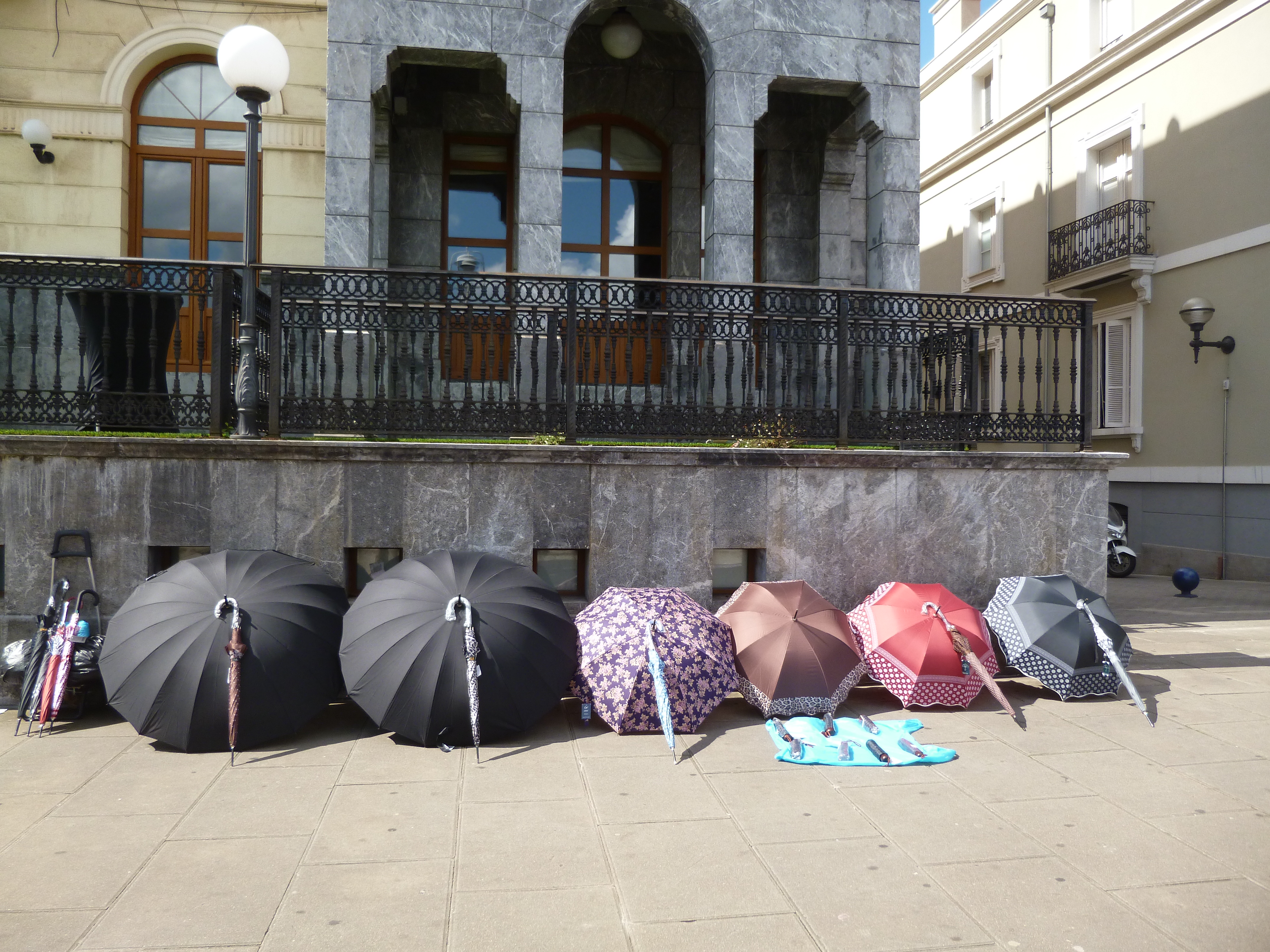
Umbrellas at a street market - Portugalete

Umbrellas at a street market – Portugalete

The walk from Portugalete to Pobeña is beautiful for the most part, and though it is “easy”, almost every inch of the 13 km. is on a walking and bicycling track that goes for miles, connecting Portugalete to the three or four towns west of it.  I end up at Playa La Arena, another gorgeous view of the blue, blue sea,  only a 20 minute walk to Pobeña, where Ria is waiting.  She calls to say that the Albergue is “competo”, but that we have an opportunity to stay in a Casa Rural,  a country house, sort of a bed and breakfast.  They have three spaces. I say, “Take it.”  The owner of the place will come to drive us to the Casa, called Casa Labeondo.  The place is lovely, though our room is fairly spare, three twin beds squinched together, and a large, modern bathroom with a nice shower.

The owner, once he has taken our passports, stamped our credenciales and explains the keys, lets us know that in the morning, we have to take the bus back to Pobeña to connect with the Camino again.  He suggests a dinner place for us, just a 20-minute walk down the hill.  I sigh, but we clean up (we’re sharing our bedroom with an older French man named Thierry) and trudge, our feet already sore.  The place serves hamburgers and pizzas, in so many varieties I can’t even read the menu.  I order an ensalata mixta, always a safe choice.

Thierry is a smoker, and I had seen him on the path from Portugalete, always stopped when I passed him.  I began to wonder whether he was a bit suspicious, but finally realized that he stops about every 20 minutes to have a cigarette.  He is coughing at least as hard as I am, but for a different reason.  As we three prepare for sleep, he and I hacking, he makes a sign with his fingers, one hand for me and one for him . . . “just shoot us!”

Monday, September 7, 2015. The night is easy, once we’re all asleep, and in the morning, we have our breakfast in the dining room of the Casa Labeonda and walk to the bus stop.  Once we are back in Pobeña, we again look for the yellow arrows.  Thierry is having a foot problem and he stays outside the Pobeña albergue, waiting for it to open early in the afternoon so he can stay put for another night.  Ria and I go on the path at our separate paces, and I encounter another 100 stone steps up to the coastal path.

I’m really writing each of these days’ events separately, but they do sound like the same thing, don’t they?  Beautiful blue skies, a raft of stone steps, and coastal walks above the sea with spectacular views.  But that’s what many of these days will be about.  Tough life, right?  The weather is being kind . . . temperatures in the low 70’s, though soon into the walks, I’m sweating like I never do in Colorado.  The exertion, even if it is not extreme, and the coastal humidity all add to the wetness of this walker.

Up on the cliffs above the coast, out of Pobeña

Up on the cliffs above the coast, out of Pobeña

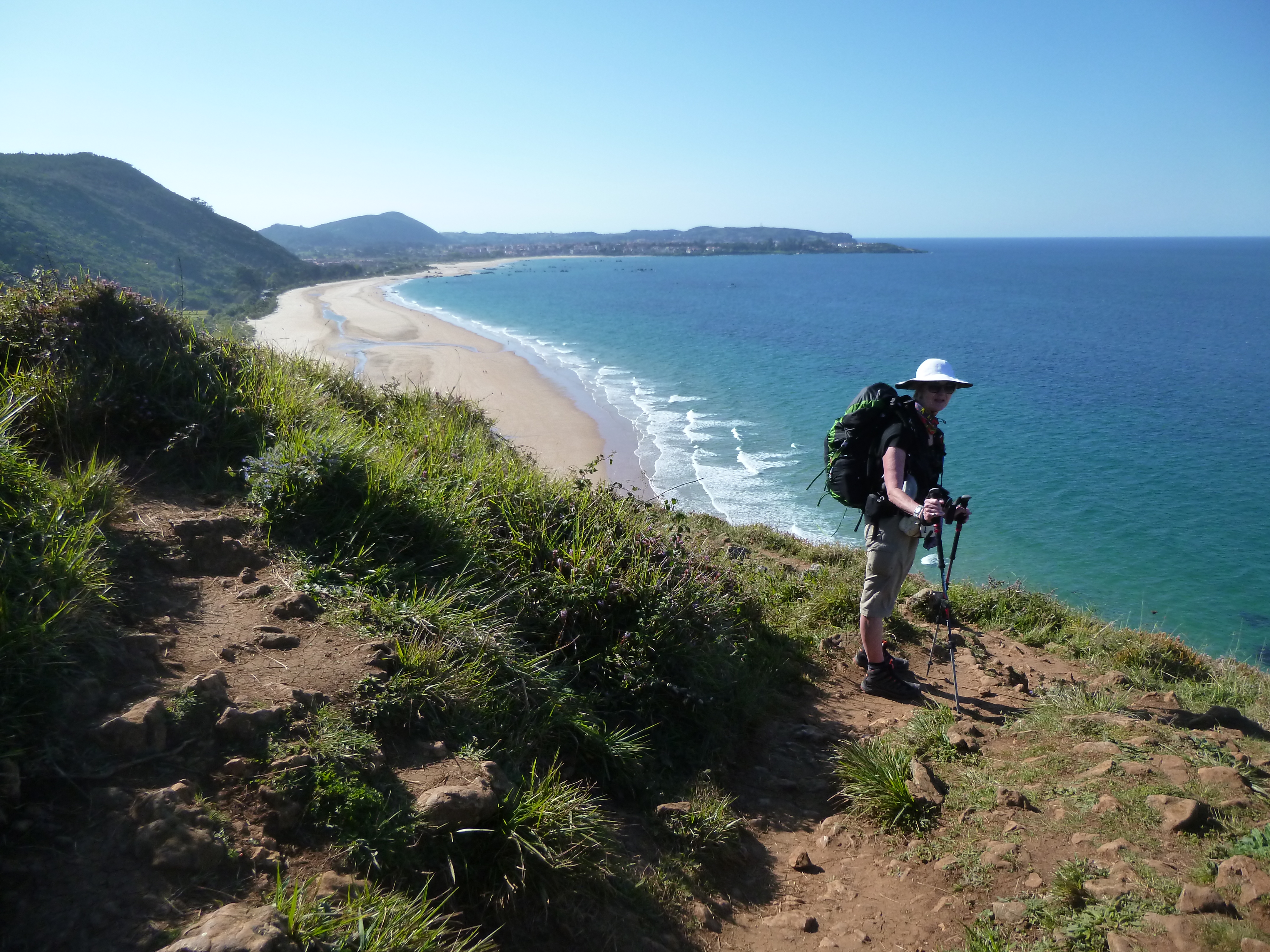
Another one of those gorgeous views

Another one of those gorgeous views

And there is pampas grass everywhere . . . an invasive species, and not much appreciated here, but it is lovely t MY eyes

And there is pampas grass everywhere . . . an invasive species, and not much appreciated here, but it is lovely to MY eyes

I get to Castro Urdiales in time to send a small package to Santiago with another pound of unneeded things in it.  I haven’t been using my iPod this time, and don’t need the external battery pack I used 0n the last Camino so there is no point in hauling it.  The days are getting easier, but that cough is still making for a more tiring day than I would otherwise have.  So every pound counts . . . and I keep reminding myself that I am not sending my pack ahead of me this time, as I did often on the Camino Frances.

Finding the Albergue is easy, and there are 16 places there.  A group of walkers have lined up their packs in the order of their arrival . . . first come, first served, but the place doesn’t open for another 15 minutes.  I see the Danish women, Inga and Bodil, and they tell me I am #16.  I hope so.  Some of the pilgrims on the other side of the building look like they are not ready for this lineup (or not aware of it).

Sure enough, I get to the registration table and am told that there are no more beds, but I could either have a mattress on the floor (after 9:30 tonight) or a tent outside.  Or the hospitalero can call a pension for me.  I have him do the latter.  Walking back to the coastline to find my Pension La Marina, I also hope to spot a washer and dryer, a real laundry where I can actually clean my clothes and know they will be dry before I put them on.

My room, #9, four flights up, smells as though a dozen Spanish old men sat up and smoked an entire carton of cigarettes, and I know I can’t stay there.  So I walk down the four flights, try to make the old man who owns the place understand “Fumare”, with some coughs just for emphasis.  His wife comes into the conversation and asks (no English, but we make do) whether I’d like my money back.  I say yes, and trudge back up the four flights to get my pack.

When I get to the second floor (Europeans call it the first floor, of course), she is waiting with a different key, and shows me to Room #1, pointing to her nose, telling me I can smell this room and see whether it is good.  It is.  Not sure why she didn’t give me this one in the first place.  Maybe they all smoke.  Bathroom and shower across the hall.  My bedroom windows are open, but the “open” space isn’t really open to anything.  Still, it’s better than the smoke, and after I get some coffee, pinxos, and do my laundry (ah, heaven to actually have a dryer), I return to my room and sleep for 10 hours.  I feel MUCH better in the morning.  More on that later. . .

Posted in Miscellany | Leave a comment

A Weekend in Bilbao

Saturday, September 5, 2015. Waking up in the Hotel Abando rather than an albergue is a shock. No sounds of the other pilgrims getting ready to hit the road at 6:30 a.m. No sound at all. Ria was in the next bed the first time I awoke, and the next time, she was gone. I’m sure she went to find a bar so she could consume her first café con leche of the day, and the first of her habitual three cigarettes. She rolls her own, you know, and carries a little ziplock bag of filters with her. Licking the filter, she places it carefully on the end of the rolling paper, and expertly sprinkles some of her tobacco, creating a perfectly formed cigarette. I should have taken lessons from her when I was rolling joints in my misspent 20’s.

Time to get up, and when Ria returns, she tells me with great pleasure that she has found a bar that serves eggs in the morning, something she knows I sorely miss on the Camino.   So off we go, and I have a real breakfast. From there, we cross the bridge to the old city again and head for the Mercado, housed in a huge building a ten-minute walk from the hotel. I expected a wide mix – food, textiles, crafts, etc. But this was all food. Mostly fish and meat, and a few stalls for vegetables, mushrooms, olives, breads, cheeses, pig snout, pig head, tongue . . . yum!  Some photos . . .

Pig's heads for dinner, darling?

Pig’s heads for dinner, darling?


And a pig shout?

Or just the snout?

With mushrooms?

With mushrooms?

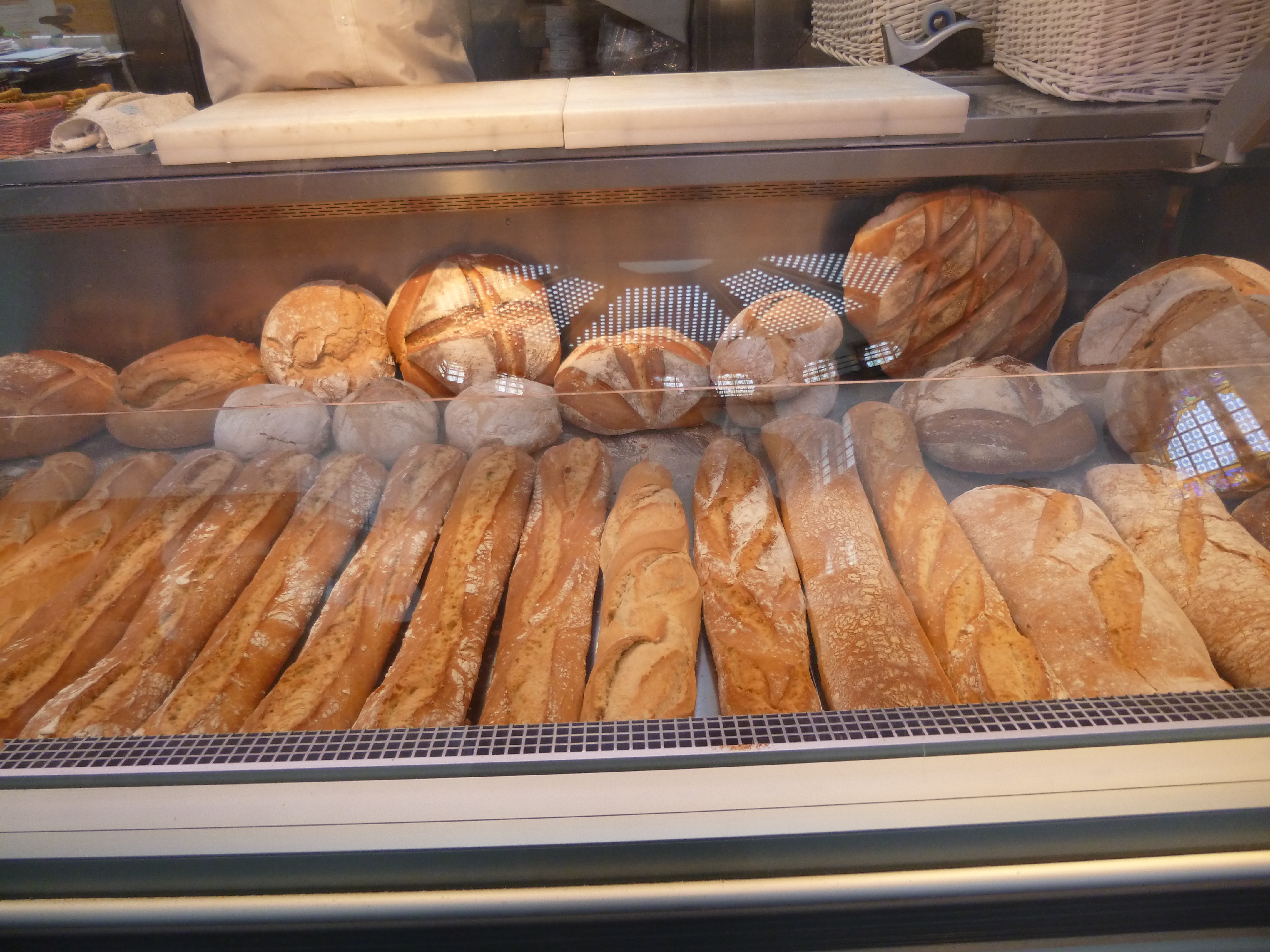
And a Spanish meal without bread is no meal at all!

And a Spanish meal without bread is no meal at all!

I’m very tired and still feeling unwell, so I head back to the hotel to post a write or two and take a rest. Our plan is to visit the Guggenheim in the early evening. I’ve been to Guggenheim museums in New York City, Las Vegas (I hate to admit it, but I WAS in Vegas about eight years ago), Venice, and now Bilbao. The featured artists are Jean-Michel Basquiat and Jeff Koons. Basquiat is fascinating, and I find myself wondering what would have become of him and his art, as well as his popularity, if he hadn’t died at 27 years of age.

The Koons exhibits arere not my cup of tea, but for the permanent installation, Puppy, a truly enormous dog made from, or covered in, flowers, on the plaza at the entrance to the museum. But the museum itself is also a work of art. Frank Geary’s design is stunning and very spectacularly “normal”. I can’t explain it, and the photos I take do not tell you anything about what I mean. The sun hits on the metal surfaces and takes away all the dimensions I am seeing from the ground. I’ll post it anyway, and you can get the drift before you go online and get some really good photos of the place.   For now . . . my insufficient representation, as well as The Spider who greets us as we turn the corner toward the entrance . . . and  . . . Puppy:

The Guggenheim - Bilbao, Spain

The Guggenheim – Bilbao, Spain


P1030309

Spider – Guggenheim Museum – Bilbao, Spain

P1030319

Puppy – Jeff Koons – Entrance to the Guggenheim Museum – Bilbao

And at the end of the day, we stumble onto a wonderful tiny restaurant about two blocks from the Museum . . . here is Ria’s dessert!

Can't even remember the name of it, but some kind of cake with chocolate, and look at the beautiful star-flower sweets for the trim!

Can’t even remember the name of it, but some kind of cake with chocolate, and look at the beautiful star-flower sweets for the trim!

Tomorrow we are to take the Metro past the ugly Bilbao industrial area, and begin walking again.  A weekend in Bilbao didn’t cure me, but the walk must go on!


Posted in Basquiat and Koons, Bilbao weekend, Camino de Santiago, Guggenheim Museum - Bilbao, Spain | Tagged , , , , | 5 Comments

On the road from Deba through Guernika to Bilbao

Thursday, September 3, 2015.  From Deba, I skip quickly past Markina (see a pilgrim getting off the bus in Deba as I get on, and two more young pilgrims joining me in Deba to points west) and walk for  two or three hours up to the Monasterio de Zenaruzza.  Though the little town names are getting shaky in my mind, I think this is the day I walk through Bolibar . . . the home of Simon de Bolibar (Bolivar as we learned in history class.)

The Monasterio was on my list, recommended by several summer Norte walkers, as well as the guide book with which I still have a love-hate relationship.  The two Danish women, Inga and Bodil, (the ones who thought they were the oldest until they met me . . . ) pass me and say they are heading up there as well, but when I get to the Monasterio and walk around to find the entrance, no one is there.  I ring a bell at the gift shop (of course) and a plain-clothed priest greets me, surprised I am alone.  I try to explain that two other women were supposed to be here, but he just shakes his head.  I am shown to a room with a kitchen sink, a table, cupboards, and four sets of bunks.

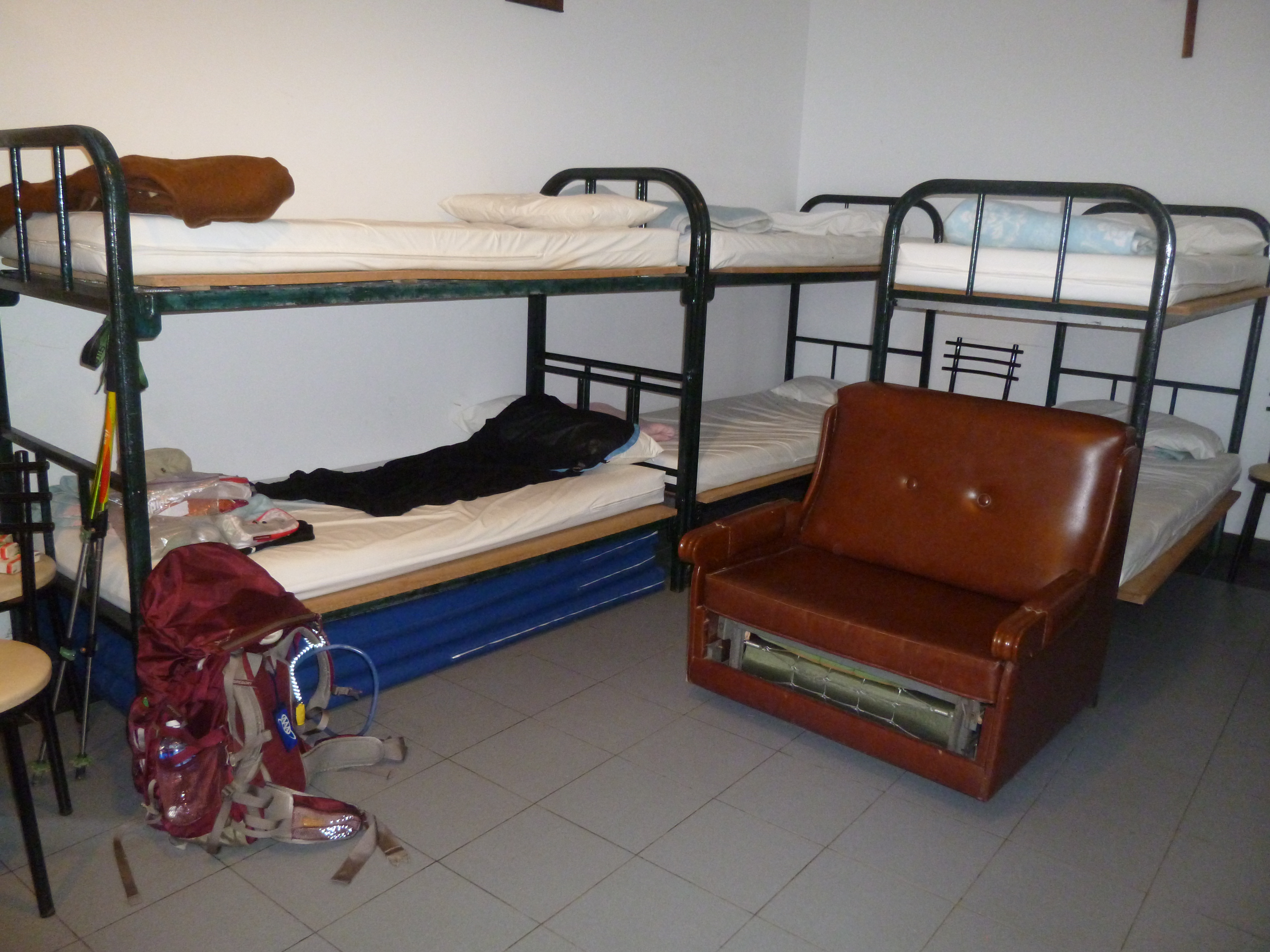
Monastic sleeping arrangements, and a sad recliner couch

Monastic sleeping arrangements, and a sad recliner couch

I choose the one nearest the door, give the padre my credenciale and listen while he tries to explain the location of the bathrooms and showers (outside and downstairs), the procedure for washing my clothes, and that dinner will be at 8:30, after Mass.

Eventually Petra shows up as well as a young couple from Valencia, 20-year olds.  She with dreadlocks and he looking like he might barely be 15.  Students in Valencia, they need to be back for class  on Monday.  The priest returns at 8:30 in full regalia from the Mass, carrying a large pot of lentil and carrot soup.  We help ourselves, clean up, and go to bed early.  During the night the rains come down, and of course my laundry is hanging outside.  By the time I realize (at 4:30 am.) that I will need to move the drying rack (a laugh at this point) to a covered area just outside the bedroom, the clothes are more wet than they had been when I washed them. So I wrap them up in my pack towel in the morning and put them, soggy, into the pack.

I had asked the priest before dinner whether he had some honey for my cough, and he took me to the gift shop and sold me a large bottle.  Just what I need to carry with me.  After dinner, he returned to our little hovel with a jar the size of a baby food jar, and I poured some of the honey in the jar so I could take it with me.  That idea lasted one day, and I leave it in Bilbao at the hotel (more on this later).  Seriously . . . all I need is more weight.  The balance of the jar became a donation to the next group of people at the Monasterio.

Friday, September 4, 2015. Breakfast is VERY simple,  Can you guess?  BREAD.  and a bit of marmalata (very good), and some of my own mint tea.  I pass on the instant coffee and instant something else in a jar, and pack up quickly, headed to Munitibar and Guernika.  The road seems smooth initially, through the woods, musty and dank.

Woods for the woodswoman

Plenty of woods for the woodswoman

At one point I see a group of bicyclers at a fork in the path, with two yellow arrows, one for each direction.  The bikers say the right path is recommended for them because the left path is not good for bicycles, but they think they’ll take the left path anyway.  I look down the left path and it is quite nicely paved, so I choose it.  Apparently the bikers don’t, and I wish I had followed them.  I should know better by now.

The paved path becomes dirt, which is fine, but after all the rain in the past two days, the mud is very slippery and the road dove steeply down the hill.  WAY down.  I know I keep saying it, but this road is not a good thing.  Everyone who passes me talks about how treacherous it is.  One man said, “You’re doing well.  You should hear those Spanish young women behind you wailing about the condition of the road.”  I don’t dare test my balance by trying to take a photo . . . sorry, all.

Well, “those Spanish young women” came along behind me just when I was stuck, with no way down that I could see . . . down off a high mud-step.  Two of the girls go around me and one holds out her hand.  “Do you need some help?”  Yes, ma’am.  Finally the track is over, at least for awhile.  Munitibar is ahead, and I stop at a bar.  The woman makes me a fresh omelette, with tomato and cheese.  Bread, of course, and some mint tea, and I sit for a while.  I’m headed to Guernika and will meet Ria there.

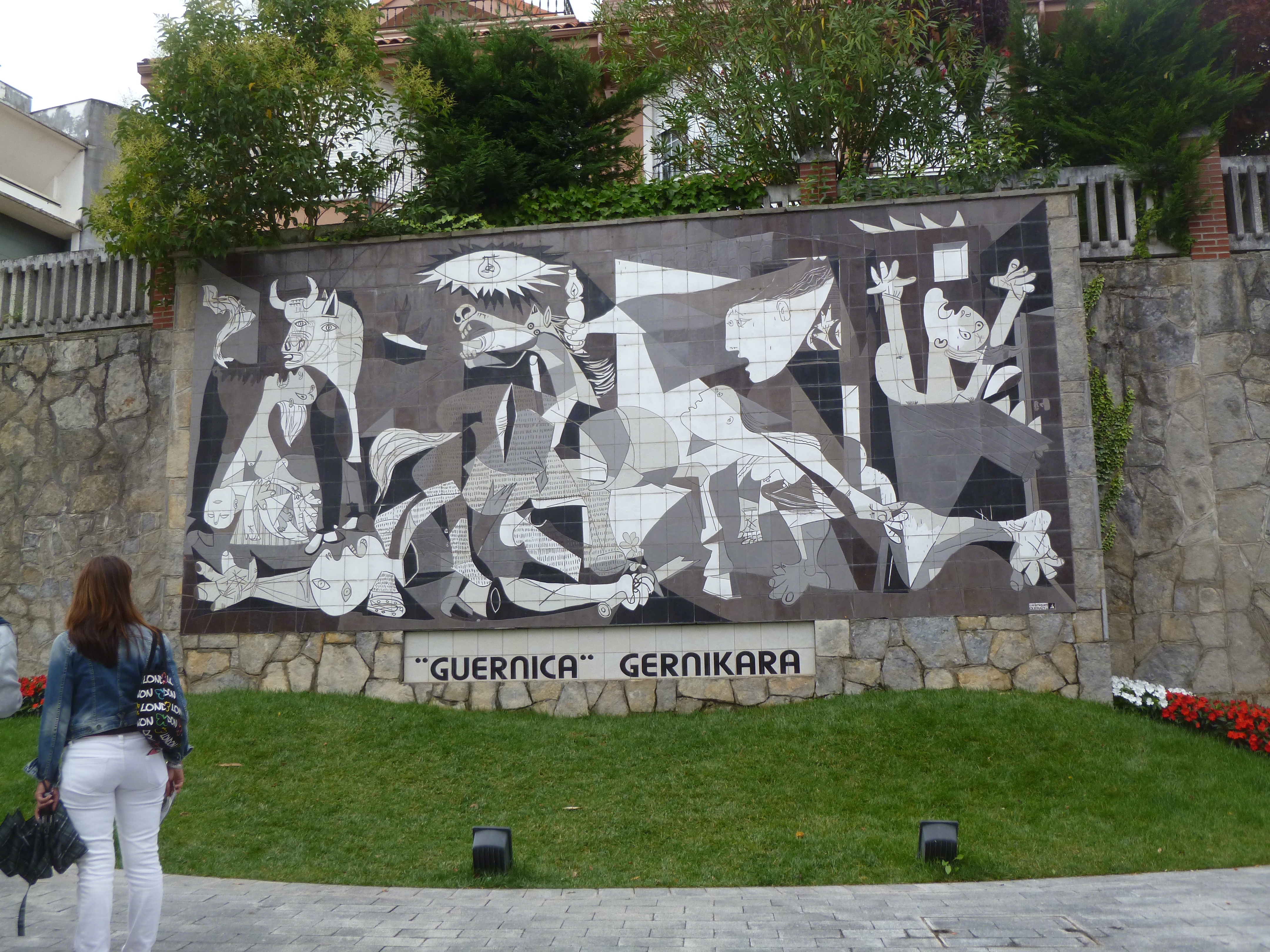
After we see the Museum of Peace we will bus it to Bilbao for the weekend.  Unfortunately, the text at the Museum of Peace is all in Basque and Spanish, and sometimes German, but not at all in English.  I’ve seen Picasso’s original at the Sofia Reina Museum in Madrid and in Guernika there is a copy in the museum as well as one at a nearby park.  A stunning representation of a tragedy of the Spanish people, victims again and again.

A reproduction of Picasso's Guernika

A reproduction of Picasso’s Guernika (or Guernica . . . depending on whose dialect you are using)

By the time we board the bus it’s 5:00, and we have jumped our budgets, booking a room at the Hotel Abando . . . yes, abandoning our budgets for the Hotel Abando.  A great choice, just two blocks from the bus and train station, with very nice men who don’t comment on the fact that these two oldish peregrinas didn’t bring proper attire for Bilbo nightlife. But the cheap Pensiones are all “Completo”.  I tell Ria she can pay whatever she can afford, and I’ll pay the rest.  My crud is not going away, and I need a rest, though a weekend in Bilbao was already in my headlights before I arrived in Spain.  I hope this weekend will help get rid of this stuff soon.  Typically it lasts and lasts, and I do NOT need that.

Showered and changed into one of my three shirts, I get ready for a good dinner.  However, we head to the old part of town, having been warned by the hotel reception man that Spain doesn’t start to eat dinner until 9:00.  We’re on Peregrino Time.  This downtown part of Bilbao is beautiful, with the river snaking through, and walking paths everywhere.  It is truly a walking-friendly city.

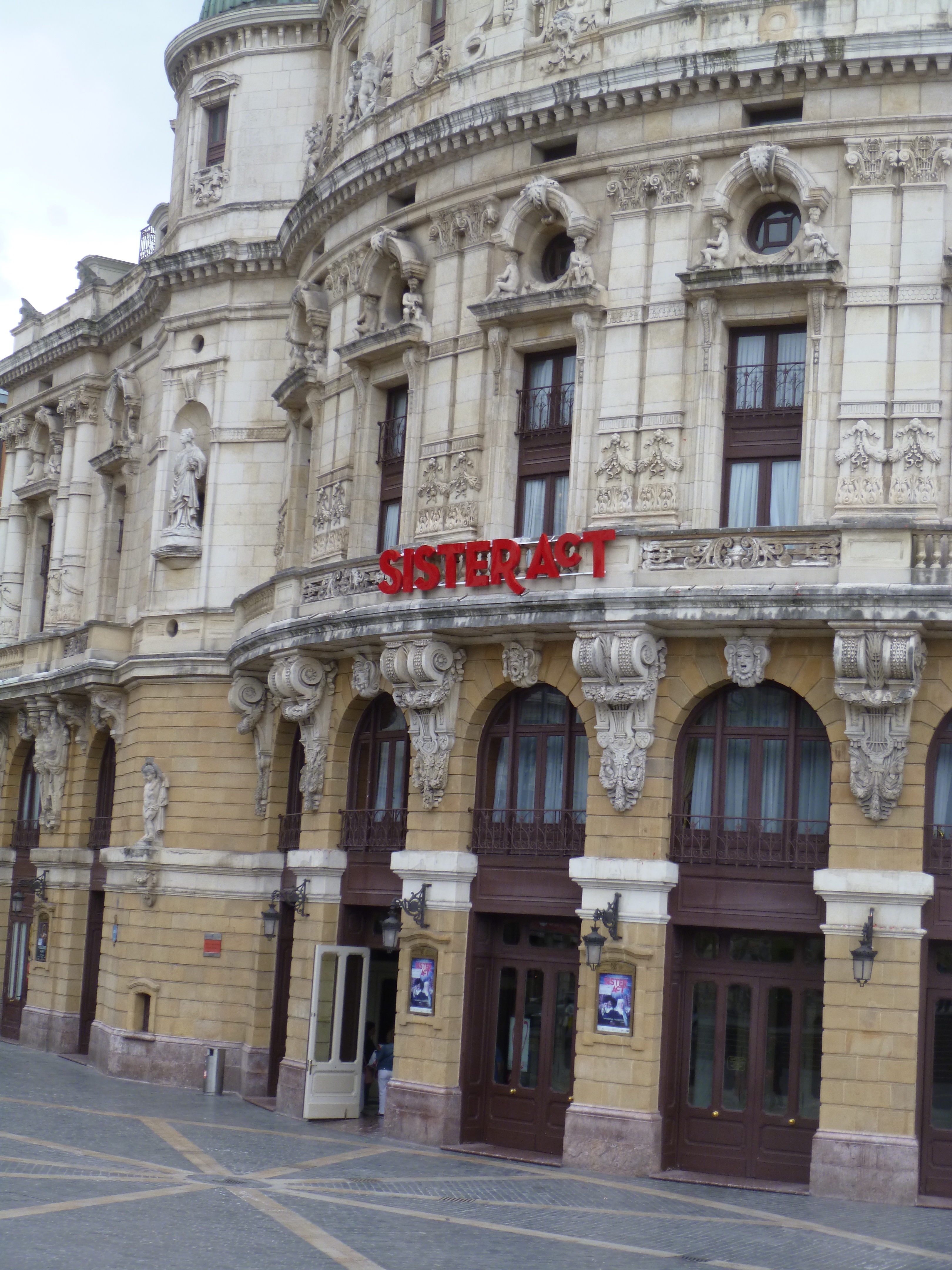
One of the first things we see is a theater playing “SISTER ACT, THE MUSICAL”  and I find that hilarious!

Sister Act . . .

Sister Act . . .

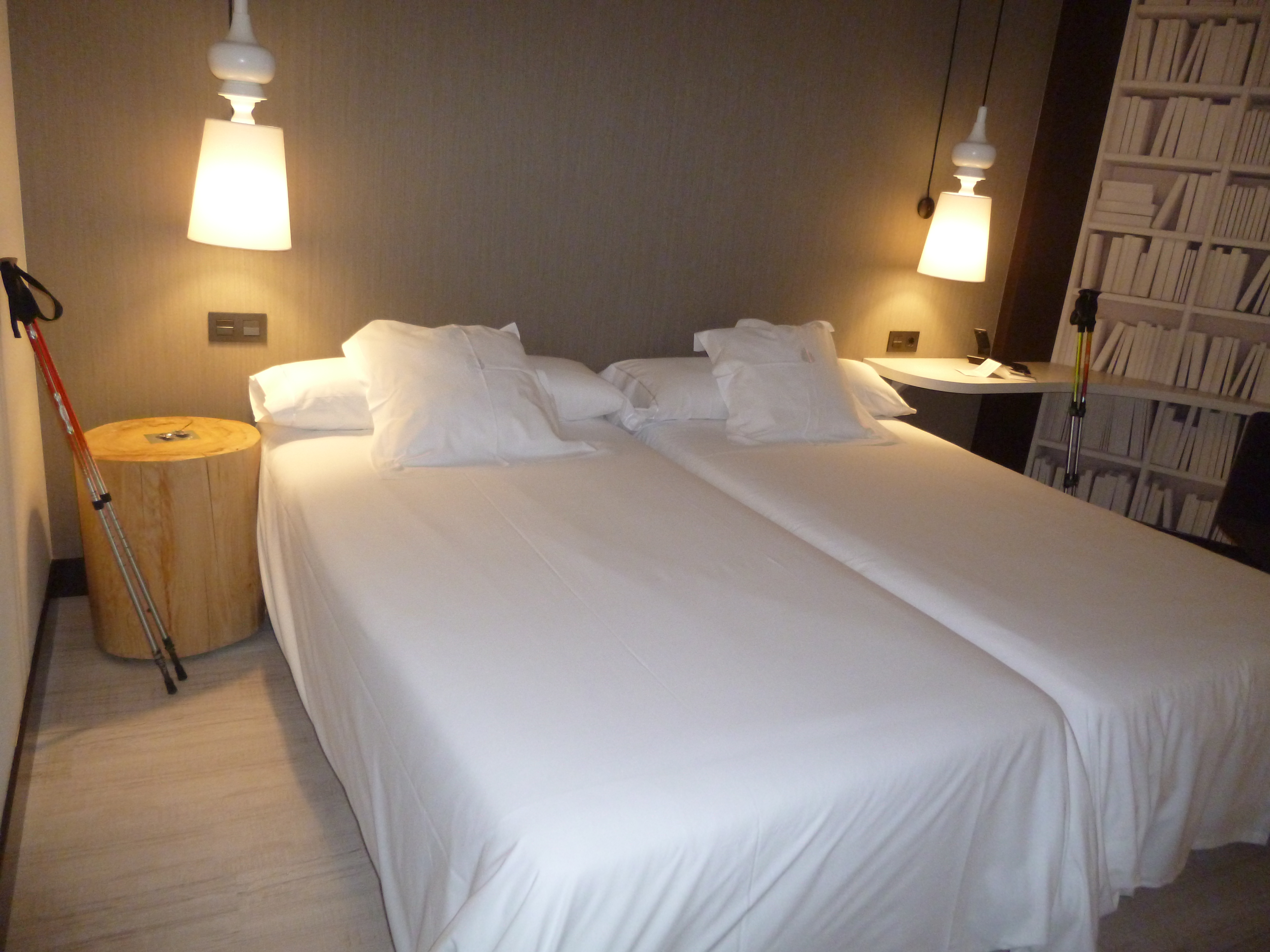
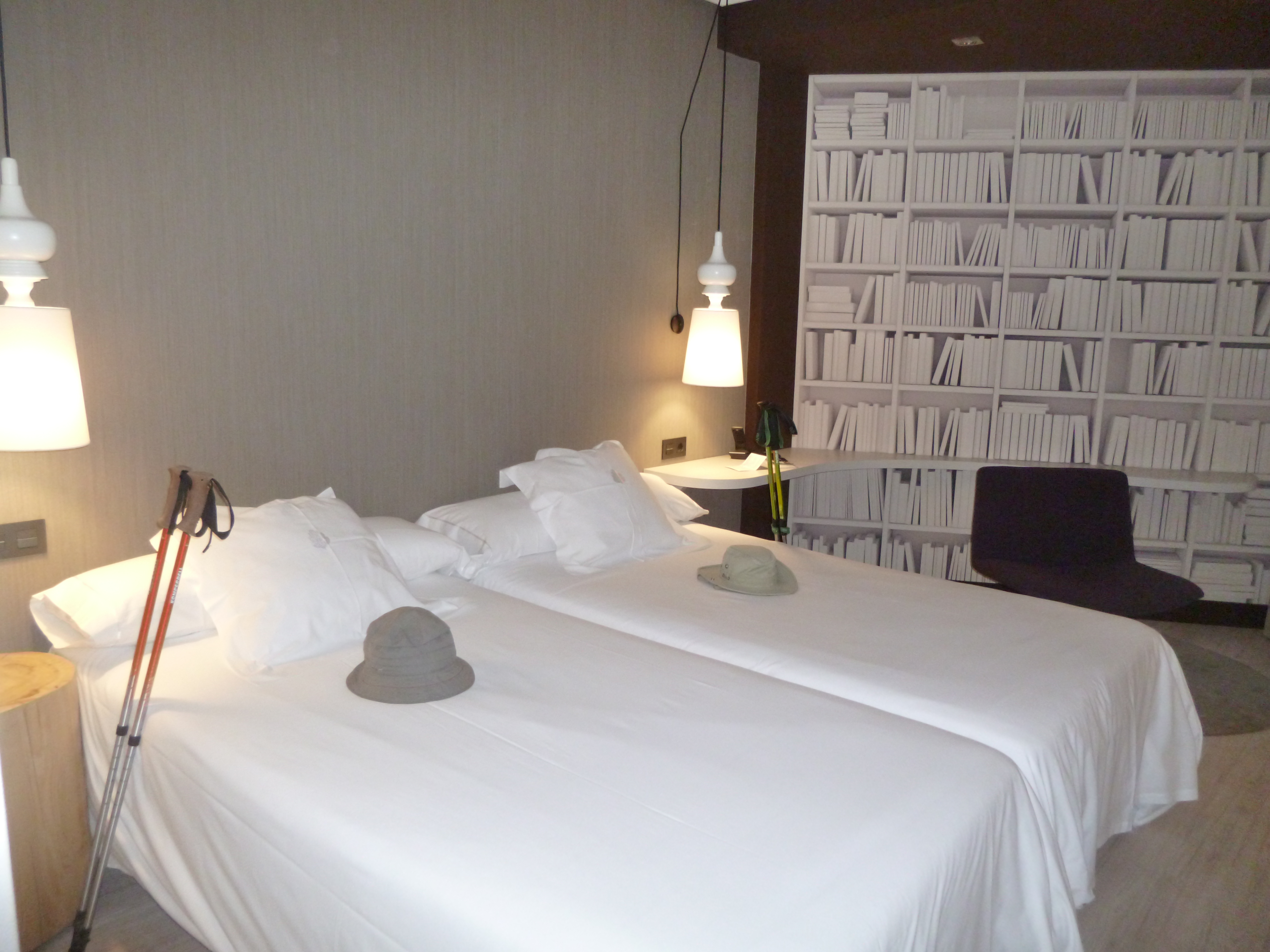
Here is our sweet, perfect white hotel room, before we settle in, then with the hats, and then the packs.  I won’t show photos of what it looks like during the weekend.  We are both “organizing”.

P1030264

A pristine room at the Hotel Abando . . .but for our poles

And check out the bookcase full of blank book covers on the side wall . . . Looks exactly like a bookshelf of blank books, but it’s ingenious wallpaper . . .

Our minimalist decorations . . . our Camino hats!

Our minimalist decorations . . . our Camino hats!

Our real settling in begins now . . .

Next come the backpacks

Next come the backpacks

Posted in Albergues on the Camino, Camino de Santiago, Oldish world traveling, Spain, Women Walking | Tagged , , , , | 1 Comment

Reflections, Part One

September 3, 2015.  Waking up in my own room in Deba was luxurious, and it gives me a chance to do some writing before I move to the next stage of the journey.  As I have walked during the past two days, I notice my thoughts have stayed with a theme or two . . . for whom am I walking , and for whom am I writing?

When I began this website very early in 2012, 18 months before I started the Camino Frances in September 2013, it was for me and I didn’t give much thought to readers.  I’ve been keeping a journal since I was a little girl, and I couldn’t imagine taking on such a venture as a walk across Spain without writing down my preparations, thoughts, fears, whatever from the moment I made the decision to do this thing.  Yes, I thought about the possibility of a book eventually, and with all the book ideas I’ve had over the past 25 years, perhaps one day I’ll be the oldest living “first book” female in the annals of history, but one step at a time, both literally and figuratively . . . Write for me, walk for me, and see what happens.

My daughter signed on to follow and so did one of my sisters.  That made sense because Ashley had written her way across the southern hemisphere with her husband during that same time period, and my youngest sister had been a “blogger” for several years.  Everything from the Houston Zoo site to one giving us great suggestions for unique Christmas gifts.  Then a friend or two here or there added their e-mail addresses to the “follow” list, as well as my other sister, and one by one, I had about a dozen followers.  As the date of my departure in 2013 drew closer, my sons added themselves to the list, as did some writing students, and a variety of other well-wishers.  But I was writing for myself, as I have always done.  I noticed one day that the number of followers had risen to over 350.  How did that happen?  I’m not sure, but the internet does strange things without anyone even noticing.  People are interested in the kind of adventure I’m taking, just as I was interested when I saw Emilio Estevez’ movie The Way, written with his father, Martin Sheen, in mind.  I saw the film and immediately decided I would walk the Camino Frances.  And I did.

At this point, I see by WordPress’ stats that I have over 700 followers, and this “audience” factor is both an encouraging thing and a daunting one, once I posed the question to myself:  To whom am I writing?

Yes, I do know these followers want to . . . well, follow.  They are supportive, appreciative, loving and non-judgmental.  This last is important, since I have plenty of judgment so surround myself sometimes.  And I also know that writing my journey is very important to me.  After all, surprisingly enough, I used the material from the last Camino, reshaped and added to, edited and cut down, to finish a Master’s Thesis attempt I’d been struggling with for more than a dozen years.  The writing I had done before, during and after my first Camino was useful to me in personal and professional ways.  And as a great side benefit, those followers seemed to really enjoy what I wrote.  For some, reading was a caring gesture.  For others, it was an energizing factor in making their own decision to walk the Camino.  And I’m sure there are dozens or hundreds of other reasons why a person would follow someone they don’t know, or even someone they DO know, watching a life’s adventure unfold.

I have MOO cards, printed with one of my scenic photos on the front and my information on the back, including the address for this website.  I invite people to read my words, every time I hand someone a card.

Yes, my posts were true, descriptive, and reflective.  Whatever showed up on the page was a valid representation of my days at any given moment.  That is still true.  No, I never thought of just bagging it.  Yes, it was hard at first, and yes, it got easier and I got stronger.  All those things were what I expected on this route.

But it doesn’t just move along slickly, with my last walk’s patterns in some tissue-paper overlay for this one.  Beautiful coastal walks, very hot days, more difficult pathways than I expected, a couple of early tumbles, and now the wretched and arriving-way-too-early bronchial plague I’m famous for.  Now.  Though my body has recovered from the falling jolts, it is now fighting the blows to the midsection every time I cough.  Time will heal this, and nothing else.

My step-by-step musing has come to this.  I will walk for me.  I will write for me.  I will stop or go on, by foot or by bus, as I need to.  And with every step, I’ll smell the smells, hear the sounds, see the sights, feel my feet as I struggle up and down the hills and mud, give thanks for sunny days with not too much heat, for coastal views and fairly manageable walkways.

And I will definitely know many people are with me in spirit.  You’ll continue to take what I write and I’ll continue to write what shows up from my heart and head through my fingers.  And no matter what, I will have a buen Camino.


Posted in Miscellany | 11 Comments

Orio to Zumaia to Deba

NOTE:  An adjusted post.  Some of you might have seen part of this erroneously attached to August 31 narratative.  Again, mea culpa.

Tuesday, September 1, 2015  Happy Birthday, Mom! She would have been 94 today. And she still would have thought I am crazy to do this. She would be correct.

Oh, and I have solved the mystery of the missing pills and glasses.  Ana, one of the hospitaleros in Pasai Donibane, wrote to say I left the ziplock bag at the Albergue with the 119 steps, and I’m welcome to come back to get it.  Seriously?  I ask if someone at the Albergue can send it on to me at the post office in Santander.  She replies that she is now in Barcelona, and that “all you have to do” is take a train back to Irun and then a bus to Donibane.  I don’t think so.  I’ll find a way, but have to get replacement pills, at least the Metformin.  There is time for that.

I leave Orio, stopping in the village for cheese, ham, and a banana, and set off up the hill again toward tonight’s destination: Zumaia. 17 km. I come to Zaurutz, another city with minimal markings, and decide to do the coastal route, rather than the mountain route today. As I walk I begin to figure the number of days I have to walk, the number of kilometers and the difficulty of the terrain on at least 1/3 of the days. At the rate I’m going, I can’t imagine how I will actually finish without having to employ a faster method of transportation here and there.

For now, I’m sitting at Charly Bar, on the boardwalk in Zaurutz, right on the sea coast, having just finished two delicious pinxos, an enormous ensalada mixta with tuna, white asparagus, hard-boiled eggs and fresh tomatoes.

Delicious salad on the beach at Zarautz

Delicious salad on the beach at Zarautz

As an aside, there is a little girl, perhaps five years old, who has been having a rising tantrum on her scooter since long before she began to sit in front of me. Finally she starts punching her brother, her father gives her a couple of swats on the behind and put her in a chair in front of me. She’s been screaming ever since, the kind of scream that lets you know she’s practicing to be Sarah Heartburn when she grows up, and the parents properly ignore her. At this point, she is trying to tip over a table, while her brother sits next to her attempting to prevent complete chaos from ensuing. Now they all walk away from her, warning that if she wants to follow, she had better behave. Children and parents are the same everywhere,, it seems.

I walk to Getaria, starting to cough.  The sore throat that threatened to become something bigger in the week before I left Colorado had subsided, so I thought I was through with it.  But here it is again, along with a familiar beginning of my winter chest cold.  Not a fun prospect with 780 km to go.  I sit at a bus stop just to rest, and the bus comes, taking me to Zumaia. I had not thought of this option today, but there is the stop, and there is the bus, and within 10 minutes, I am at my destination, saving myself another five kilometers. I am beginning to feel guilty about this, and the feeling will take over on tomorrow’s walk. A big new lesson for me to chew on. More about that soon.

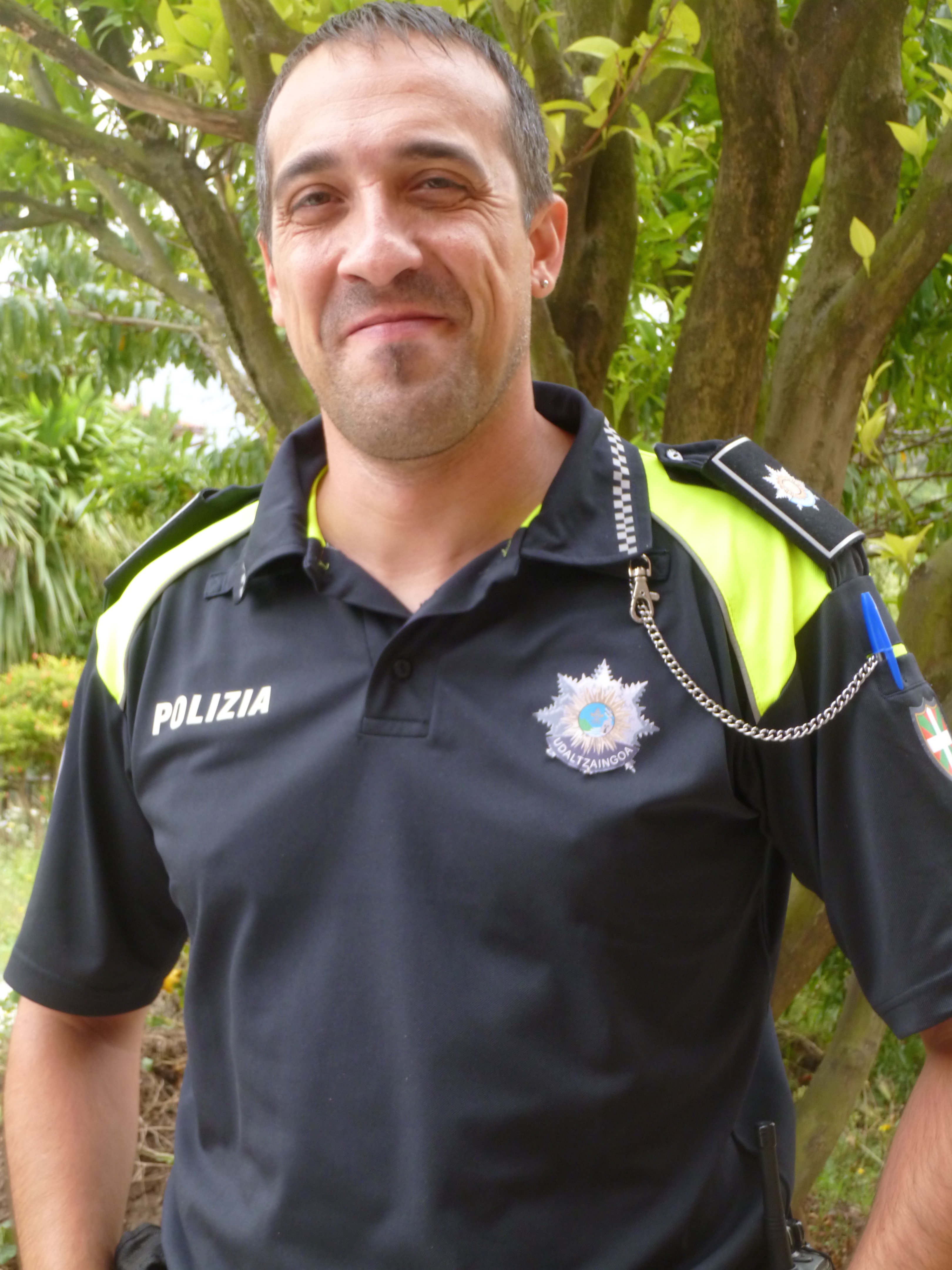
Since I am not following yellow arrows into town, I’m not sure where the Convento-Albergue is located, but I do spot a police station and walk there to ask directions. An adorable young policeman sits at the desk and tries to explain where I should go, apologizing constantly for his poor English. I remind him as often that I have nearly NO Spanish, and we laugh.

He takes me outside, points to a big building, and begins with directions. I am puzzled. He ducks his head into the little Polizia building, tells the man he will walk with me to the Convento, and I hold out my wrists. “Would you like to put me in handcuffs? It will look interesting . . . policeman arrests oldish pilgrim in Zumaia.”  He smiles, hoping he understands me.

We talk about where he has been in the US . . . NYC, DC, Philadelphia, before taking a train to Toronto.  He’d like to go to California (and Colorado, now), but he has a new baby . . . perhaps in five years, the baby will be old enough to take with him and his wife.

Continuous apologies for his “poor English”, and then we are at the Convento gate.  He ducks his head to walk through, and gestures that I am to follow.  I ask to take his picture, and he smiles a shy grimace.  Then he kisses me on the cheek, ducks back through the gate in the stone wall of the convent, wishing me Buen Camino as he retreats down the hill to the Polizia station.  What a treat!

The kind policeman (and inadvertent guide to the Convento)

The kind policeman (and inadvertent guide to the Convento

Since I took a bus for the last few kilometers, I actually beat Ria. Petra and Yanira are already in the reception area and Petra says, “Ria will be so surprised!”  True. When Ria does arrive, she stops and says, “Taxi?” I shake my head. I”ll tell her later.

The hostess, Mari, takes me to my room . . . a single bedroom. “The old people get to sleep alone,” quips Ria. “

However I can get it,” I respond.

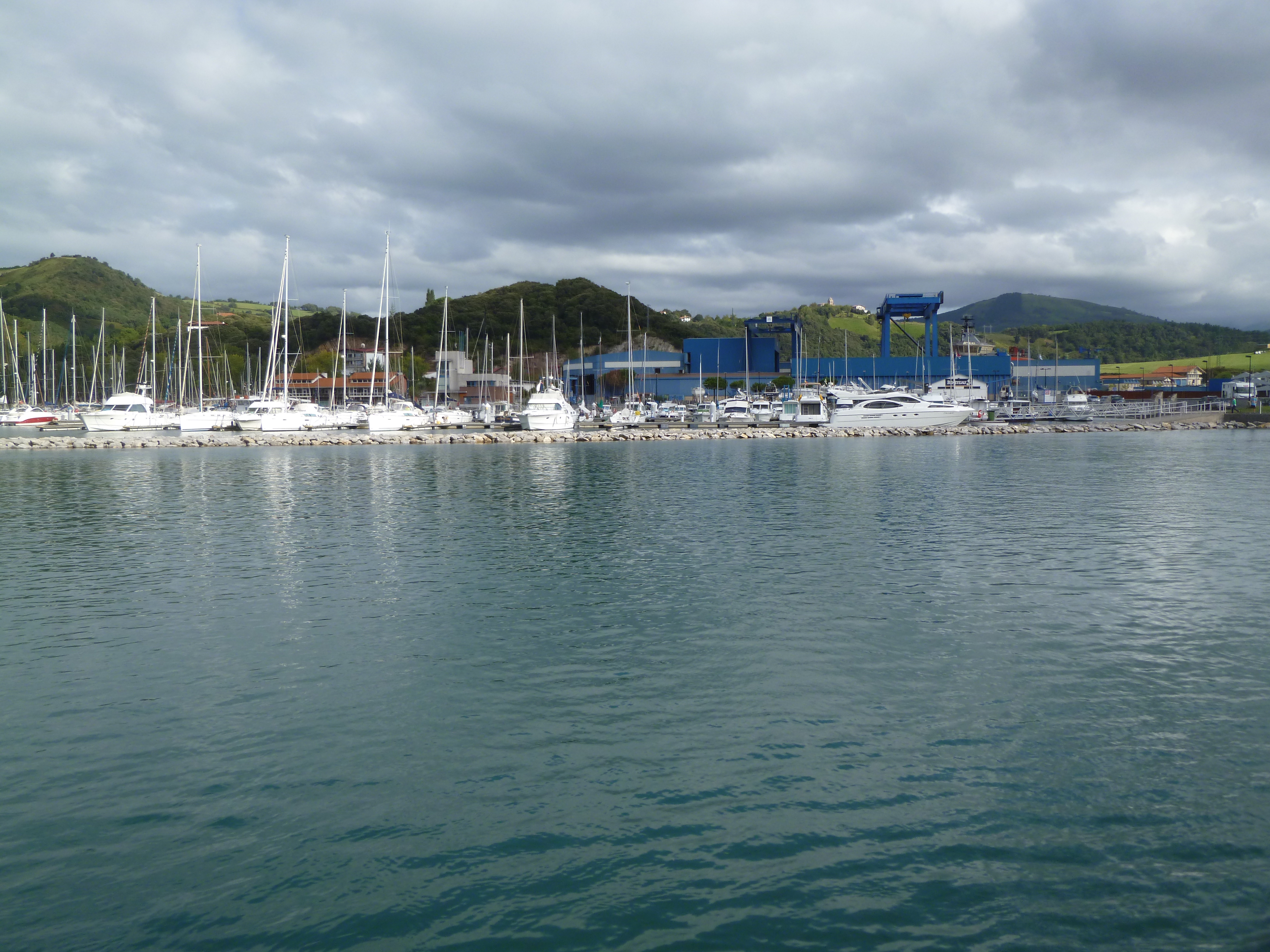
The boats at Zumaia

The boats at Zumaia

Pinxos tonight, a walk on the shoreline of the harbor, watching parents and children swimming, then café con leche and some pastry, more pinxos, before we go back to the Convento and make a second or third snacky dinner with the ham and cheese. We’ve also bought bread and tomatoes so we sit out in the garden with many other peregrinos, talking about definitions for the word “closet”.  It’s a moment thing, as my daughter would say, but it starts because a German young woman asks me whether “closet” is a correct word in English . . . I nod. “A place to hang your clothes, yes?” I nod again. Then I can’t resist . . . “Or a place to hide your homosexuality . . . before you tell your parents and your employer.”   And we’re off.

One man says, “Oh, no one has to be in the closet anymore, yes?” I tell him it depends on which country you live in and where the conservatives hang out. So the conversations continue.

Sometimes on my last Camino, I avoided sitting at a table with a mix of people, having these interactions, but tonight the scene is just right. After an hour, Mari comes out to ask whether I would like a eucalyptus steam treatment. She has heard me coughing, and she has some freshly dried leaves. She gives me a basin and a real towel, takes me to the teapot to warm some water to pour over the crushed leaves, and wishes me good health.

In my little room, I think again of my mother, who used to give me these same treatments, but with Vicks Vap-O-Rub rather than real eucalyptus leaves. And I inhale, both the vapors and the memories of the magnificent Rosemary.

You've seen her before, but hey, it's her birthday! Rosemary Teresa Mercurio Joseph . . . 1921-2012

You’ve seen her before, but hey, it’s her birthday! Rosemary Teresa Mercurio Joseph . . . 1921-2012


September 2, 2015. Today I walk out of Zumaia and who knows how far I’ll get.  One possibility is to stay tonight in a “nature setting”, meaning just a sleeping quarters with no town around it, 5 km past Deba.  The other option is to stay in Deba itself.  My cough is just revving up, and I’ll see how the path goes and how far I will be able to travel.

The day is near perfect for walking, with cool breezes and some cloud cover, but enough blue sky to enliven the sea view as I walk.  Our hospitalero, Mari, has suggested that we take the “German Way” for awhile, marked with a white and a red horizontal stripe, rather than the Camino’s yellow arrows.  A bit longer but not by much, and with sweeping seacoast views.  And it joins with the Camino very soon.  So off we go, first together, and then alone, each at our own pace as usual.

Here are some tempting eye-treats:

The coastal way out of Zumaia

The coastal way out of Zumaia

Another rewarding view for walking the coastline out of Zumaia

Another rewarding view for walking the coastline out of Zumaia

And when the path takes me back to the countryside, I must share with large tractors moving hay on the path

And when the path takes me back to the countryside, I must share with large tractors moving hay on the path

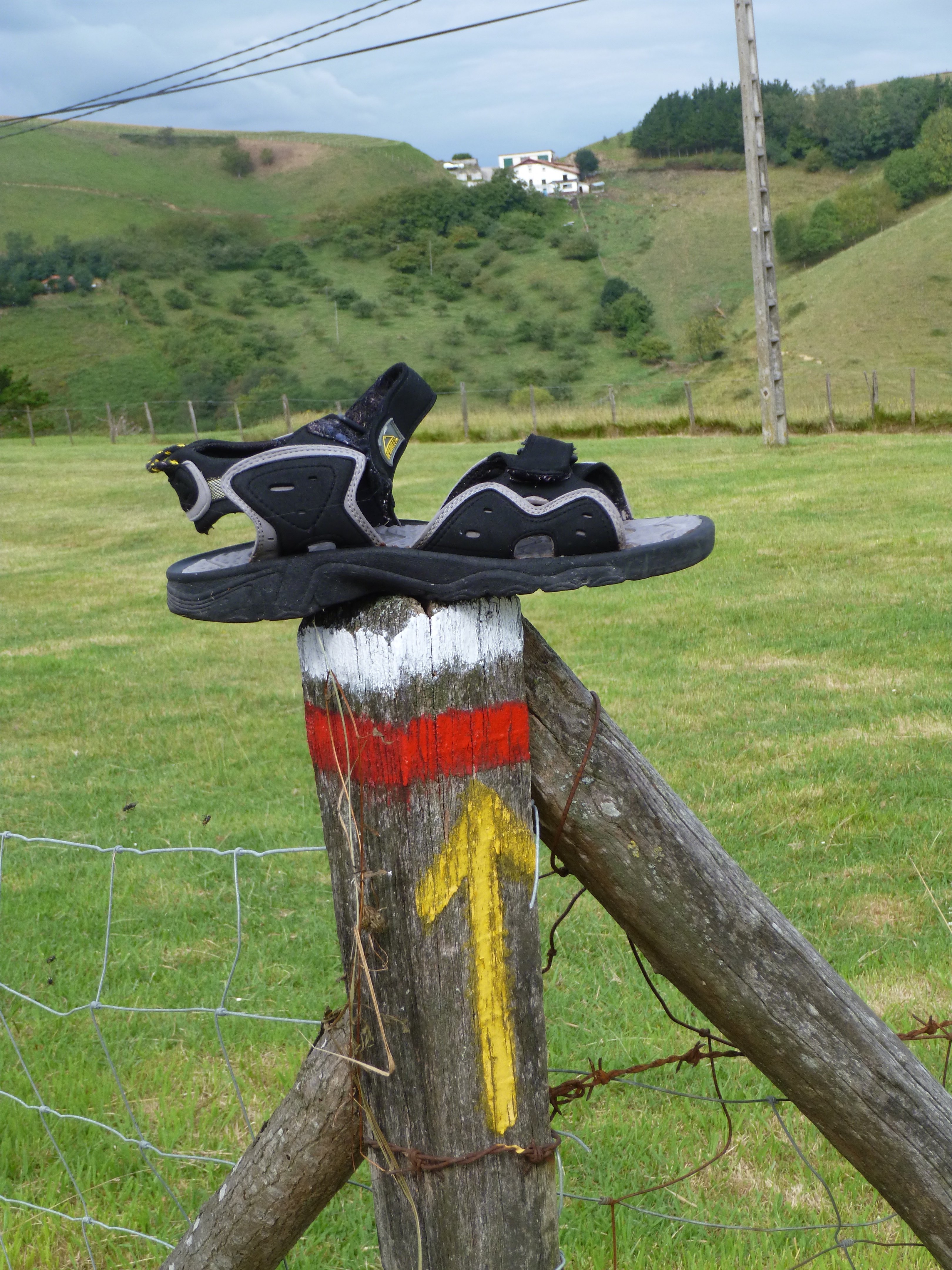
Remember the Keen sandal I found on my last Camino? I doubt this one will find its owner by my efforts . . .

Remember the Keen sandal I found on my last Camino? I doubt this one will find its owner by my efforts . . .

After several hours of up and down, through farmlands, I hear a buzzbuzzbuzz.  Sounds like a weed-whacker, but there are only wide open rolling hills.  I come up over one of them and see, to my complete surprise, an old farmer literally weed-whacking his several-acre hillside.  Perhaps it’s too steep to to cut with a tractor, but this work looks endless.

On the way past this man, I meet Mark and Stacy from Boston.  They seem to be going at a pretty good clip, though they tell me this is their first Camino and ask me how it compares to the Frances.  They say it seems really difficult.  I tell them I’m very happy I did the Frances first, and yes, this one is much harder, at least so far.

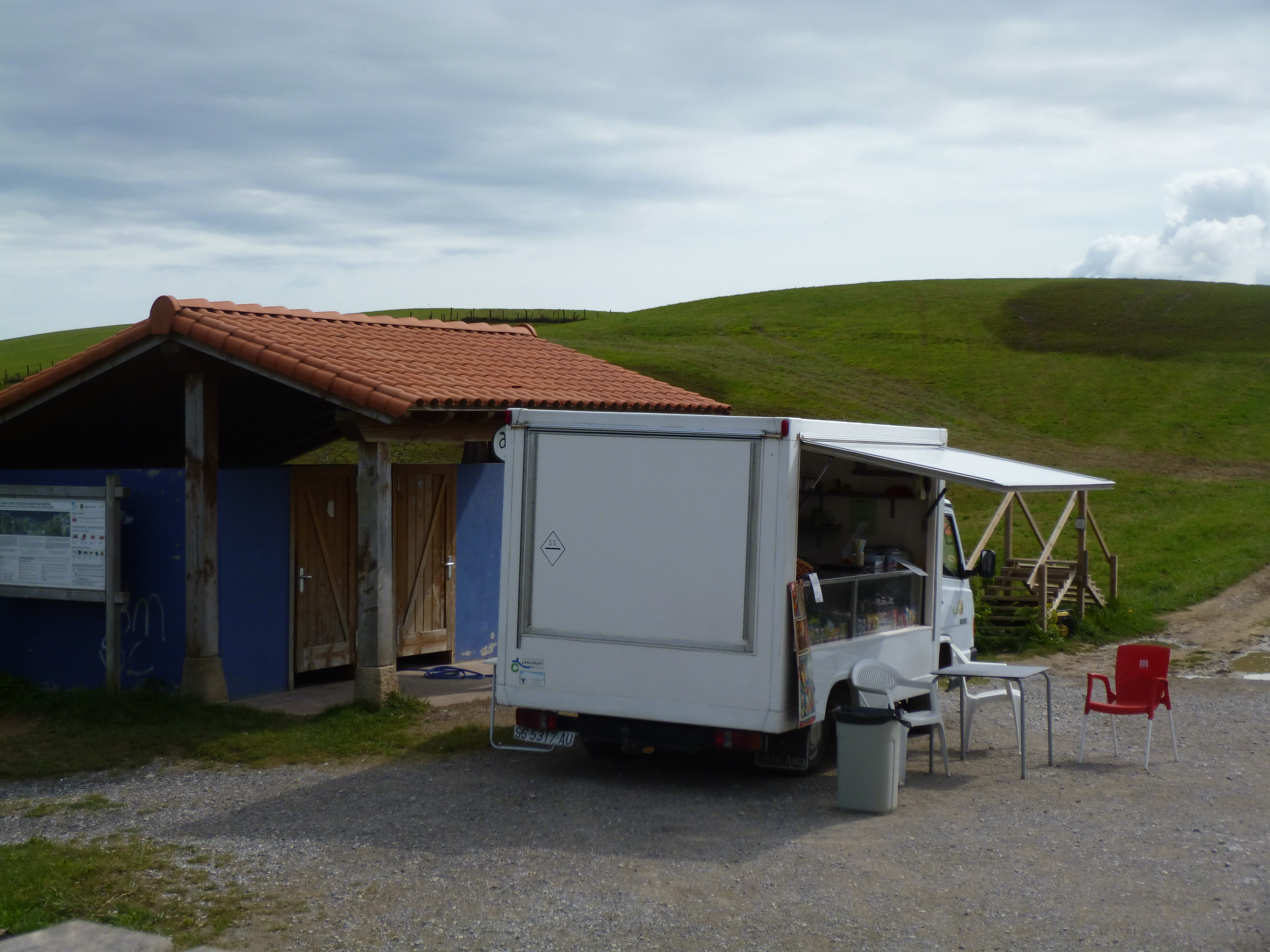
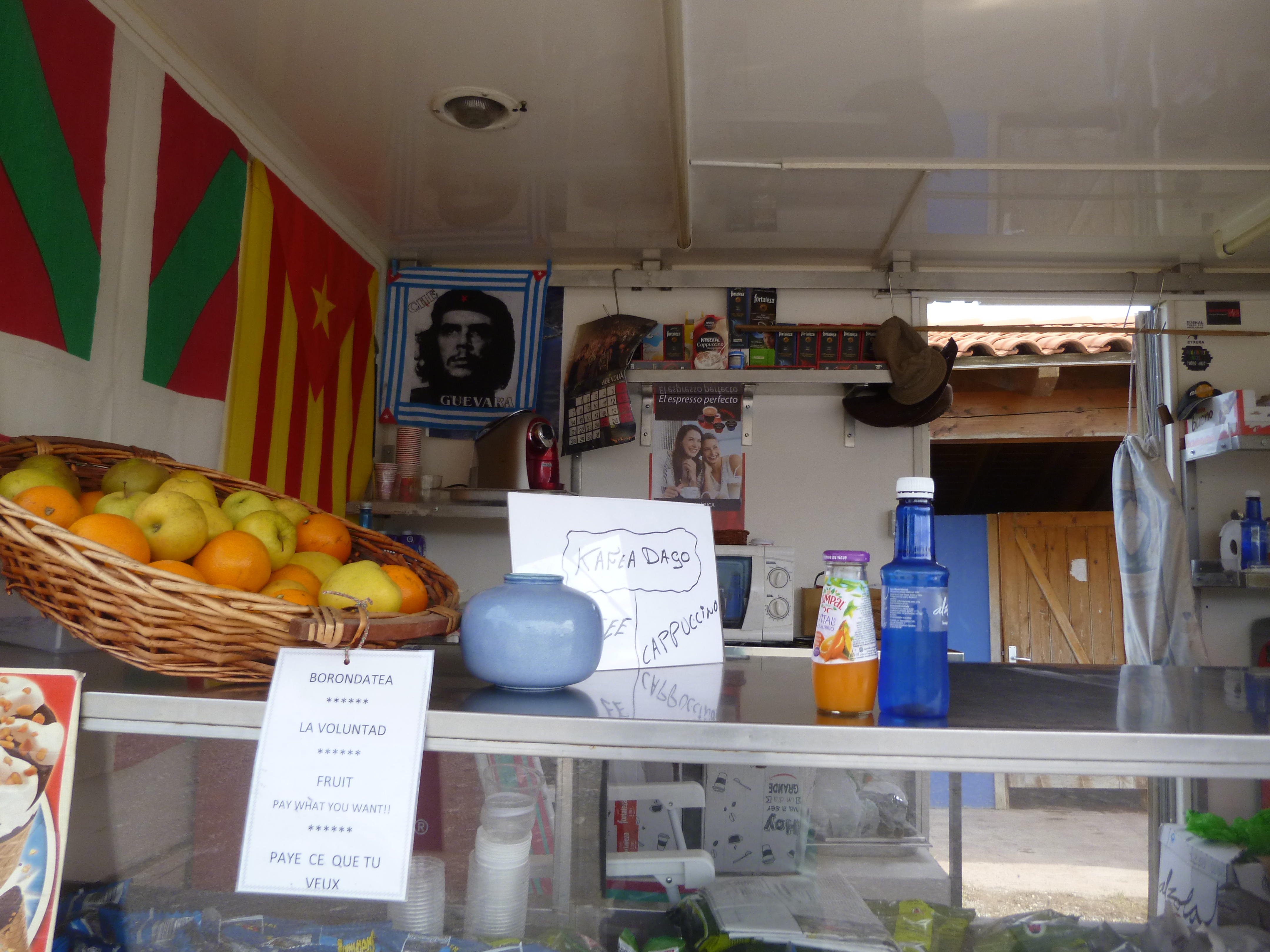
We all turn a country corner and there, in the middle of nowhere, is a food-truck and WCs, picnic tables and a park area.  An older man stands ready to deliver juice, water, bocadiillos already made up, or one made to order.  I choose the latter.  He gestures toward a baguette, asking how big I want the sandwich, shows me some prosciutto (called something else here), and I ask for tomato.  He nods.  Always a surprise on these pathways and sometimes it’s a good one, not muddy, rutted, rocky downslopes.

A surprise food truck!

A surprise food truck! With servicios behind . . .

Selling wares to peregrinos . . . just what they need . . . food and drink.

Selling wares to peregrinos . . . just what they need . . . food and drink.

Feeling refreshed after my lunch break, I journey toward the west.  The hills become more challenging, but the breeze and mixture of clouds and sun keep things enjoyable.  However, I become more and more aware of my knees, both with knee braces on.  Carefully I trudge.  My shoes are behaving very well, and I still have no blisters, for which I’m especially grateful after I’ve seen the feet of some of my fellow travelers.

A large woman passes me on the trail.  She is probably 50-60 lbs heavier than I am, hauling a huge backpack with a foam bedroll on the top, right hand holding a bottle of water, and left side clutching a PURSE, a beige vinyl pouchy purse, under her arm. Merrily she rolls along, with no sticks, a pink nylon windbreaker and denim calf-length pants. Amazing.

By the time I come to a restaurant, also in the middle of almost nowhere, I’m ready for another break, before I arrive in Deba.  No “nature albergue” for me tonight.  Deba will be my destination.  Ultimately a good choice for several reasons.  First of all, the town is just the right size to people-watch, family-watch, and have good choices for food.  Second, the pharmacia is actually open, and a very solicitous blond pharmacist speaks good enough English to understand my Metformin needs.  She sells me a 50-pack of 1000 mg pills, twice what I need, but I can easily break them in half for my 500 mg. dose.  That box and one of Tylenol costs me Euro 5.50.

The third reason I’m happy to stay here is that I decide to get a real Pension, rather than sleep in an albergue.  The Tourist Information office directs me to the only Pension in town, near the beach, after having called to make sure there is a room for me.  Pensione (or Pensioa in the Basque area) Zumardi has clean sheets, real towels, a very nice breakfast in the morning, and a 12:00 noon checkout.   Euro 50, and I’ll be happy to pay that.

I headed toward the park and the beach, ready to dump my pack load, shower, and go back to town for some nice little pinxos and wine for dinner.  I see Pau (our musician from Pasai Donibane) in the park in Deba.  He’s probably Tanner’s age, thin and strong . . . and he’s carrying a guitar, but not such a large pack. Wearing a hat . . . a sort of Johnny Depp kind of character, very sweet and quiet, though he hails me from his park bench as I walked across the park toward my pensione.  He too is taking buses to save his feet. He walks 5 km and then takes the bus to give himself a break from the very difficult hills. I don’t feel so bad.

I have spoken to Ria and she says it is a good thing I didn’t try the last 5 km up to the nature albergue.  Her feet are very sore and blistery and she might take the bus from Markinen tomorrow toward Guernika.  We will meet there.

My little respite in Deba

My little respite in Deba


Posted in Miscellany | 7 Comments