On The Road Again . . . Soon!

February 18, 2015

Hanna and Tanner

Tanner and Hanna on Gili Trawangan, Lombok

Last month I was traveling in Indonesia, more accurately on the Gili Islands and Bali, visiting my son Tanner and his girlfriend Hanna from Sweden.  Traveling halfway around the world to meet Hanna and to see my son over a year after he left the states again, I had nearly two full days of travel to think about how blithely we hop on a plane to go across much of the earth, arriving on the other side, dusting off our hands and stepping into a completely different culture.

My children are travelers, much sooner than I ever was, but I have made up for some of my late blooming over the years.  Didn’t have a passport until I was 46 years old, but I’ve managed to explore 25 countries in the past 20 years.  I looked at my “test”, mourning the 175 countries on that particular list whose paths I have not crossed.  And frankly, as I scan over them again, many aren’t countries I have any desire to visit.  I want to have time for some “repeats”.  Twice to Australia isn’t enough.  Four times to France . . . not enough.  A dozen time to Italy?  Not nearly enough for me.  One special journey in 2013 is about to be repeated again.  My pilgrimage on the Camino de Santiago.

On September 1, 2013, I began in St. Jean Pied-de-Port, walked over the Pyrenees and into Spain, the beginning of a forty-three day walk to Santiago de Compostela.  A month ago, while I was in Bali, I reserved a one-way ticket, again through Reykjavik, Iceland to Paris.  August 27 is my departure date from Denver, and once I arrive in Paris, I will take trains and perhaps buses to get to the start of my next Camino.  My debate is whether to take the Norte route this time or go with the Frances again.  I lean toward the Norte, a new route for me, on the northern Spanish coast.  The water will be spectacular, though the Camino del Norte itself is said to be less well supported, less well marked, with more of the path on pavement.

Double-packed, both turtle and kangaroo . . .

Double-packed, both turtle and kangaroo . . .

But this time I am a seasoned pilgrim, in some ways.  No great worries about what I will bring, about what happens if it is “too hard”, no real worries at all.  I will begin in the way that it took two weeks to learn on my first Camino . . . one step at a time is the only way to go.  Be careful, pay attention, use my hiking poles, and tilt my head to the sun each day.  Revel in this solitude path.  Follow the yellow arrows and scallop shells and my heart.  “The Way” reveals itself.

I.  Can’t.  Wait.

More later.  Thanks for following.

Posted in Camino de Santiago, Oldish world traveling, Solitude journeys, Spain | Tagged , , , , , | 13 Comments

Walking Between Woods and Ocean – October 2014

October 15, 2014 – Point Reyes National Seashore

Well, for the past two-and-one-half years, this website has been about walking the Camino de Santiago, a project that was NOT ever on my Bucket List.  My Bucket List, for 10-20 years, has included things like:

Two weeks (or a month, but I wouldn’t push it) on the Isle of Sky in Scotland; a cross-country Canadian train trip, stopping wherever and whenever I choose; having a real vegetable garden and a summer at home to tend to it; really learning Italian, which would mean spending enough time IN Italy to actually speak it for more than two or three weeks at a time; reading all of Proust’s 4500 page, multi-volume classic; getting another piano to replace the one that melted in the first of two house fires within 9 months (December 2009 and August 2010).  Things like that.

I haven’t done any of these things.  I did walk the Camino, which showed up as a very wild hair, sprouted at the Lyric Cinema Cafe in Fort Collins in November 2011, and the rest of THAT, as most of you know, is history.

However, something I have wanted to do for at least fifteen years was to spend “a long weekend” at Point Reyes National Seashore. It seemed nearly impossible to manage for some reason.  But three months after returning from the Camino, that Point Reyes desire showed up with a vengeance, and a long weekend now seemed impossible because it was WAY too short.  So I did what I typically do when I light a fire under myself . . . I found a house for two weeks, a house that looked beautiful, a house that would allow me to take my last old dog, Marley, a house I could afford.  And I put my deposit down six months ago.

So here I am, though sIMG_2026adly without Marley.  He would not have been able to get into the house, up the set of stairs at the entry way.  And by the time I was ready to drive to Inverness, Marley could not get up on all four feet by himself.  We let him go on Tuesday, October 7, a sunny morning, surrounded by people who loved him.  Neil and I, our wonderful vet, Amy Womack, and her tender technicians.  We surrounded him as he lay on his traveling blanket on the grass under the wide arms of a large tree, helping him make that last journey.

The next day, my traveling car feeling quite empty in the back seat, I began mine, from Colorado to California, and I arrived three days later.  The house is better than I even dreamed it would be, but Marley would have spent this two weeks sitting at the bottom of the driveway, unable to move much at all, so we definitely made the right decision for him.

P1020597Since then, I’ve been walking/hiking in breathtaking surroundings.  Saturday an Oakland-based man I met on the Camino, Spencer, drove up to meet me and we hiked Drake’s Estero to Sunrise Beach (well, but for the mud, we would have actually arrived at Sunrise Beach).  We reminisced about the Camino for hours, as we hiked, picnicked, hiked some more, and finally had dinner in Point Reyes Station.  Such a rich connection when two people have shared that Camino experience.  Even walking solo, one is connected in spirit to others who have done the same.

On Sunday, another beautiful day, I drove to Bolinas to see what I could see . . . sat on a bench at the junction of the bay and the ocean, and within five minutes got a parking ticket.  $99 fee, said a sign posted at least 15-feet above the cars, on a hill covered by foliage.  That ticket is going to be protested, and I have plenty of photos to show how ridiculous the position of the sign.

P1020634Monday, a Sausilito woman, Beverly, whom I have known through e-mails for several years, drove up and we hiked the McClures Beach/Tomales Point trail, after which time she came to my little house for dinner.  The weather was in the low 70’s with a very cool breeze off the ocean, making our brilliantly sun-filled day cool enough for this heat-avoidant hiker to thoroughly enjoy the views from the beach and abP1020664ove it.

And the bonus yesterday was over an hour by the side of the road, watching a magnificent bull elk and his harem,, all walking closer and closer to us, from the top of a ridge quite far away to within about 50 feet of our car.    The bull was protective, watchful, but we were patient.

Here’s what he looked like close up . . . a gift for the first part of my Point Reyes Bucket List dream come true:

P1020716To think that I have ten days remaining in this lovely place, and on Saturday, Neil will join me for my second week here, joined for one day by his daughter, son-in-law, and two grandchildren.  Nature’s pleasures are a wonder.

Posted in Bucket List, Hiking oceanfront, Point Reyes National Seashore | Tagged , , , , , , | 6 Comments

The Roof Over My Head – Albergues, Hostals, and Hotels on the Camino – Part 3

July 19, 2014

If you want to start at the beginning, please read the previous posts for an intro to this three-part list . . .

Day 31 – Foncebadon – Monte Irago – €5 (if you are over 65). REALLY funky town. Excellent dinner at this place, but when I was there, the owner was quite crabby. Nice wife and kids, good chef, and I saw lots of peregrinos I knew, met a few great new friends, etc. If you stay in Foncebadon for the night, you will get to Cruz de Ferro in the morning, a lovely time to throw your stone, but you will not be alone at the Cruz.

Day 32 – Molinaseca – Albergue Santa Marina – €7. You will think you’ve gone too far, but this yellow house is WAY outside of the main part of town, on your right. They offer dinner, but I went into town to a little grocery store and purchased some of my favorite things to take back with me to the peaceful porch at the albergue.

Day 33 – Cacabelos – Muni Albergue – €5. Very unique arrangement inside the stone walls around this stone church courtyard. 70 “rooms” in 35 windowless pods. An adventure. No meals available.

Day 34 – Vega de Valcarce – Albergue El Roble – €5. New young owners Matthew and Livia. Delicious dinner. Good place to stop before O’Cebreiro. Unfortunately, my understanding is that the Albergue is closed until sometime in 2015 for extensive renovation/repairs. Too bad. I very much liked this couple and I’ve read on the Albergue’s Facebook page that they will be managing Albergue La Magdalena in Vega de Valcarce until the El Roble is up and running again next year. If I were going now, I’d check out the couple and their management, rather than the actual place they had just purchased while I was there last year.

Day 35 – O’Cebreiro – Muni Albergue – €5. Very few places to stay here, but the muni has about 100+ beds in three rooms. Tight quarters, but who cares at this point?

Day 36 – Triacastela – Complexo Xoajacobeo – €9. Large complex with private and bunk rooms. Kitchen, laundry facilities, a community room with TV and computer. Complex-owned restaurant just down the street with good dinners, eggs for breakfast (!), etc. Two little grocery stores in town, an ATM, and nothing much else.

Day 37 – Triacastela – Complexo Xoajacobeo – €35 for private room. Needed to heal my shin splints just a bit, and though my journal says a private room was this expensive, I didn’t think that was right. If you want a private room there, you’ll learn the price for yourself. Nice place, though.

***Day 38 – Barbadelo – Albergue Casa Barbadelo – €9. Perhaps my favorite place all ‘round. Technically between Ponte Áspera and Barbadelo itself, welcoming entry, full dining room, relaxing patio with soft lighting up the pathway. I stayed in a bunk room with very few people, but they also have private rooms. Highly recommended. Just the next stop after Sarria – about 2.5 more km. NOTE: Watch the scallop shell signs carefully in downtown Sarria. They are on the sidewalk sometimes, and then they seem to disappear, though I might have just missed one or two,. Can be very confusing and I wasted about 30 minutes getting lost in there.

Day 39 – Portomarin – Albergue Porto Santiago – €10. Kitchen, laundry, such a sweet manager.

Day 40 – Palas de Rei – Albergue San Marcos – €10. Brand new, just at the early edge of town on the right across from the church. Great croissants for breakfast.

*Day 41 – Castañeda – Albergue Castañeda – €10. A little place. Husband and wife made dinner and breakfast for us. Like staying with family. A star for kindness and atmosphere, as well as the dinner and the omelet for breakfast!

**Day 42 – Santa Irene – Albergue Santa Irene – €13 for a single bed in an alcove. Stars for the homey living room with a fire in the wood stove and classical music playing. An excellent dinner cooked by the young woman who greeted me.

Day 43/44 – Santiago de Compostela – Hostal Santa Cruz – €20. Well located, though quite funky. Right across the street from a nice restaurant with very dysfunctional service. See Days 46-49 for an excellent recommendation.

Day 45 – Finisterre – Albergue do Sol y Luz – €24 for a private twin-bedded room to share with Ria. Homemade and delicious meal (donative), and a very communal feeling.

***Day 46/47/48/49 – Seminario Maior – St. Martin Pinario – private room with bath and breakfast included – €23. If you’d rather pay less and sleep in a bunk room, you can still stay here. The environment was just what I needed post-Camino. Dining room for lunch and/or dinner (extra charge but very affordable). Large community room with fireplace and a little bar for tea, coffee and the delicious Tarta de Santiago. Peaceful, wonderful, just across the Plaça from the Cathedral. Highly recommended. They will hold your luggage while you go to Finisterre and Muxia, are very cooperative and accommodating.

These are but a very few of the possibilities for shelter in the night on the Camino de Santiago.  I thank everyone who participated in my safe journey and who provided comfort each evening after a long, often arduous walk.

For those who are planning your trip now, Buen Camino!

Posted in Albergues on the Camino, Camino Albergues, Camino de Santiago | Tagged , , | Leave a comment

The Roof Over My Head – Albergues, Hostals, and Hotels on the Camino – Part 2

July 15, 2014

If you want to start at the beginning, please read the previous post for an intro to this three-part list . . .

Day 16– Burgos – (I was not feeling well in Montes de Oca so I took a bus to Burgos, thus missing a day of walking.) Hotel Norte y Londres – €55.  A lovely little hotel, and the desk attendant, Teresa Alonso, was delightful. We talked for quite awhile. I would have stayed two nights, but I had already booked the second night at a bit less expensive place.

Day 17 – Burgos – Hotel Entreacos – €49.50, I think. Another nice little hotel, and the last relief from bunk beds for awhile.

Day 18 – Rabe de las Calzados – Albergue Liberanos Domine – €8. Another delicious dinner for €8. Saffron soup, a beautiful “tortilla” without potatoes(!), and a green salad.

Bar down the street for pre-dinner cheese and crackers, and a drink.

**Day 19 – Hontanas – Albergue Santa Brigida – €6. Looked brand new, with spacious rooms, a plug and a reading light at each bunk level. Down comforters on each bed. Lovely courtyard in back. Offered dinner for another €8-10 (?). Delicious salad, paella and homemade vanilla pudding.   A darling Cuban couple manages the place. VERY friendly.

Day 20 – Itero de la Vega – Albergue Puenta Fitero – €8 or so. Can’t find it. Two old Spanish men (brothers?) own this place. Restaurant on the grounds.

Day 21 – Fromista – Albergue Estrella del Camino – €7. Nice place, though the owners weren’t very friendly. Several restaurants around the town square. A nice village in which to spend an evening.

Day 22 – Carrion de los Condos – Albergue Espiritu Sancto, run by nuns. €5. Delightful place. Large room with 13 single beds for women, and a big bathroom across the hall.

Day 23 – Caldadilla de la Cueza – Albergue Camino Real – €7. A new swimming pool was the high point of this place, since we had just walked 18 km without a town, water fountain, or decent place to sit. Hot, no wind, no trees, etc. Everyone was ready for this place with its crowded bunk rooms and the pool. Family owned Hostal down the road was the only place to eat, with a Pilgrim’s menu at €10.

Day 24 – Sahagun – Hostal Don Pacho – €15 for a private room. The Muni Albergue is in the center but I had just taken the only fall on my Camino, and appreciated a room of my own.

Day 25 – Hermanillos de la Caldaza (or Calzadilla de los Hermanillos) – Muni Albergue with kitchen – Donativo (I paid €5). Small albergue with good bed set-up. Wonderful little Tienda (a food shop) a few blocks off the main path (follow the blue or white arrows and the “Tienda” sign).

Day 26 – Mansilla – Muni Albergue – €5. Full kitchen, very large courtyard with tables for eating, and clothing racks for drying laundry. The manager there is “Nurse Blister”, and loves helping those with sores on their feet. Fortunately, I didn’t need her sevices.

Several little grocery stores between the entrance to Mansilla and the Muni Alb., where you can pick up food for your dinner. Also several restaurants in the area.

**Day 27/28 – Leon – Hotel Albany (Thank you, Rick Steves) – €40. Perfect location, just off the main Cathedral plaza. Has coffee shop, very nice restaurant, or will give you plate and silverware to eat in your room if you have your own food. Two rest days in Leon.

**Day 29 – Hospital de Orbigo – Albergue San Miguel – €7. Alberto is our host, Begoña his younger assistant – two of the kindest people I met on the Camino. Kitchen and eating room.

*Day 30 – Murias – Albergue Las Agnedas – €9. Washer AND dryer. Very nice dinner cooked by the lovely couple who manage or own the place. Relaxing, large courtyard. A good stop.

To be continued . . .  Part 3 – Day 31-49


Posted in Albergues on the Camino, Camino Albergues, Camino de Santiago, Dorm life, Hostals and Hotels | Tagged , , , | 3 Comments

The Roof Over My Head: Albergues, Hostals, and Hotels on the Camino – Part 1

July 13, 2014

An annotated directory for myself and other travelers

This list has information as clear as I can find it after the fact, as well as occasional comments about an exceptional or highly recommended place (**). In general, each albergue had its own charm or comfort, and most were managed by people who want to do their best for the stream of peregrinos who come through their doors. There were only one or two exceptions to the warm hospitality I found at each place.

Most had laundry facilities or at least a sink to do hand wash with clothes lines or racks for drying. Some had kitchens and cooking facilities, some served dinner, some did neither. Check out the specific locations or contact me for more details about one or another. There are travel books for all of this, so I won’t write another one. I just wanted to keep track of where I stayed each night.

If the albergue is not designated “Muni”, please assume it was a privately owned albergue. NOTE: I’m sure the personnel changes quickly in some places, but these are the details as I experienced them. Prices should be fairly stable, and most of them are published in John Brierley’s book mentioned many times on this website. I have provided addresses or phone numbers for a few whose info might not be widely available in the books at this point.

Pre-Camino days 1 and 2 – St. Jean Pied de Port – Aubergue de Pelerin – 55 Rue de la Citadelle by Porte St. Jacques. €15, I think, plus extra for breakfast and dinner. Might be wrong about that. The book says €8, but I paid €33 per day for two meals and a bed. Ah, well. Camaraderie around the eating tables; wry, humorous manager, and well located

Camino Day 1 – Kayola, €15, an overflow gite, about 800 meters before Auberge Orisson. Check-in at Auberge Orisson, and you can purchase dinner and breakfast for an additional €31.50. Dinner was delicious. Breakfast consisted of a cereal bowl of coffee, with bread and jam. If I were to do this again, I’d bring my own meat, cheese and croissant breakfast supplies from St. Jean. There’s a little kitchen at Kayola to store those things.

If you eat dinner at Auberge Orisson, don’t you dare ask for a second glass for water or wine. Jean-Jacques got really nasty and his staff had to settle him down. To be completely fair, he finally sort of “made it up” as I was leaving, but it was not a pleasant interchange.

Day 2 – Roncesvalles – old monastery Albergue (municipal) – €6. 110 bunk bed spaces in one room. By the time I got to Roncesvalles, I was so tired I didn’t care where I slept! Good staff there. And you wake up to classical music, albeit at 6:00 a.m.

Day 3 – Zubiri – Albergue El Palo de Avellano – €17 for a “flat bed” in a room with nine spaces. €12 for a delicious dinner. Lots of back yard space for doing laundry and hanging clothes.   NOTE: This is a town with only two private and one municipal albergue. If I hadn’t happened to reserve a bed, I would have found nothing when I arrived, due to some sort of music festival in a nearby area.

Day 4/5 – Pamploma – Rest stop with extra day for me. Pensione Escaray, Novara 24 (this is one I stumbled on via another peregrine as I wandered through Pamploma). €20 per night. Private room. Very nice bathroom down a short hallway, shared by very few other boarders.

Day 6 – Obanos – Albergue Usda – €8. Dinner down the street for €10.

Day 7 – Lorca – La Bodega del Camino €8. Good dinner €10. A restaurant across the street as well. Very nice owners at the Bodega.

**Day 8 – Villa Mayor de Monjardin – brand new albergue aptly named Albergue Villa Mayor de Monjardin. €15? Full kitchen, laundry, very nice bunk rooms with new blankets, electrical plugs all around, etc. Two brothers as owners, I think. A lovely place. Good idea to reserve here. (948-53-71-39)

Day 9 – Torres del Rio – Casa Mari – €7. Kitchen, eating area, patio, terrace.

Day 10 – Navarette – Albergue El Cantaro – €10. No eating facilities, but several restaurants around town.

Day 11 – Najera – Puerta de Najera – €8-10 – kitchen, but this albergue is located just across the bridge into the old Najera, and there are plenty of places to eat near the water. A very helpful family runs the place, with a teenaged daughter who likes to practice her English. Spacious common area, but tight squeeze in the bunk rooms.

Day 12 – Cirueña – Albergue Virgen de Guadalupe – €8. Padric is a strange duck, but he does supply a delicious wholesome one-dish dinner.

**Day 13 – Santo Domingo de la Calzada – Hostal Pedroi – €45, I think – only 4 km from Cirueña, this stop was my second “rest day,” a nice room, surrounded by a variety of restaurants, a “downtown”, etc.

**Day 14 – Viloria de la Rioja – Albergue Acaco y Orietta – €5 plus donativo for home cooked dinner. Drop back into the 60’s in all the delightful ways. Paulo Coehlo is the spiritual godfather ”padrino” of this albergue.   A very peaceful place.

**Day 15 – Villa Franca Montes de Oca – San Anton Abad – €8. The owner of this hotel was a peregrino and wanted to “give back”, so he built one wing of his lovely hotel as an albergue for pilgrims. The Menu del Dia or Pilgrim’s Menu is a discounted price on the regular hotel meal and the paella was delicious!! Call ahead (as usual) to secure a “baja”. One room of this hostal/albergue is single beds, and the other has bunks.

To be continued . . . Part 2 – Day 16-30, Part 3 – Day 31-49

Posted in Albergues on the Camino, Arriving in St. Jean Pied-de-Port, Camino de Santiago, Hostals and Hotels, Kayola/Orisson | Tagged , , , | Leave a comment

Post-Camino – A Long Time Coming

It has been nearly nine months since I reached Santiago de Compostela, and eight months since my return to my normal life, if I could call it normal . . . My best plans for a change of pace at home included calm days, time to read in the evening with my dog at my feet, no daily commitments outside my home, and a concentrated effort to finish a thesis I had been not finishing since 2000.

The first three weeks of November were close to that ideal.  I did actually sit on the recliner couch, in front of the fireplace, Marley, our old Golden Retriever, at my feet, every night for at least two hours, reading and relaxing.  I went to bed early, waking up at 5:30 every morning, ready to put my pack back on and head out of the albergue, until I woke up enough to recognize my own bed, not a room full of bunks.  Our social calendar was nearly blank by design, only making room for an occasional movie and dinner with one couple who love that activity, lively discussions ensuing over appetizers, shared main courses, and dessert.

I met with my new thesis advisor, J.C., who gave me a deadline . . . Spring 2014.  I switched from sorting out 400 pages of a collage memoir to re-crafting my Camino writings.  Yes, the ones that are on this website.  J.C. strongly urged me to hold the size of the thesis to 70 pages.  I told him I doubted I could do that, but I would select carefully, adding some background writing he thought would be useful for this project. Ready to tackle the end-of-my-Master’s-Degree-for fun, which I had begun in the late 1990’s, I was both extremely stressed and extremely relieved that I could finally see the light at the end of that tunnel we all talk about.

Then Marley stopped eating.  He weighs over 100 pounds, so eating is his favorite activity.  Two vet appointments with our regular animal hospital resulted in no explanation, but we did discover a handball-sized growth on his right front elbow.  Colorado State University’s Veterinary Teaching Hospital, one of the best in the country, is fortunately located two miles from our house.  And that visit set off three months of tests, surgery, feeding tube installed in his neck, syringes of “slurry”, a thick mixture of nourishment since he was not eating, and daily appointments for bandage changes, suture changes, etc.  Final diagnosis:  an antibiotic-resistant staph infection, life-threatening in this case.  We went through five or six types of antibiotics before CSU found one that would begin to touch this infection.  I was required to wear rubber gloves to touch the pills that finally worked.  Marley lost twenty pounds in about six weeks.  His body looked great, but this was not the way we wanted him to slim down.

Needless to say, I had no energy for thesis writing.  No energy for preparation for Christmas, though we were so happy to have Neil’s daughter and her family, my two sisters, all three of my children and the spouses/partners of two of them at our house for several days. And Marley had no energy for anything.

But slowly, as is usually the case, things settled into a routine.  It wasn’t the routine I had planned post-Camino but as on the Camino, we take things a day at a time.  As Marley recovered, I worked hard on the thesis. My computer decided to follow Marley’s lead and it got very sick. Six weeks of computer hospital by phone. More frustrating and much less illuminating than my six weeks on the Camino. But I persevered, and finished the writing. Proofed it, corrected, copied it, distributed it to committee members and my adviser in late April, and defended on May 6.  Completed paperwork for graduation.  After sixteen years or more, from my first course to defense, I finally have a second Master’s degree, this time in English/Communication Development.  That makes me MA Squared.

And in this past eight months, I have taught three courses called Cinema du Jour at our local art-house theater, with discussion following each film.  A six-week course, Flow Writing for your WHOLE life, attracted wonderful participants and ended in late May. Requests to speak about my Camino experience come in, and I’ve done several presentations about my walk.  I love presenting, and am at ease in front of people; however, the cacaphony of unplanned activity in my life is not at all helpful, except as a “character builder.”  And the best laid plans, as you all know . . .

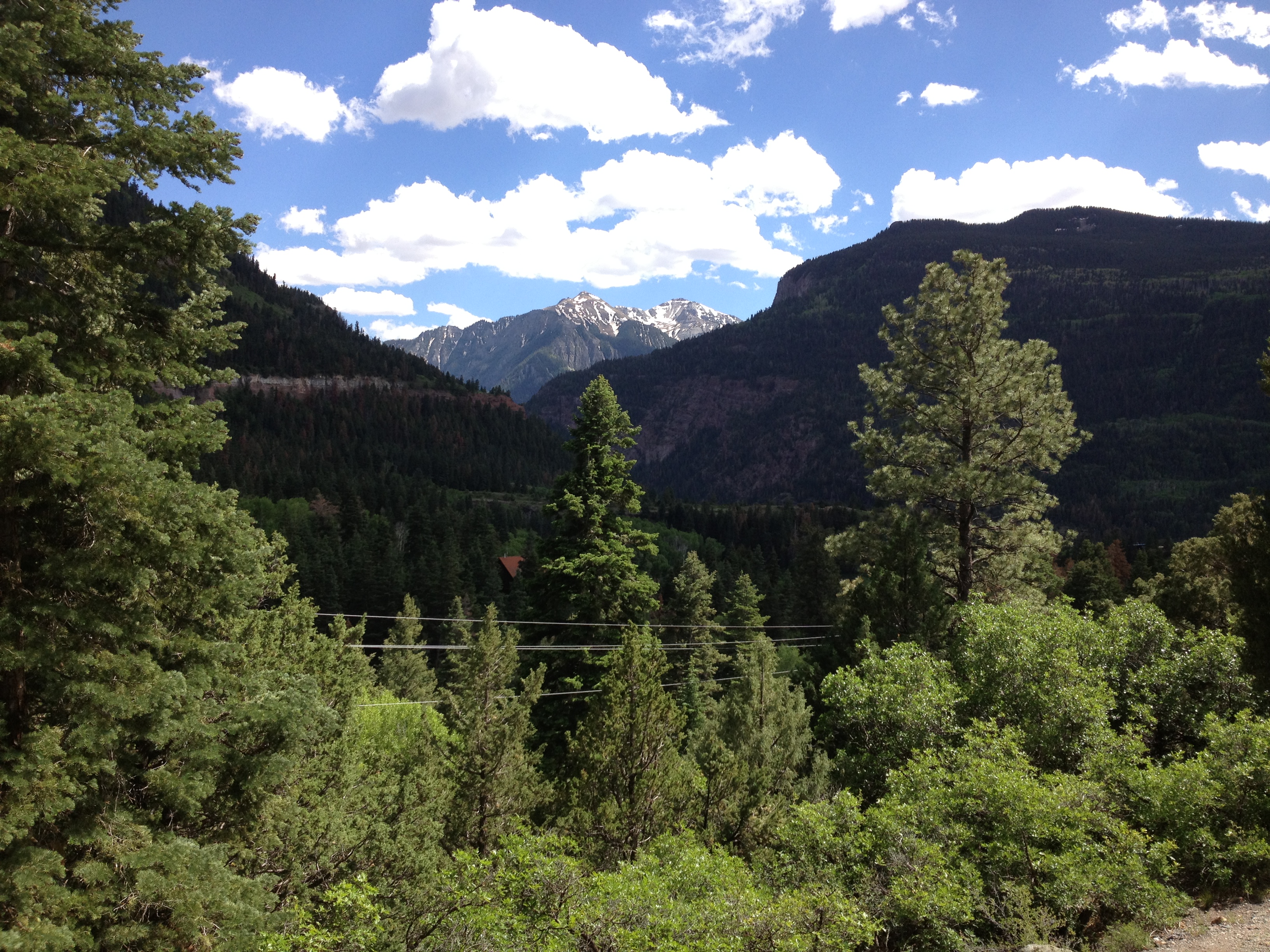
View from the cabin - north of Ouray, Coloradoa

View from the cabin – north of Ouray, Coloradoa

Now Neil, Marley and I have spent the past three weeks at Neil’s beautiful cabin near Ouray, Colorado, sitting on the porch with this view in front of us every day. It is a calming experience, and I’m grateful.

I’ve begun planning to walk the Camino again in September 2015, either the Camino Frances again or the Camino del Norte. I’ll make the decision later, but the timing is fixed. Since I’m a “seasoned pilgrim” at this point, the agony of planning what to take, of adding and discarding various items, will not take up the entire next year. I could pack up and go next week if that were practical. Everything I need is already set aside. For now, just the thought of setting out again makes me smile.

Next posts:  A list of my Camino Albergues, day by day, with occasional comments for each.


Posted in Miscellany | 9 Comments

And the answer is . . . (Or, “Thank you, Gertrude . . . , Thank you, Rilke”)

P1020047Saturday, November 30, 2013.  When I was preparing for the Camino, I was making lists of things to take on the trip, partially based on the books I was reading about and by other Camino pilgrims.  “Take something meaningful from home . . . ” said one.  Well, I looked lovingly at the pocket goddesses Neil has bought for me over the years, bronze woman-shapes that fit in your hand.  They are so special and adorn my bedroom dresser.  But the constantly growing awareness of weight in my backpack required that I discard any notion of taking a small bronze goddess who weighed at least a pound.

In close proximity to the goddesses I spotted this.  A light-weight wooden star, created by a Vermont artist, Meta Strick, whom I had the pleasure of meeting at an Artisan Fair in Manchester, Vermont about 10 years ago.  I had purchased many of her little goodies, all with calligraphy sayings or words on them.  “Create!”  “Solitude!”  “Artist working HERE”.  And this favorite from Gertrude Stein:  What is the question?”

It seemed a perfect thing to take, especially since I had to keep trying to answer my friends, who asked, “Why are you going?”  “What made you decide to do this?”  And I continued to say, “I saw the movie, The Way.  Otherwise, I have no idea.”  As I’ve written on this website previously, the typical response I got was, “Oh, you’ll know soon enough (or when you get there . . . or when you are in Santiago, etc.).”  I see that I still have no ability or desire to come up with an answer.  There is a finality to answers, some of which we must have, and others for which we should not even search.  I have a relative who always says, “The TRUTH is . . . ” and then pontificates.  What that relative says is most often nowhere close to the truth.  There are many versions of the truth, but perhaps for things like “1 + 1 = 2”, and even then, perhaps a mathematician could try to dispute this truth.  But that’s for another century.  I have no interest in it.

I’m grateful for every minute, every second, of my Camino experience.  The exhaustion, frustration, curiosity, exhilaration, and everything in between were gifts, pure and simple.  I gave those gifts to myself.  The Camino gave them to me.  My partner and children, sisters and friends gave them to me. My body gave them to me.  And everyone with whom I spoke on the trail, every person who said, “Buen Camino” to me as they passed me or as I passed them, gave these gifts to me.  But I asked for no answers from any of them . . . and gave them none in return.

My conclusion, at least for myself, is that there are often only the questions, whether we like it or not.  The question itself encourages contemplation, consideration, communion with one’s Self.  As Rainer Maria Rilke writes so exquisitely . . . live the questions now.

…I would like to beg you dear Sir, as well as I can, to have patience with everything unresolved in your heart and to try to love the questions themselves as if they were locked rooms or books written in a very foreign language. Don’t search for the answers, which could not be given to you now, because you would not be able to live them. And the point is to live everything. Live the questions now. Perhaps then, someday far in the future, you will gradually, without even noticing it, live your way into the answer.

Rainer Maria Rilke, 1903
in Letters to a Young Poet

I’ve thought quite a bit about writing a “closure” piece, both while I was on the Camino and since I’ve returned home.  What I know more clearly now than I ever have before is that at least for this experience, the “closure” is learning (yet again) to remain open.  To find silence whenever possible.  To stop the brain from reeling in the chaos of daily life.  To arrange for part of a day where there is nothing to do but sit with myself.

The “answer”, I’ve learned, is not to look too hard for an answer . . . the questions, the silence between questions, and all the bits and pieces of this experience are held together in a sort of snow-globe-container with wide boundaries.  I can shake it up, watch the details of my Camino memories, or my daily life, for that matter, float down in front of me, around me. The joy, determination, exhaustion, sense of majesty and accomplishment just make me shine with gratitude, make me want to go back and do it again . . .not with a plan to “do it better”, but rather with pure desire to be on the path once more.

Posted in Miscellany | 7 Comments

The Sun Shines On Muxia

P1010997Wednesday, October 16, 2013  Waking up in a non-bunk bed is refreshing, and having only one roommate is rare in an albergue.  But here we are . . . Ria and I, in our hippy haven at the end of the earth.  I head downstairs to take our laundry off the racks, since the dryer didn’t quite do the job last night, and when I return we each pack up our backpacks, hoping for the possibility of walking from here to Muxia.

But looking outside at the dreary pouring weather, we don’t have much hope of that.  Our alternative is to meet Barbara at the bar across from the bus stop, eat breakfast, share a cab to Muxia, 28 km from here, and then ride the bus from Muxia back to Santiago de Compostela.  And given our bus nausea yesterday, we must find an open farmacia in the mix.  Annie, our British host here at Albergue Sol y Luz, gives us directions to two establishments just a block or two from our breakfast place, so we pack up, give hugs and waves to the volunteers, and head out.

The air is thick, with low clouds and not great promise of a better day.  Settling into a table with Ria and Barbara, we order carefully.  Eggs, croissants, tea.  No juice, no cafe con leche.  If we have to take a bus later today, I want no repeats of yesterday’s motion sickness.  And while we wait, I leave to find the farmacia and some dramamine.  Success . . . finally a farmacia whose posted “open hours” sign tell the truth.  I ask for the ibuprofen I’ve needed for the last two weeks, and finally have a supply of super pills.  What we get in the States is a 200 mg pill.  Here . . .long white tabs of 600 mg.  Hope I don’t need them at this point, but we’ve got them.  Ria and I split the pack of nausea remedy, take one dose each, and slowly eat our food.

The owner of the bar calls to the driver of a sleek unmarked car parked just outside.  Apparently this driver is a taxi for hire, though you wouldn’t know it if you didn’t know the bar owner.  I settle myself in the front, Ria and Barbara in back, and I pretend I can see more than the cloud-encased buildings ahead of me as we head north to Muxia.  For those of you who have seen The Way, Muxia is the gorgeous coastal spot where Martin Sheen’s character scattered his son’s ashes at the end of the Camino walk.  We only got a glimpse of it in the film, and I find myself regretting that we will head to this potentially stunning spot in this weather.

Ria, Joannah, and Barbara

Ria, Joannah, and Barbara

However, halfway to our destination, the clouds give a hint of a reprieve, and as we approach Muxia, we can actually see blue in patches among the mass of grey.  Very quickly, the sky is ablaze in sunlit blue, and the effect of sky on water is breathtaking.  We have almost four hours to explore before the bus leaves for Santiago.  Off we go down the path next to the ocean . . . three Muxia-muskateers.

The big destination here is at the end of this long coastal path, but first, a bit of cafe con leche across the street, and as we walk toward the bar, there are two familiar faces . . . Kevin (backward baseball cap), whom I first met in Foncebadon where I met Ria, and Larraine, my Cacabelos pod-mate from about 10 days ago.  They and another woman had walked from Santiago TO Muxia and are headed to Finisterre today.  It always surprises me when I run into two people, each of whom were from separate parts of either my life, or in this case, my walk.  But there they were . . . so both Ria and I checked Kevin off our list of people we wish we had seen just one more time.  And talking with Larraine gave me a chance to learn that she and Kevin MET in the pods of Cacabelos . . . well, not IN the pods, but at the municipal Albergue there. There are those strings of connection again.

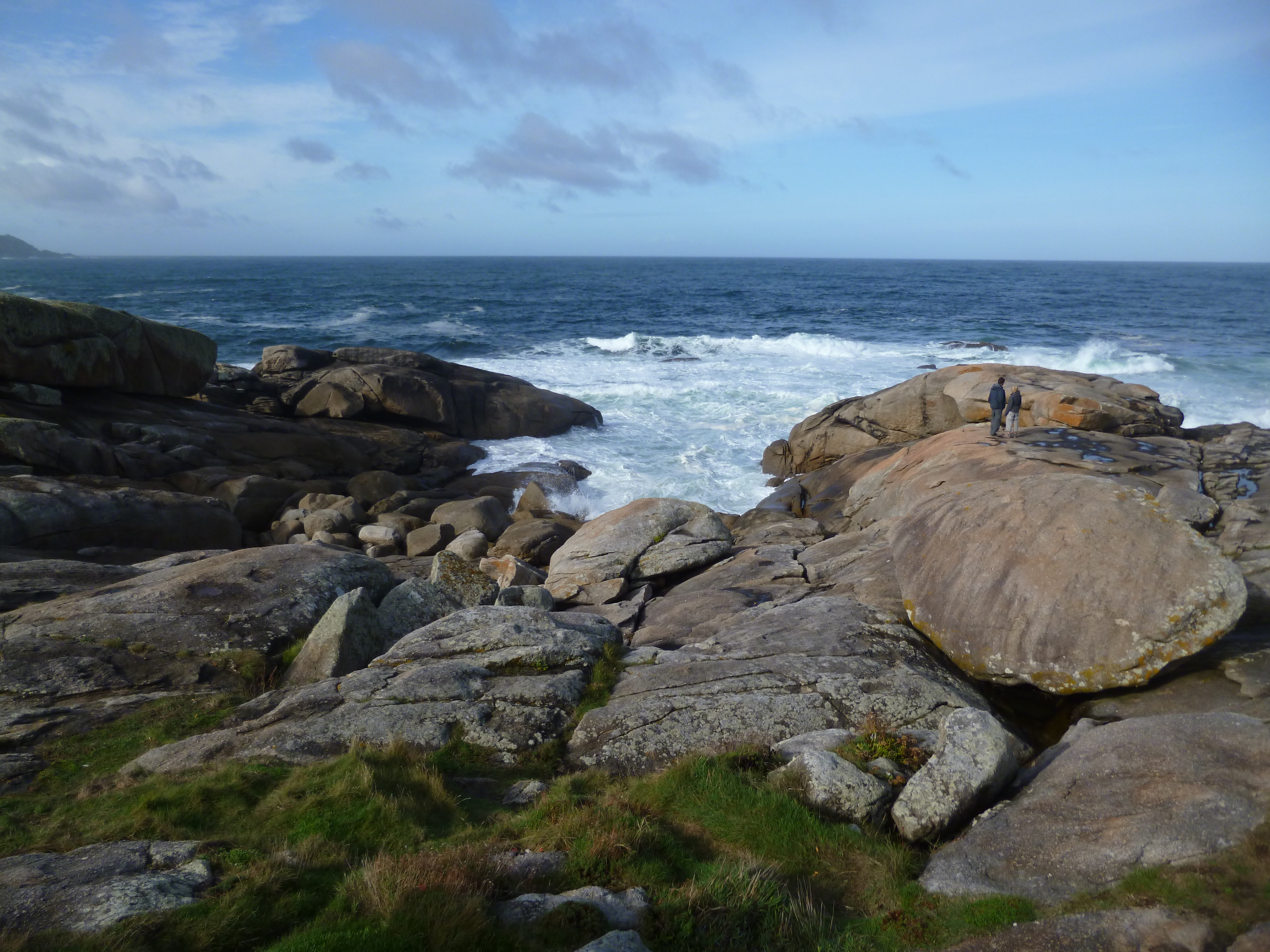
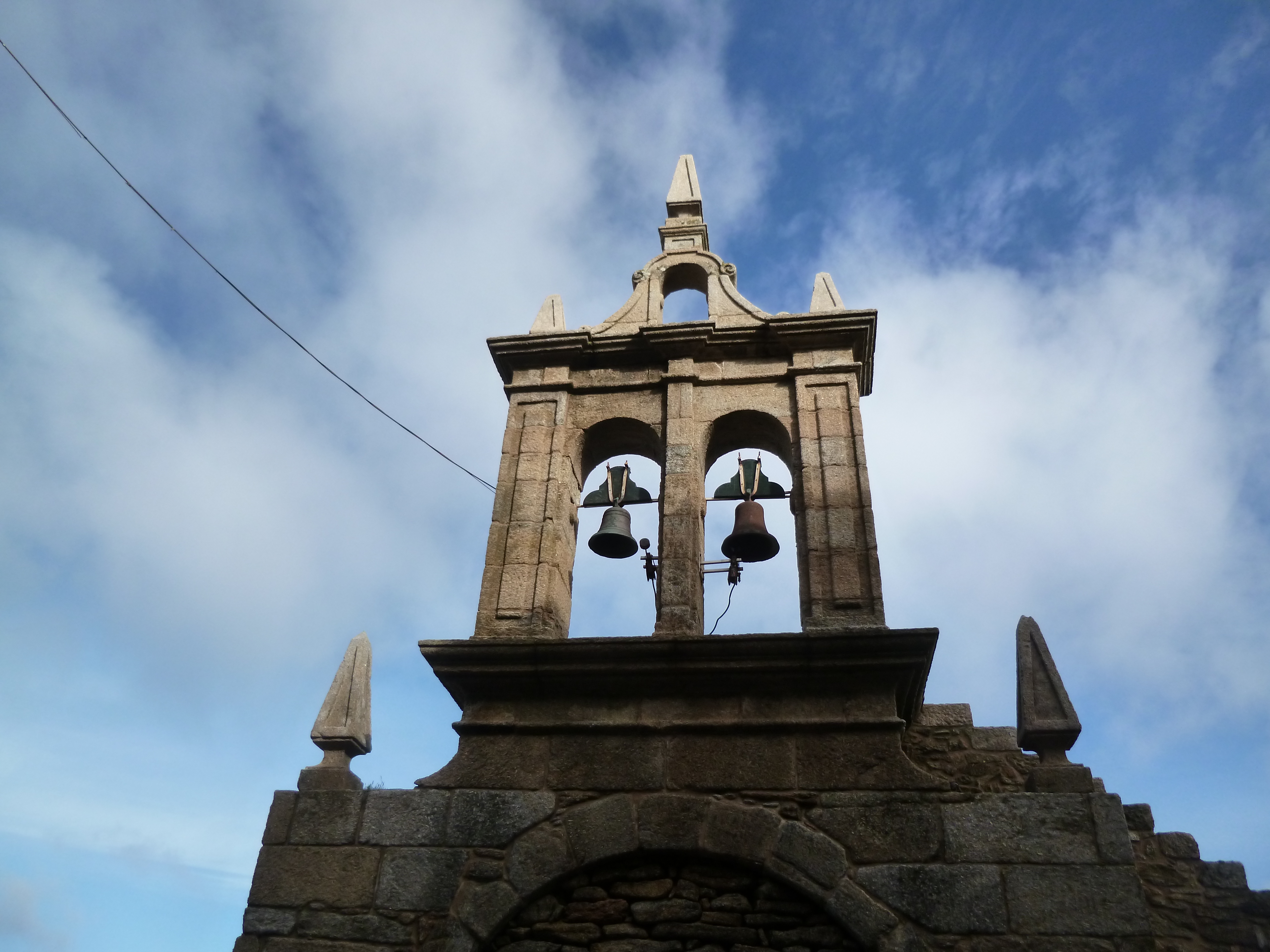
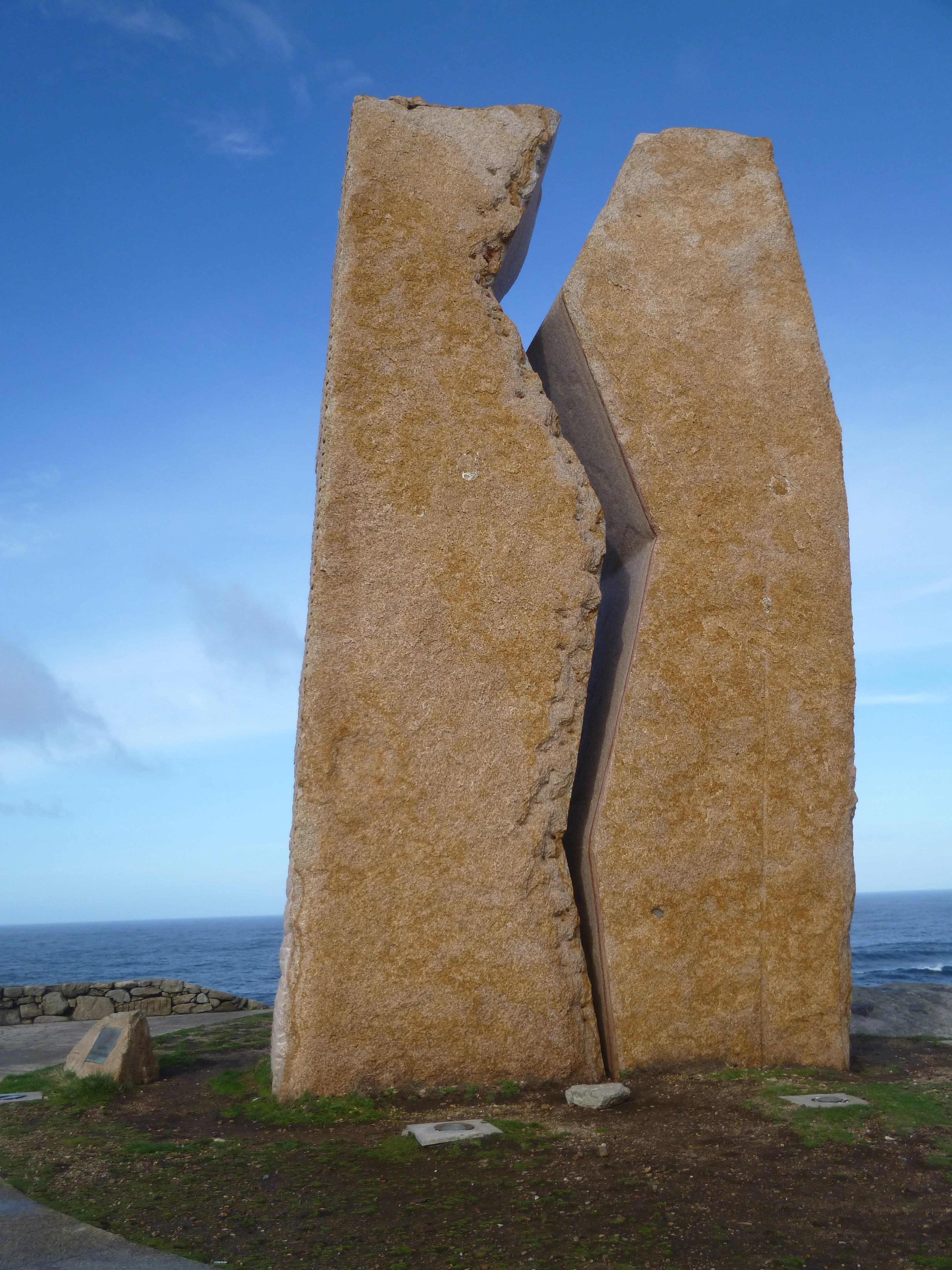
After our drinks, we are refreshed and head toward the rocks at the end of the walkway.  The legend of the Nova Señora de Barca, or Our Lady of the Boat, takes place here, and the Sanctuary of the Virgin Mary of the Boat represents the Virgin Mary’s voyage in a stone boat to help St. James the Apostle in his ministry.  According to the legend, the boat is petrified in the stones on the headland.  Boat or no boat, the headland and surrounding coastline is stark and stunning.  A contemporary stone sculpture adds to the magic.P1010990 P1010995   And the bell tower of the Santuario is beautiful in its simplicity.

The three of us split up and explore in directions that move us, wandering along the rocky water’s edge, climbing to a higher rock hill to see the town to our left, making the circular pathway around the hill and back to the Santuario.  Eventually, we all end up where we started, in the middle of “town”, albeit from the sea-side of the village, rather than the front path.  Everywhere I look is a sparkly, peaceful scene.

As we revisit our bar from earlier today and order lunch, we see Robert and Tim, the Canadian priests, relaxing at a table near us, and we smile, wave, and walk over to talk for a few minutes.  Another connection reunited for a moment on the post-Camino path.

After our lunch, we have just enough time to walk the block’s distance to the bus stop.  Armed with more dramamine, we sit on the bus, traveling down a winding road.  The sunny weather stays in Muxia as we travel east, more rain clouds gathering above us on the journey.  The bus stops at several little villages, picking up and dropping off its passengers, until we arrive back in Santiago de Compostela, our post-Camino exploration nearly complete.

P1020013

New rock formations and old ones . . . the beauty of Muxia’s coastline

P1020004

Posted in Miscellany | 5 Comments

To The End of The Earth

Tuesday, October 15, 2013.   It’s raining this morning, a confirmation that our decision to take a bus to Finisterre was a wise one.  Waking up early has become a habit after all these weeks and by 6:30 a.m. my backpack is ready.  Yesterday afternoon I delivered a duffel  bag to the Seminario Maior, full of things that are not essential for the next week, and I’m prepared to go to the end of the earth.  I knock on Ria’s door and tell her that I will meet her for breakfast at a bar down the street that should be open at this hour.  My key for this funky room is hanging from the door lock, and the sweet old man who manages or owns the Hospidaje Santa Cruz will be along later to collect it.

My hiking poles are collapsed and tucked into the sides of my pack, waiting for another opportunity to prevent me from tripping half a dozen times a day.  But I’ll need to do more walking than just to the bus stop to justify pulling them out again.

Getting to the bus stop is fairly simple, and we meet Christel there, take a short hop to the main bus depot and buy a ticket for a longer-distance ride to Finisterre.  Ria and I discuss our tendency to get motion-sick, and our plan is to make sure we have plenty of windows from which to see the horizon and sky, often a good remedy for road-nausea.  The day is gloomy, foggy, and drizzly, so what might have been a gorgeous coastline is haze.  The bus we board is a double-decker, so we head for the top, thinking (erroneously, it turns out) that if we’re up high with more glass, we’ll be better off.

Unfortunately, since the road is winding, our upper seats make us sway even more than we would have on the lower level, and within about 30 minutes, I’m sitting on the front bus steps, gesturing desperately for the bus driver to pull over.  He finds a turn-out, I jump off the bus and lose that delicious breakfast of eggs, ham, orange juice, etc.  He reaches behind him, hands me a blue plastic bag and gestures to the back of the bus.  “Bathroom back there,” he says cryptically.
Not a pretty photo, but it's evident this isn't fun weather.

Not a pretty photo, but it’s evident this isn’t fun weather.

I see that Ria is having the same issues.  Without more gruesome details, just let me say that I needed those bags four more times on this less-than-three-hour ride, and when we arrive in still completely-socked-in Finisterre, Ria and I are in matching wiped-out physical states.  Christel is doing just fine, and we envy her.

Right off the bus, we are fairly well assaulted with people who hand us flyers about various albergues in the area, with the prices crossed off in favor of their “deals” for pilgrims like us.  We head for a bar.  Coffee for Christel, mint tea for Ria and for me.  Stomach settling tea.  Another German woman, Barbara, has been on the ride with us, and she joins us as we plan our next steps.

First I call the number on a flyer that looks promising.  10 Euro for a private room.  The woman at the other end of the line says it’s 15 Euro, and I tell her I have a written commitment for the lower price.  She reluctantly acquiesces, so Ria and I decide to check out the place.  After our tea, Christel and Barbara take off to walk to the Finisterre lighthouse, since Christel has to be on the 3:00 bus back to Santiago.  Ria and I leave the bar as a blond older woman rushes up to us, thrusting in our faces the same flyer we have in our hands.

She gestures rather frantically (that should have been our first clue) and says, “Three minute walk, three minute walk.”  We follow her down the street, up a hill, through a winding neighborhood pathway, all the while listening to her throwing the phrase over her shoulder, “Few more minutes, few more minutes.”  We pass an inviting place called Albergue Sol y Luz, as we are rushed along up yet another hill.  Ria comments that at least this is a quiet neighborhood, and we finally arrive at our potential destination.  The blond woman escorts us inside the house, where in the parlor sit an ancient couple, nearly wax-museum specimens.

Blondy shows us a room with three twin beds.  She echoes the flyer price, 10 Euro, and we say, “No, the price on the flyer is supposed to be for private rooms.”  So she moves to the second bedroom, and suggests that we can have one of each.  We say we’ll think about it.  Ria mutters, “This feels like a nursing home to me . . . that scene with the couple in the front room is unnerving.”  I nod in agreement.  The Blondy hovers.  We again say we’ll think about it, and we leave.  Walking back toward town, I notice that the woman is rushing toward us.  She waves a hand back toward her place, tells us in her minimal English that we can have BOTH rooms for 10 Euro.  We again try to tell her we aren’t ready to make a decision, so she scurries down the hill toward the bus stop, obviously wasting no time attempting to recruit some other newcomers.

Pretending to look out at the foggy sea view, I notice that we are directly in front of the Albergue Sol y Luz, and Ria comments that this is one of the highly recommended places Matthew and Livia (Vega de Valcarce new albergue owners) suggested we stay, so we duck in to this hippy house and meet Elizabeth, a delightful, friendly Brit.  I tell her this place has been recommended and when I mention the two names above, her smile grows wider and she gives us each a hug.  She explains the charges for the only available twin-bedded room, the donativo community dinner prepared by Mario, one of the volunteer residents, and we see the washer and dryer behind the desk in the reception room.  We’re in . . . and relieved to be in this soothing place instead of the mausoleum we just left.
Protective tree-line on the way to the Finisterre Lighthouse (the Faro)

Protective tree-line on the way to the Finisterre Lighthouse (the Faro)

After a bit of a nap, I think it’s possible to head out to the lighthouse, a mere 3 km. outside of town, before dinner.  We hope the fog will have lifted and we can make our quick trip, back before dinnertime.  Heading out toward the sea again, asking directions for a rather badly marked, though popular landmark (occasionally the word “Faro” and an arrow), I find that the scene to my left is complete soup, and to my right, ethereal tree lines.  I hope the lighthouse is big enough to be seen through the dense atmosphere, and continue to trudge uphill.  No sticks.  That was dumb.

We walk and walk, walk and walk, peering into the fog, seeing nothing.  Not only have I brought no walking sticks, neither of us has any water.  After nearly an hour of trudging, peering, we come to bathrooms and a gift shop with postcards of the view we cannot see today, but still there is no water to drink.  So we continue, finally coming to a bar at the top of a hill.  I climb the several sets of stairs while Ria continues to the Faro, because she has saved her stone to throw here, rather than at Cruz de Ferro, which we passed two weeks ago.

I feel rather disoriented, after weeks of being able to see the landscape around me.  The end of the earth is a haze, unfortunately.  I can’t see the Faro/lighthouse, though I have walked to the place it should be.  It is there, obviously, but certainly not visible from the walking path.  How can it possibly help sailors near the coastline if those on land can’t even see its light?

I had so hoped to walk to Muxia from here tomorrow, but am hesitant to travel two days on foot in more badly marked, nearly invisible surrounds.  Ria and I are trying to connect near the bar, but in the haze, we don’t see one another for a while as we criss-cross the pathways.  Finally we are together again and headed back down to town for our dinner.  Since it is a community meal, we don’t want to be late.

Ria sees a Camino friend from Germany coming up the path as we are descending, and she stops to talk.  I wave and say I’ll see her at the albergue.  Entering the town, trying to retrace my steps is even more confusing than exiting, and I find myself asking old people for directions, people who act as though they’ve been in Finisterre for less time than I.  It’s a frustrating experience, and the dinner hour has approached and moved past my disoriented self.  I hate being late, especially for a communal dinner.

Just across from the bus stop . . .

Just across from the bus stop . . .

Six weeks of walking across a country and I’m lost in one little town!  Having gone around the very long way, I begin to see familiar landmarks, including the bus stop and the bar we just visited hours ago.  And there is the Blondy, still trying to solicit bodies for her two grim bedrooms.  I duck my head practically into my shoulders and hustle up the hill to Sol y Luz, just in time for dinner, in a circle on the floor, to begin in true hippy fashion.
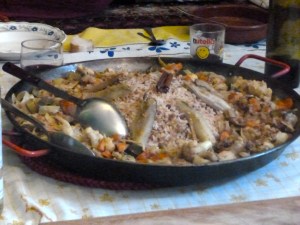
Delicious, steaming veggie dinner . . .

Delicious, steaming veggie dinner . . .

I stumble into the “dining room” apologizing profusely, with all the smiling faces assuring me they are just beginning the meal.  Three more familiar people are sitting near the floor spot they make for me , and one of them greets me by name. She is Josie, from Belgium, and the three of them were my bunk-mates in Palas de Rei.  Her companions, all French-speaking as she is, don’t say a word to me, but she’s happy to catch up in English.  We continue our conversation from at least a week ago about old movies, as we eat another delicious soup, and a vegetarian rice dish, not quite paella, steaming in the middle of the bed sheet that is our sitting mat and tablecloth all at the same time.

Another subset of my dinner companions are a group of three British men, well versed in the names and practices of various Buddhist “gurus” around Colorado from the past several decades, since we somehow started talking about where I’m from, the Shambala center, Boulder, etc.  I quickly drop out of the conversation, since I only can offer a few tidbits and they pick up that ball and run with it.  As we are clearing plates after dinner, they begin talking with a young British woman who comments that as she travels through this part of Spain, she is hoping to run across a particular man who is a close friend/teacher of one of her friends in England or Ireland.  She mentions the name, and one of my Buddhist dinner-mates laughs in surprise, points to the friend next to him and says, “Well, here he is!”  So strange, the distant connections that become immediate, no matter how far we travel.

After dinner, I finish the laundry I began before the Faro excursion, we check in with Barbara, who has discovered that for 30 Euro, we can take a taxi to Muxia tomorrow if the weather is still soup, and then catch the 2:30 p.m. bus back to Santiago.  We’ll meet at the original bar near the bus stop at 9:00 tomorrow morning.  Worst case, at least I’ll be able to complete the visit to the last town on my Spain agenda, soup or no.  Still hoping the weather will clear, I am mentally read to do a two-day walk, rather than a 45–minute cab ride.  One way or another, Ria and I agree that we won’t get into another vehicle without visiting a farmacia in the morning to purchase some Dramamine.  I don’t think taxis have blue bags.

I drift off to sleep, adamantly grateful that we are in this place, rather than in the Albergue Wax-Museum . . . The Blondy doesn’t even dip her face or her flyers into my dreamscape.

Posted in Miscellany | Leave a comment

Post-Camino: Day One

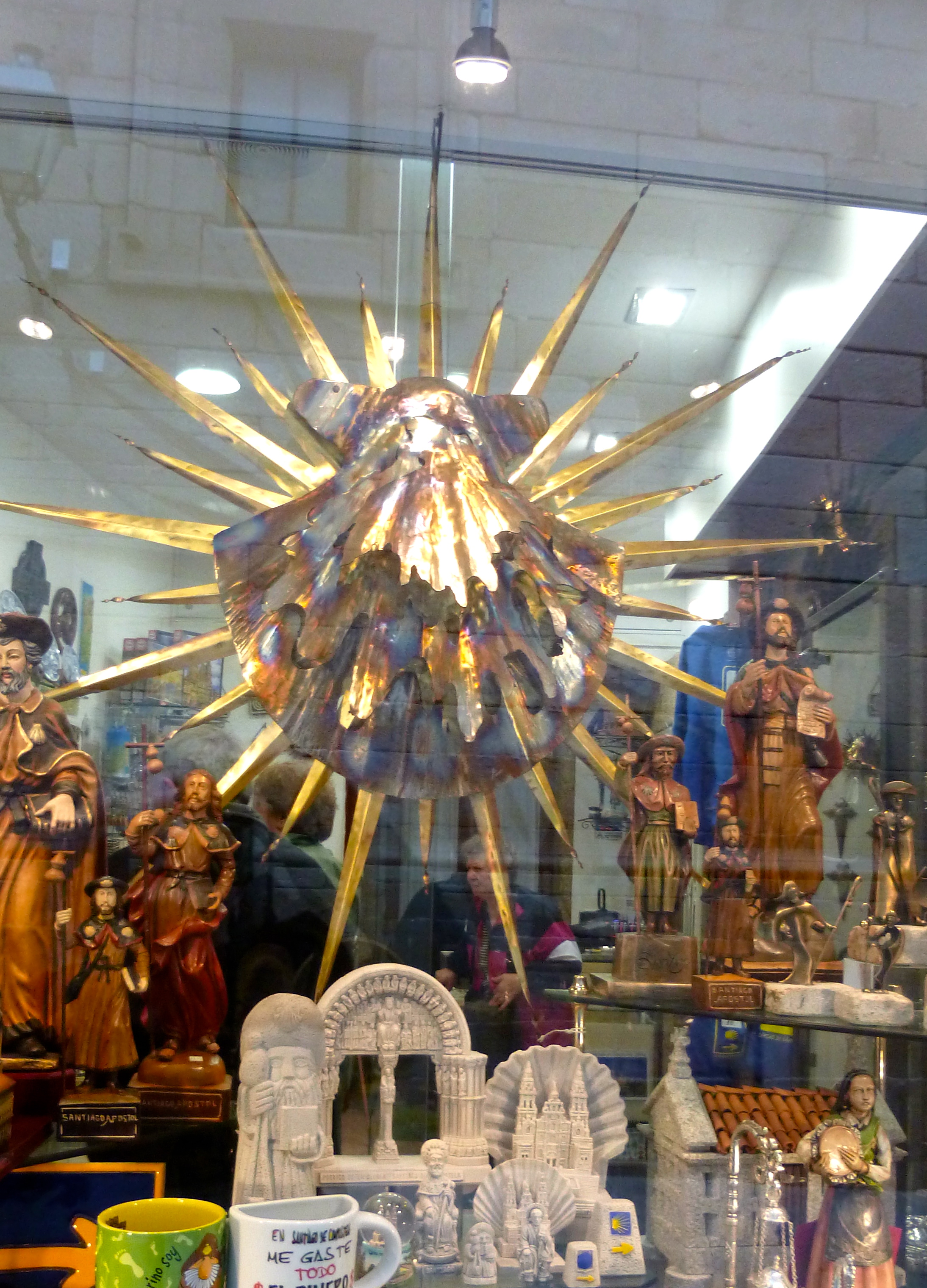
Stylized scallop shell in a local shop near the Cathedral

Stylized scallop shell in a local shop near the Cathedral

Monday, October 14, 2013.  Waking up today with no particular place to go, as the old rock and roll song says . . . you have to be my age to actually remember that song, but it is on my mind as I awaken on Monday in my funky room at the Hospidaje Santa Cruz in Santiago de Compostela.  I am on my hotel street, a beautiful old stone-building-lined street, Rue de Vilar, sandwiched between the Pilgrim’s Information Office and the Tourist Information Office, making the clear distinction that pilgrims are not tourists.

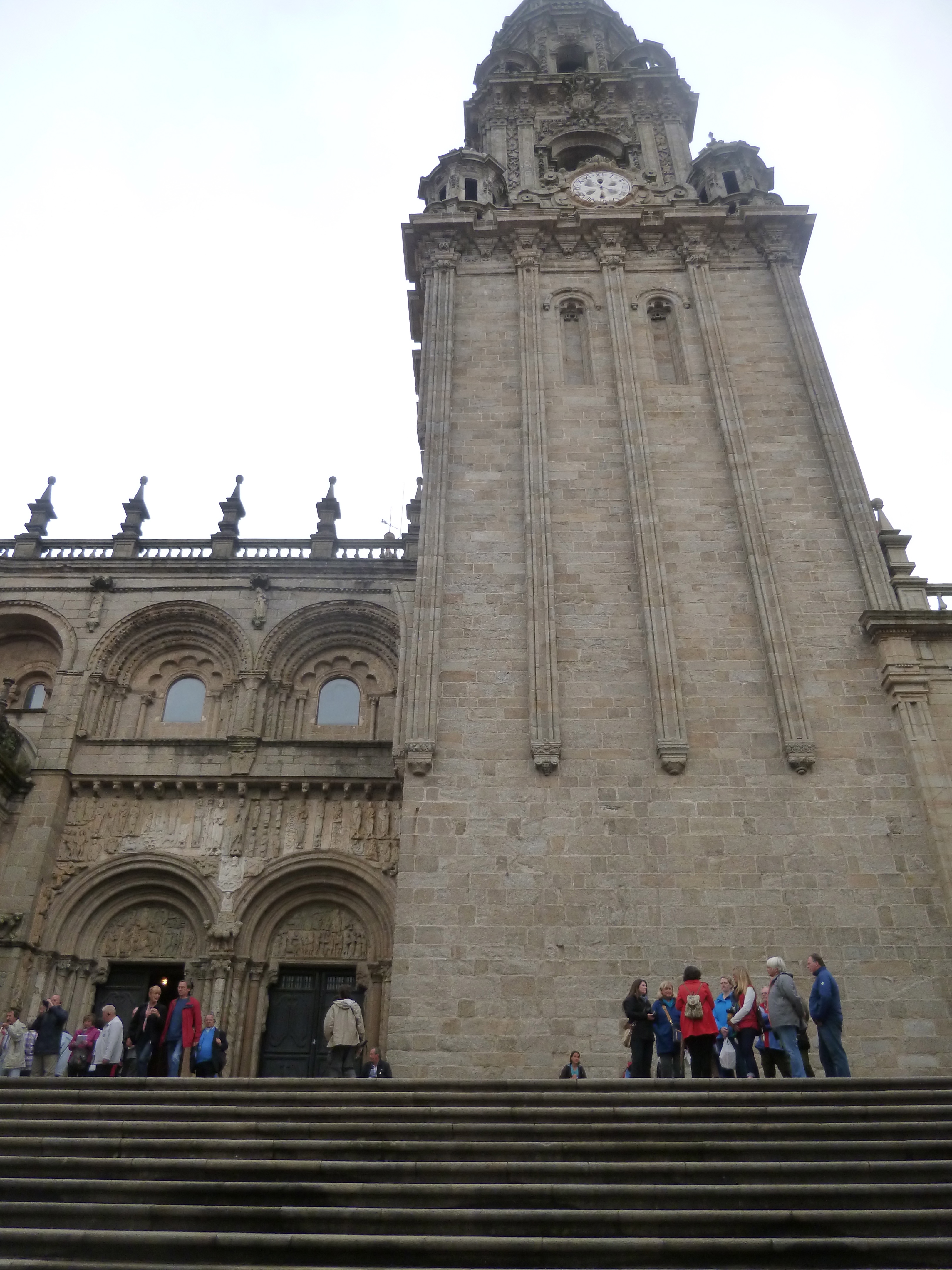
Today is the day I will attend the Pilgrim’s Mass at noon in the Cathedral, the first Mass other than my mother’s memorial Mass that I’ve attended in a long time.  It’s certainly the first Mass I’ve attended other than funeral Masses for perhaps twenty years.  Ria will meet me, though first we need breakfast.  I knock on her door, next door to mine, and then wander down the hall to the similarly funky bathroom I share with four other sets of people.  It’s not the private room the woman promised on the phone the other day, but it’s also not a top bunk in a municipal albergue with one hundred inhabitants, so I am not complaining.  Now breakfast.

The restaurant across the street from the hostal is most convenient, though more expensive, with wait-staff that can’t seem to pay attention to their customers in any ordered fashion, but I wait patiently for my eggs and toast, zumo naranja and cafe con leche, of course.  It’s a time to try to regroup after my experience yesterday, walking in the pouring to Santiago.  I’m hearing from other Camino walkers that the entry to Santiago was anticlimactic for them, and perhaps it is thus for many of us.

Should we hear harps and angels’ voices?  Should we feel as though the walk solved our problems?  I did meet people on the walk that were struggling with something and really believed that if they could only “make it to the end”, they would find an answer.   One can find insight from within, most definitely, on a long walk with plenty of time to contemplate a multitude of things, but I can’t imagine some “answer” will be dropped out of the sky at the entrance to the Cathedral.  My thoughts turned to some of the people I had hoped to see before the end, people that most likely got here before I did.  Jim and Patte, Matthé and Elma from the Netherlands, and Larry, the recent widower who is considering becoming a drifter.  People I will miss for awhile.  But all in all, we know that most of our Camino contacts are fleeting, pilgrims passing one another on a beautiful path, sharing a dinner or two, or a set of bunk beds.   We will remember some names, other faces, some even matching up with one another, and most of them will blend into the soup that is each experience, along with the smells, sights, sounds that came our way as we walked, showered, ate, slept.

I know I feel a sense of accomplishment, a quiet I hope will stay with me for awhile, and a great desire to keep walking.  I had hoped to begin tomorrow or the next day to walk to Finisterre and Muxia, figuring a week for that, and a bus ride back to Santiago.  But the weather is pretty miserable and is expected to be for the next  seven to ten days.  Christel has gathered information for a bus to Finisterre in the morning and I decide I will take all my gear, or most of it, prepared to walk from Finisterre to Muxia if it looks like the weather is breaking at all.  One way or another, I’ll stay in Finisterre for the night tomorrow, though Christel will return to Santiago, because she has a flight out to Holland on Wednesday morning.  Ria will come with me and we’ll play it all by ear.  Right now it’s time for the noon Mass.

The Botofumerio is hanging . . .

The Botofumerio is hanging . . .

We sit in a pew that will have a good vantage point in case the botofumeiro swings today.  I’m surprised that a nun with a lovely voice leads some of the service, even before the priests come out to the altar.  And when the men in red vestments do come out, there are more than half a dozen of them.  The lead priest says the Mass, the nun sings in the parts of the Mass I remember from my childhood.  And the other priests, each in a different language, greet the pilgrims from the pulpit.  It’s actually quite moving to hear these men address us in English, Spanish, German, French, Polish, and perhaps Portugese . . . We aren’t just the mob in the cathedral.  We are pilgrims who have walked here, many of us from the border of France, all of us on our feet in our own sincerity.  They honor us.  We honor one another and ourselves.   I certainly honor myself for my journey.

At money collection time (there is always money collection time in a church), a short little man in a red cassock comes out wearing a sort of gnome or dwarf hat.  He takes the hat off his head and holds it out for the collection. The coins jingle and jangle, more frenetically as the man passes his hat down the aisles of the massive church.  Sort of looks like one of the Seven Dwarfs doing this duty, and I try not to giggle, but I am amused.The church holds 1000 people, so I’m sure more than one red-coated gnome is scattered throughout this place, but I only see this one.

When it is all over, the botofumeiro doesn’t swing, though the people in the Pilgrim Information office told me that if it was hanging in the church, it would swing.  But the church security person said there is a new rope, and the burner is hanging to stretch the rope.  The man in the Pilgrim office, when I told him after the service, said, “Oh, seriously??? I never have heard THAT before!”  And so it goes.

As we leave the Cathedral . . . another opportunity to find friends one last time.

As we leave the Cathedral . . . another opportunity to find friends one last time.

As I descend the massive stone steps from the church back to my Rue de Vilar, I see Jim and Patte from Westminster, Colorado, also coming from the Mass.  There’s one couple to whom I can say a last goodbye.  They tell me about a place their friends are staying, across on the other side of the church.  It’s a Seminario and is apparently reasonable and quite lovely, with huge breakfasts included in the room rate.  I think perhaps if I reserve a room there after my return from Finisterre, they might hold a bag for me now, with things I don’t need on my trip to the end of the world.

Jim and Patte are going on to other parts of Europe and we say we hope we can see one another back in Colorado, since we live only an hour apart.  When they leave, I make my way around to the other side of the large stone area which houses the church, and I see the sign for the Seminario Maior across the Placa.  As I enter the stately old stone building, yellow arrows show me the way to the reception . . . and a courtyard reminds me of the one at Santa Croce in Florence.  I feel as though I’ve come to a familiar place.

Reception attendants are quite helpful, assuring me that they will be happy to house some of my belongings safely in their store-room until I return for the reservation I’ve just made for three nights.  And yes, if I decide to walk to Muxia, I can call to revise the reservation dates.  Smiling, I head back to my hostel to meet Ria before lunch.

Larry . . . a dear Camino friend . . .

Larry . . . a dear Camino friend . . .

And as I walk down Rue de Vilar yet again, I see sitting at an outside table at the restaurant across the street, a very familiar face.  It is Larry, and I can’t believe my eyes.  He is with a woman I don’t recognize, having soup and salad.  I stop.  He looks up, as startled as I am, and interrupts the woman.  “Excuse me for a moment, please,” he tells her. Stands up and holds out his arms.  I give him a big hug and tell him how happy I am to see him, this nearly last person I thought I’d missed.

He introduces me to the woman, I apologize for the interruption before he and I continue our conversation.  He’s actually staying at the Seminario at the moment, but is arranging for an adventure in Morocco very soon.  Camel rides, sleeping in tents . . . he is quite excited about his next voyage and so am I.  We had exchanged e-mail addresses way back on the meseta somewhere, so we’ll stay in touch.  Ria appears and I introduce them before she and I find some lunch.  Tomorrow morning we will go with Christel to Finisterre on the bus.  From Holland, Germany, Michigan, Colorado.  To Morocco and The End of the Earth.  Who would’a thunk it?

Posted in Miscellany | 4 Comments